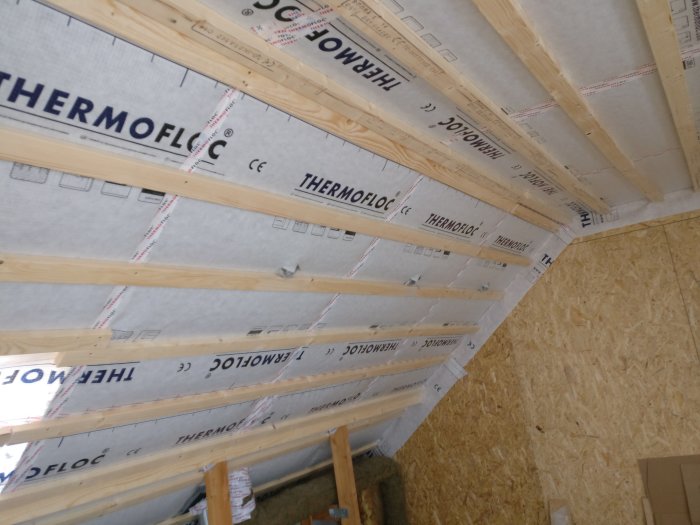
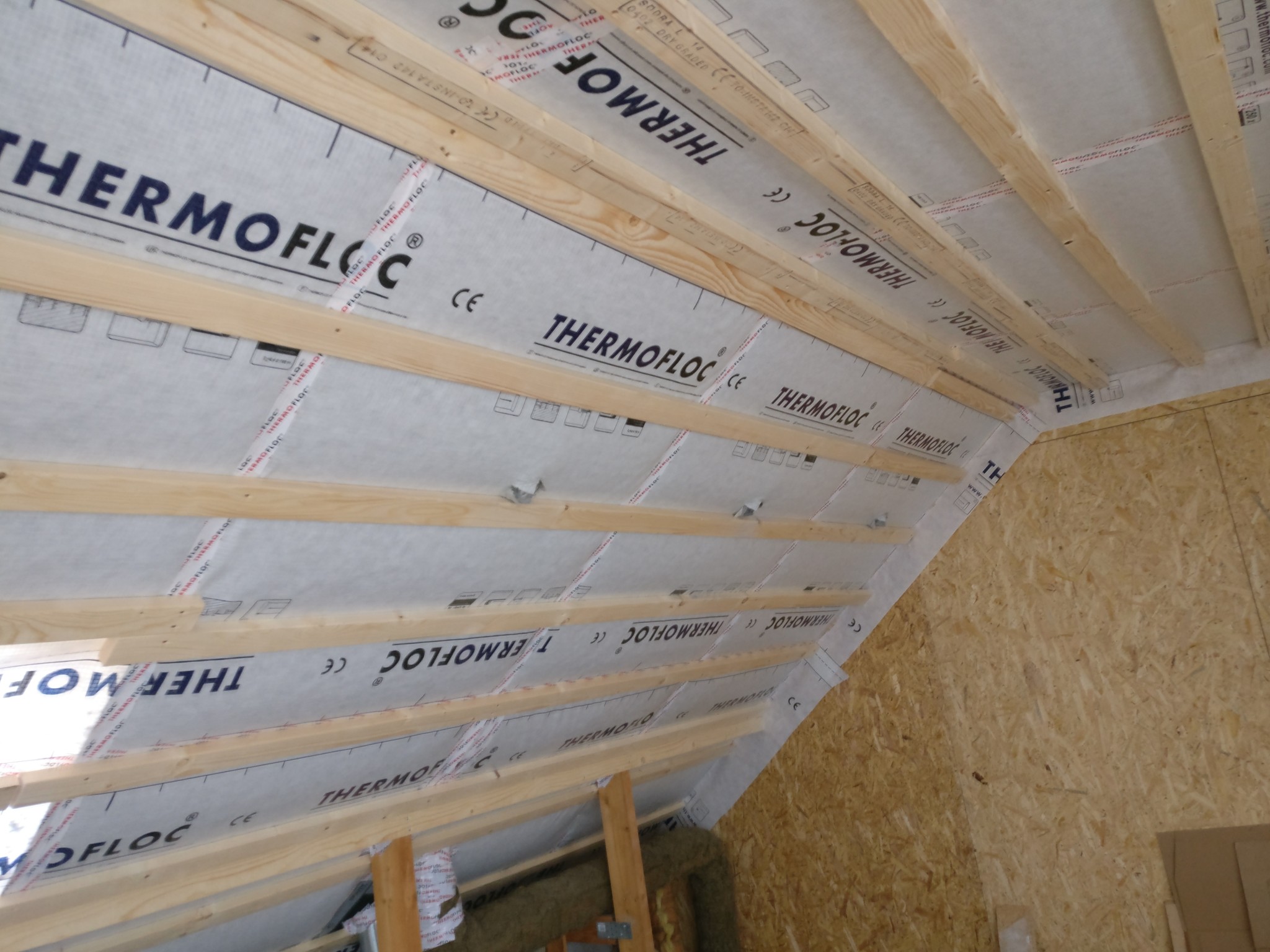
I am in the process of installing battens on the ceiling and then will put up drywall.
I'm considering how to make the joint between the drywall as neat and straight as possible in the joint between the ceiling and sloped ceiling but also between the sloped ceiling and knee wall. Preferably, I don't want to cover with moldings.
How do you do it?
Should I place the drywall edge to edge or let one overlap the other a bit before plastering, if so, which one?
Tape and plaster or just caulk?
Steel tracks?
Do you have any good tips?
It is terribly difficult to make this look nice. I have crown molding on the sides of the sloped ceiling (I think it looks nice), and in the joint between ceiling/sloped ceiling and sloped ceiling/wall, you glue on a paper strip. Ready-made ones with a fold in the middle are available at the nearest paint store. Just glue it in place with wallpaper paste and spackle over it. However, be careful when sanding as it is paper.
Otherwise, I always use metal edging on outer corners as I find it easiest for a good result. But that was a bit off-topic.
It's also a ceiling/sloped ceiling in a bathroom we're talking about, so it's wet room filler that's required.
Can't you turn a metal strip around and use it in the joint instead of tape? It should hold better.
Or are there ready-made metal strips for inner corners? I'm a bit worried it will crack.
Isn't there a magic trick for how you let the boards meet each other in the joint that can ease the filler work?
Well, you probably can't avoid filling and sanding. If you have tiles on the wall, maybe no tape is needed. That builds up a bit. Personally, I haven't done sloped ceilings in bathrooms, only in closets and on a staircase.
Cutting sloped ceilings can be tricky. It's best to try to set the first board plumb and not just parallel to the wall. That way it's easier to measure the following boards (so that at least one edge is straight). Sloped ceilings can usually lean a bit.
We broke the panels at the transition between wall/sloped ceiling, but without cutting through. This way, you get a finished edge without plastering. However, this only works if the wall+sloped wall is shorter than the length of the drywall. Then you probably need two people to put it up this way.
We broke the boards at the transition between wall and sloped ceiling, but without cutting through. This way you get a finished edge without plastering. However, this only works if the wall + sloped ceiling is less than the length of the gypsum. Then you probably need two people to put it up that way.
That sounds smooth.
But is just the gypsum paper enough? I'm thinking about cracking in case of some movement over time.
Maybe some form of metal strip/tape that holds together the studs under the gypsum can minimize movement?
I have a different method that has worked flawlessly for me.
Between the slanted roof and the ceiling, at the roof break.
Attach a metal profile to the lattice panel, the metal profile is a standard corner profile but not at 90 degrees, have a tinsmith bend one or hammer out a standard corner profile to the angle the roof has.
I don't cut the drywall too precisely, and it's okay if there's a gap of 5 - 10 mm.
I fill the gap with joint compound, any excess I sand down flush with the drywall.
I apply a regular joint compound (or waterproof joint compound) once.
Glue the tape with waterproof glue.
Spackle over.
Paint.
Then it's time. It has really dragged on, but next week I will start plastering. What I'm pondering now is what's easiest to start with, ceiling, sloped ceiling, or wall?
So, should I
1. Start with the ceiling, then wall, and finally the sloped ceiling?
Or
2. Start with the ceiling, then sloped ceiling, then wall?
Or
3. Start with the wall, then sloped ceiling, then ceiling?
Should any board be mitred and should the boards meet edge to edge or should one of them cover the other where they meet at the joint between ceiling/sloped ceiling/wall?
Found Fermacell's guide online but also saw this video where the carpenter chose to miter one of the boards and place it flush.
This weekend, I plan to plaster the ceiling, slanted ceiling, and wall. It is spaced edge to edge at the transitions. Not sure if that was the wisest choice, but that's how it is now.
So the question is, how do I get strong and fairly straight transitions with the plasterboard!?
I was thinking of gluing a strip with wet room adhesive. But since the plasterboards are broken at the joints, there will be no space for a strip and filler in the transitions between ceiling/slanted ceiling/wall. The recessed joints end up vertically to get nice transitions in the other direction...
Is this a problem, or simply something you have to live with and solve by plastering away the seam from the paper strip?
Other tips for achieving an even and strong transition between the plasterboard?
There are metal strips on rolls with punched holes that you can bend at the desired angle and place in the joint. Then you screw the gypsum board through both the metal and the sparse framing. This usually provides stable corners. There are also 3m lengths called LPP 50. Looks like an LP 50.
Last edited:
Click here to reply
Vi vill skicka notiser för ämnen du bevakar och händelser som berör dig.