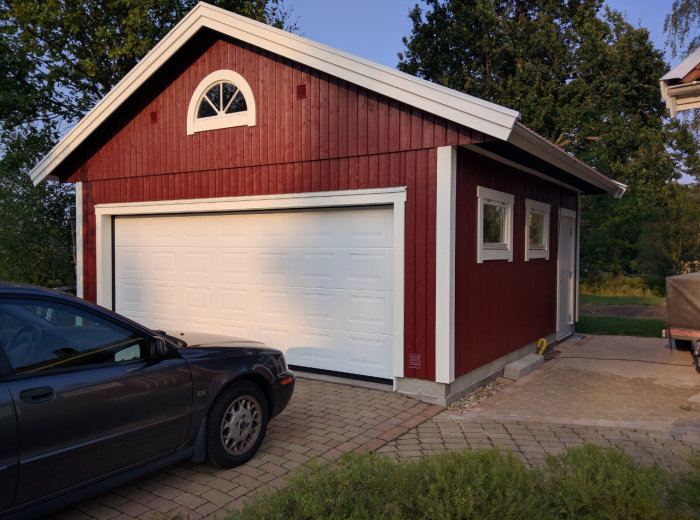
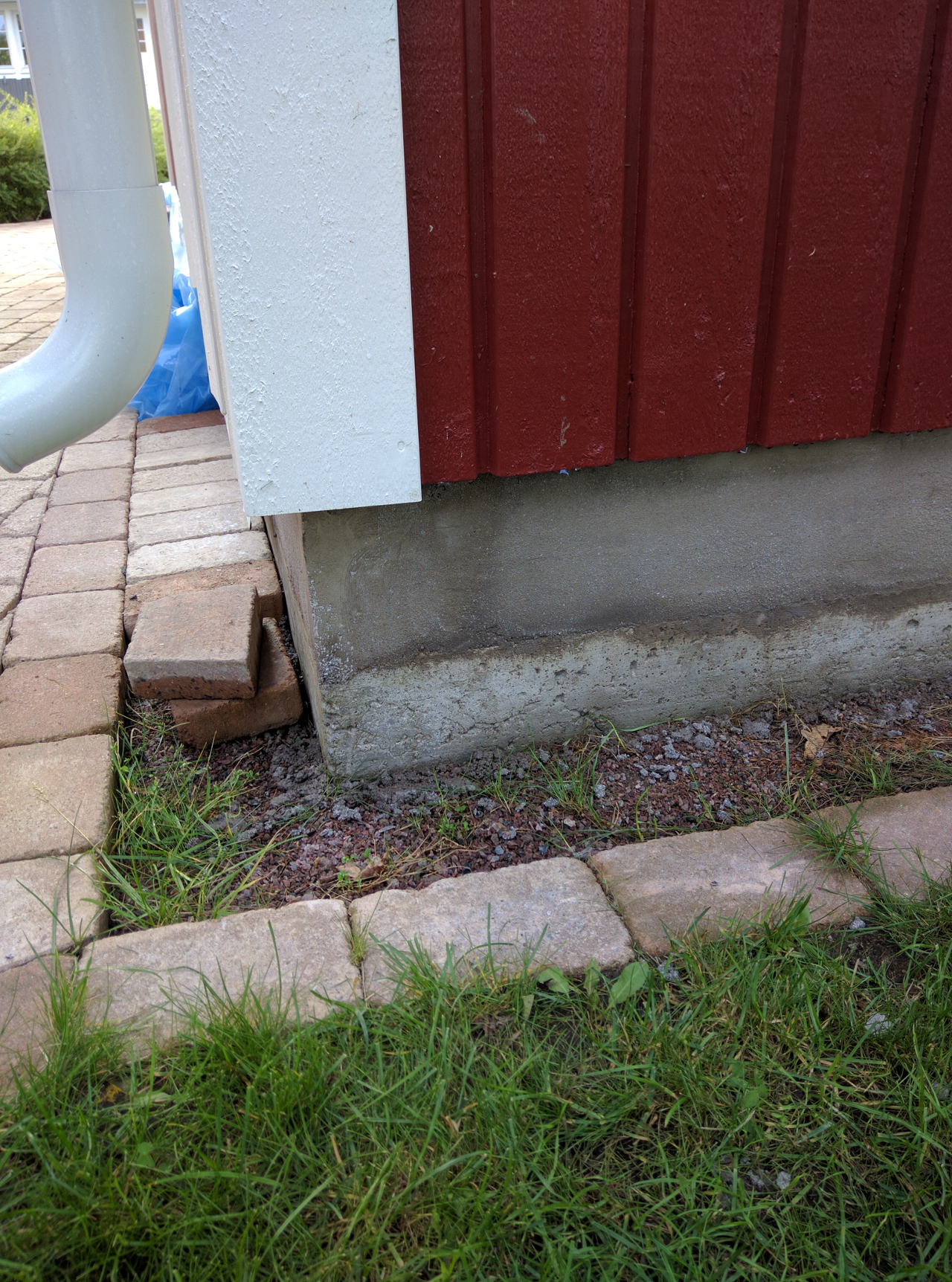
I have built a garage. All the walls stand on lecablock which in turn are on a cast slab. I am wondering what type of mortar I can use on the outside of the lecablock?
When I cast the lecablock on the slab, I used mortar B. I had some left over. Can I use the same mortar for the outside? I plan to paint it afterwards with the same color as the house.
According to the manufacturers, you should coat the surface of the Leca blocks with A-bruk and a broom. This seals the blocks so that water and myro do not get in. If you don't find the surface appealing enough, you can then apply a layer of B-bruk.
1. Slama. Mix Weber's cement mortar A to a porridge-like consistency.
2. Wet the lecablocks and then apply the mortar. I imagine using a brush that is somewhat softer than a scrubbing brush.
3. Wait a day.
4. Mix the cement mortar according to Weber's recommendations and apply with a trowel.
5. Cover with plastic.
It says it should be kept moist for 3 days. Should you water it for 3 days, or is it enough to just cover with plastic?
I can't apply it too thick as the house panel (which extends below the lecablocks) is only 0.5 cm from the stone. Do I nevertheless need a mesh nailed onto the lecablocks?
Had the same thought for my garage with a layer of leca. First used Weber's Rödgrund if I remember correctly, and then render mix. No mesh. Don't remember which render, but it's held up great for 3 years now. Not a single crack. Also had the same "problem" with the panel near the leca. Simply beveled the edge of the render upwards just below the panel.
First, I'm supposed to apply the slurry (porridge-like consistency), but what should the consistency be when you actually "mortar"? Should it be the same consistency as with Murbruk B?
Not primarily searching in Danish... But it still doesn't turn out quite right. I'm going to slam first so it will be watertight according to previous advice. Don't know if it's necessary? Well, there doesn't seem to be much knowledge here, so I'll do it my own way. Thanks for the help from those who replied!
You mix the mortar according to the recipe on the package. You make slurry by adding more water...
Impossible to describe the exact consistency. You've heard about porridge, right... Isn't that enough?
Every product has its own optimal consistency, and it's not so easy to describe it with words. It's also a matter of personal preference. The plaster consistency I like might not be exactly your favorite. The easiest way is to mix it a few times and test on some leftover blocks or a small part of the wall. I probably tried 5 different attempts before I felt I got a good mix when I started plastering at home in the basement. But now I know I like the lower drier range when I mix my plaster mortar. But instead, I might whip my mortar longer than you would have... Are you beginning to sense now that there's no surefire way to describe this? Test a little, and it will go smoothly.
I've "plastered" one side of the foundation that's the least visible to practice. It's quite difficult to throw it on and get it to stick. I figured out a trick by taking a brush, dipping it in the mix, and dabbing it on before throwing on the rest. That made it stick a bit better. I'll try the next round with a "firmer" consistency tomorrow.
As mentioned, it's trial and error with the consistency of the plastering mix. I have a good handle on the consistency for the next layer. Still wondering if plastering is necessary to make the lecablock waterproof, or do you only plaster to make the next layer of mix adhere better? I'm continuing to plaster in any case.
Perhaps I don't have the right tools for this. I only have a square trowel that I’m using. I don't feel like buying a bunch of different things just for this small strip I'm building. I guess I'm just stingy...
Couldn't get the mortar to stick well to the concrete slab itself, so I skipped it and only applied the mortar on the lecablocks.
I am going to paint the whole thing and have understood that you should use silicate primer before painting. What I find is Beckers silicate primer but it only seems to be available in 5-liter cans. Feels unnecessary since it will only take about a liter or so (guessing again).
Is there any other silicate primer besides Beckers that can work just as well and comes in 1-liter bottles?
(Yes, I'm going to fix the paving stones around the foundation and fill with gravel between the paving stones and the foundation after I've painted)
Vi vill skicka notiser för ämnen du bevakar och händelser som berör dig.