Hello. I can't find an appropriate forum to ask my question, so I'm trying here
I want to make a copy of a profile in the shape of an airplane wing. It's about 55 cm long, 25 cm wide, 1-1.5 cm thick. It's slightly profiled and gently curved. The original profile has a core of some kind of foam and a thinner surface layer of something like reinforced polyester, hard and quite durable.
My idea is to try to cast a copy in something like polyester. I was thinking of doing it like this.
Use a box/mold that is slightly larger than the original profile.
Place the original profile on spacers (about 4 cm) at the bottom of the mold.
Pour in something like fine concrete, so that about 2/3 of the profile's thickness is covered.
Let the concrete cure, dry.
Detach the profile from the concrete.
Place the profile back and cover with something like foil plastic.
Fill up with about 5 cm of fine concrete, which then cures, dries.
Then I should have a mold. Drill, shape filler holes, 3 pcs.
In the lower half of the mold (has the largest imprint of the profile, 2/3 of the thickness), I pour a bit of polyester, lay fiberglass reinforcement, and continue layering as much as possible. Then place the upper part of the mold and fill up with just polyester in the filler holes.
The problem might be that the polyester sticks in the mold, which will be difficult to separate?
Will there be enough strength with maybe just a couple of layers of reinforcement, as the wing tips are quite thin and need to withstand some stress?
Instead of using fine concrete for the mold, perhaps reinforced plaster is better. I'm a bit concerned about casting and damaging my original profile in the concrete.
Feel free to share opinions, suggestions, etc.
In principle, your idea could be used, but practically speaking, hardly.
It is better to make the mold in fiberglass-reinforced polyester instead, i.e., in the same way molds for boats are made. If you make the mold in concrete, you will encounter problems filling properly around the embedded wing, and it will "float up" in the concrete unless you screw it down, but that would ruin the original.
If by chance you succeed, there will be quite a lot of air bubbles, i.e., voids in the mold around the wing, because you have to vibrate the concrete well for it to fill out and be smooth around the wing, and if it lies loose on a couple of spacers, you won’t be able to do that. Then filling and sanding the mold to a perfect casting surface will not be easy with concrete and only creates more problems.
You don’t need to worry too much about it sticking as long as you use release oil for the concrete or wax it if you make the mold in polyester instead.
My advice after several projects with both polyester and concrete is to make two mold halves in polyester instead.
Here's the principle for making a mold: make two halves with flanges that you can bolt together instead.
Make the mold in polyester!
Everything must be super smooth to avoid sticking
- Spray filler
- Wet sanding
- Release agent
- Wax
- Polyester/epoxy
- Fiberglass/carbon fiber, etc.
The fiber mat should be soaked with polyester so there are no bubbles; beyond that, as little "extra" polyester as possible. It's probably best to try on a test piece first to gain some experience.
Also, keep in mind that if you want a core of foam plastic, regular EPS doesn't withstand polyester solvent, so you'll have to either use epoxy or use other foam (PU/balsa). It's also possible to wrap the fiber around a foam core and sand down to achieve the fine surface.
Thanks for the good response. As I previously mentioned, the profile is only about 15 mm thick. The issue of it floating can be adjusted by fixing it at the right height, pressed down about 10 mm in the concrete, the lower mold part. I also find it hard to believe there would be air bubbles. An acceptable surface on the finished casting should perhaps be possible to polish/sand to achieve. Is gypsum perhaps better than concrete in this case? Polyester mold seems smart. What release agent/wax do you use between the original profile and the polyester, and between the polyester mold and the polyester casting? The problem will be trying to include fiberglass reinforcement in the casting in the mold?
Save yourself a few hundred hours of fun, and buy a ready-made wing!
It can't cost that many kronor, can it?
Well, 3-7000 kr I think is quite a lot of kronor, an overprice. Also doesn't hold up very well. I think it could be a fun project to try to copy, but it seems quite tricky.
What is commonly done when building airplane wings in fiberglass/carbon fiber/Kevlar reinforced polyester is to make two molds, one for the top side and one for the underside.
Then, once the top and underside are laminated, they are "glued" together with the same plastic + a little fabric.
Then you may fill it with PU foam.
But I've never built wings in "plastic," only boats, model boats, and model airplane fuselages.
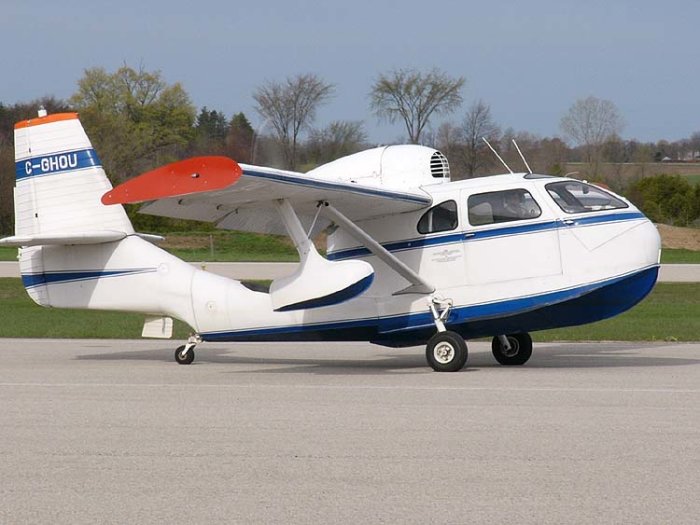
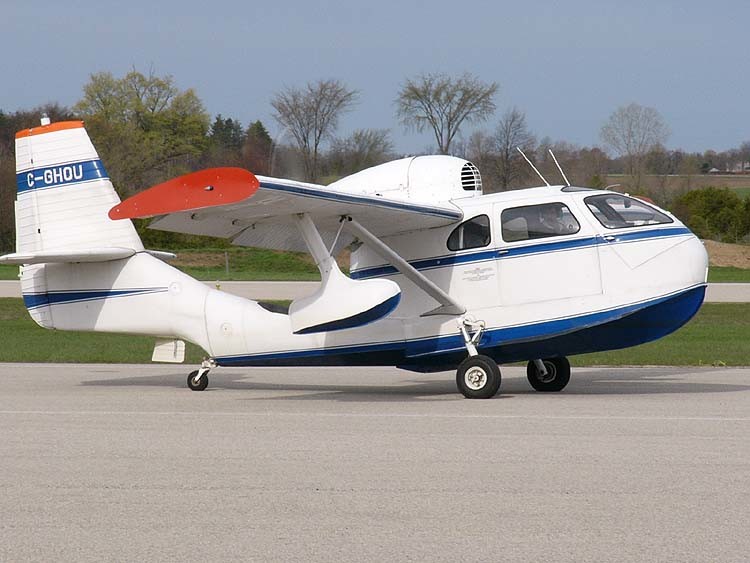
The model plane (a Republic RC-3 Seabee) I built in two halves, right and left.
What is commonly done when building aircraft wings in fiberglass-/carbon fiber-/Kevlar-reinforced polyester is probably to make two molds, one for the top and one for the underside.
Then, when the top and underside are laminated, they are "glued" together with the same plastic + some fabric.
After that, you might fill with PU foam.
But I have never built wings in "plastic," only boats, model boats, and model aircraft fuselages.
The model plane (a Republic RC-3 Seabee) I built in two halves, right and left.
[image]
Ahh, it sounds reasonable with two mold parts, one over and one under which you fill separately and then glue/laminate together. What materials did you use to manufacture the mold parts, polyester, plaster? Did you use a release agent, if so, what? Found a page where they made custom fins for surfboards in exactly the same way you describe, seems to work well.
It's a heck of a job to build, as there are three steps:
1.
Build a plug, i.e. a model that is exactly like what the final result should be.
You build the plug, for example, in Styrofoam, which is easy to shape.
Rasp, file, sand, paint with paint that a) doesn't dissolve the Styrofoam and b) withstands polyester/styrene.
Fill, sand more, fill again, etc.
Then rub, polish, and wax, and finally release agent.
2.
Build the mold from gelcoat, polyester, and fiberglass, and possibly reinforcements to keep the correct shape.
And then polish and adjust the mold so it's perfect.
3.
Release agent in the mold, gelcoat, and then laminate the final result.
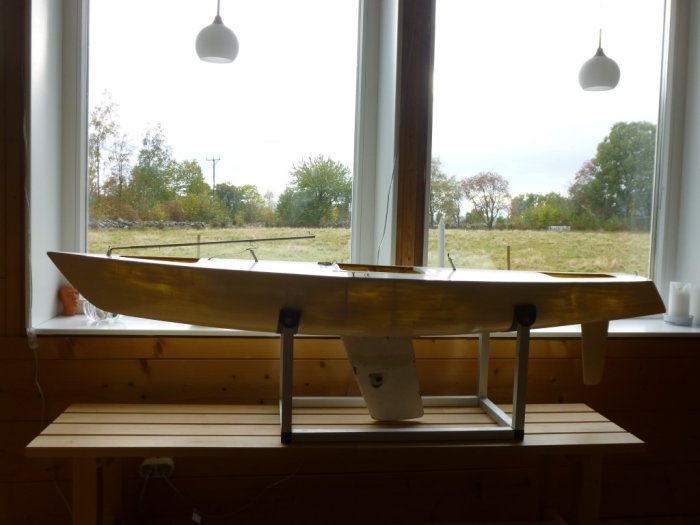
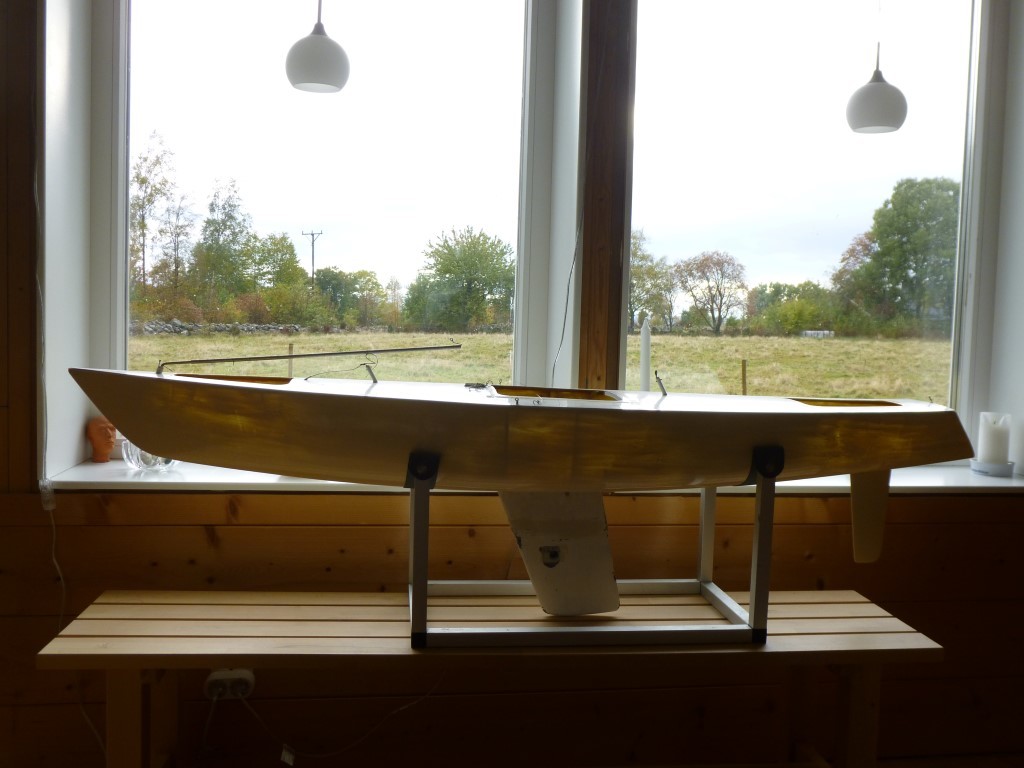
Here is a model boat.
A scale model of our Wasa 30, which we built in 1978.
The original was 11 m long, the model 1.65 m, i.e. scale 0.15 : 1.
I built the model when I was about to turn 40. Spent an entire winter filing, filling, polishing, and laminating.
A way to get through the 40-year crisis
I was thinking of using my wing/profile for the casting, which saves me the first step, likely saving a lot of time and work. It should work if I coat the wing with release agent and create the mold from it. The surface layers of the wing seem to be of Polyester/Epoxy type, so it should withstand this.
Thanks for the tips and good description, I have some tinkering to do in the autumn darkness now
Very beautiful model boat, fun to see
Ghaa, this is difficult. I've been thinking back and forth now and watched a lot of YouTube clips, and I've probably become more doubtful. It feels quite risky to use the original profile as a plug. I'm worried that it might get stuck or be chemically affected since I'm not sure what material it's made of. It's hard to make a good mold of both sides as it's curved in both width and depth, and it's very thin at the rear edge and wing tips (about 2 mm). I've seen several clips where people make fins for surfboards. They start with a wooden core in the right profile and shape, which they cover with fiberglass and polyester on each side. Could this be a possible and workable method? I'm thinking of starting with, for example, 4 mm plywood, cutting out the profile shape based on the original, covering it with fiberglass, and fixing it to get the right curvature. Once it has dried, adjust the thickness and profile with plastic and fiberglass, sand, adjust, and maybe fine-tune with gelcoat filler, paint??? Linking a clip where they shape and fix the wing about 3 minutes into the clip https://www.youtube.com/watch?v=2uIWdEI1f2Y
How are you going to get the right profile and shape on the wing with the handicraft technique? Johannes Carlssom suggested that method at the beginning of the thread. If you're going to laminate on a core, it will be easier to shape if you use balsa or PU foam instead of plywood.
Vi vill skicka notiser för ämnen du bevakar och händelser som berör dig.