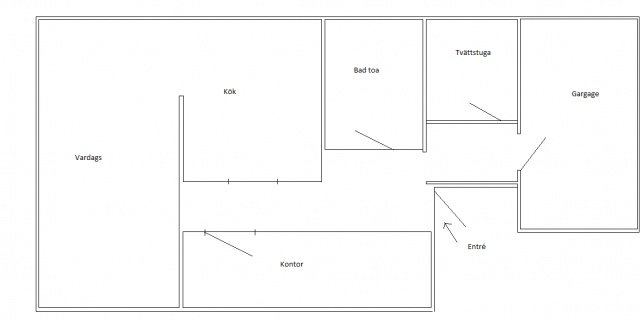
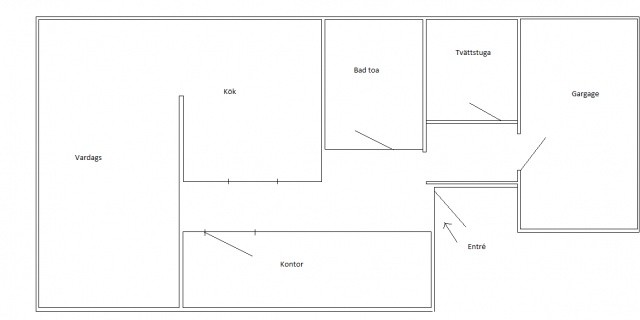
I'm seeking answers to some questions I'm pondering. I'm going to renovate the bathroom, laundry room, and garage in a house from '64 and also add insulation where the affected rooms' walls meet the exterior wall. See sketch.
Currently, the insulation between the garage and the laundry room is poor, although there is some insulation. The garage is heated since it's a terraced house, but it leaks like a sieve. The plan is to add insulation to the garage wall against the laundry room as there isn't much space in the laundry room as it is.
Furthermore, all exterior walls will be additionally insulated with 10cm. Today, there's 10cm of rock wool. So a total of 20cm.
In the bathroom, I will install water-based floor heating. The entire ground floor has a concrete slab floor, where all floors except the bathroom and laundry room are raised 50mm and insulated with glass wool, then covered with floorboard/parquet.
In the bathroom and laundry room, an additional layer is poured to match the thickness, approximately 70mm. The foundation is a well-dimensioned slab foundation.
Since the bathroom will be a sealed zone with a moisture barrier, I'm wondering how it will affect the laundry room with all the moisture and the garage, which is relatively cold during winter?
The questions are = Where should I use a vapor barrier, I know I shouldn't have it in the laundry room against the bathroom, but elsewhere, against the exterior wall and garage? Maybe no vapor barrier at all? Of course, I need good ventilation in the bathroom and laundry room, but is that enough?
How will it be with floor heating on/an uninsulated slab? Could I cause condensation problems in the nearby kitchen, for example, where there are wooden beams and insulation directly against the concrete slab?
These are difficult questions to formulate, but I have to start somewhere. Ventilation is passive, only through the kitchen exhaust fan and one in the toilet, so the drafty windows probably account for most of it.
It feels impossible for me to find an answer, and maybe it is without careful moisture measurements over time. Every thing I "improve" in the house (new windows or sealing old ones, additional insulation, underfloor heating, plastic) can be a potential disservice?
It's difficult to get wrapping done well afterwards. And the question is whether it's better to skip it entirely rather than have it turn out half-hearted.
I can make a cautious little suggestion, not at all sure if it's the best, not even sure if it's good. :blushing:
Arrange mechanical ventilation, i.e., install one or more fans.
Try to determine if you've achieved a suitable negative pressure in all areas of the house.
For convection (i.e., air flow) expels much more moisture into the walls than diffusion. If you have negative pressure, it's only diffusion moisture that gets out.
Click here to reply
Vi vill skicka notiser för ämnen du bevakar och händelser som berör dig.