
Bought a house from 1976 about six months ago.
After a month or so, we discovered that the wall was sagging under the shower mixer in the bathroom.
The house was inspected by Anticimex and no moisture was noted in the bathroom.
The bathroom had been renovated following water damage near the floor drain in the late '80s.
The tiles in the shower corner were placed directly on the drywall without any additional moisture barrier.
Here's a picture of the shower corner after the tiles and drywall have been removed and the floor has been broken up:
After a month or so, we discovered that the wall was sagging under the shower mixer in the bathroom.
The house was inspected by Anticimex and no moisture was noted in the bathroom.
The bathroom had been renovated following water damage near the floor drain in the late '80s.
The tiles in the shower corner were placed directly on the drywall without any additional moisture barrier.
Here's a picture of the shower corner after the tiles and drywall have been removed and the floor has been broken up:
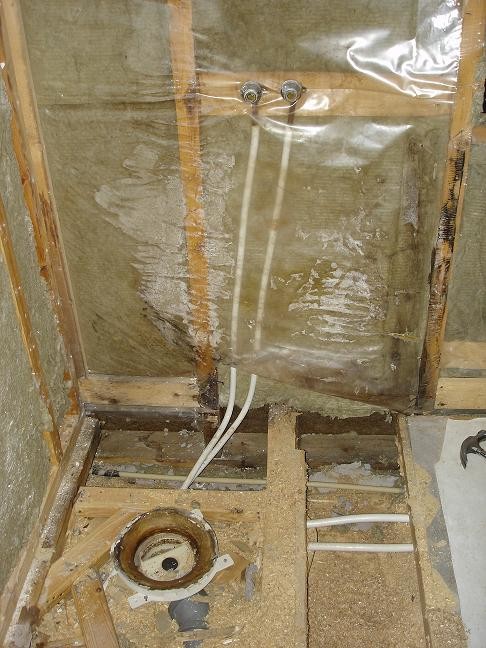
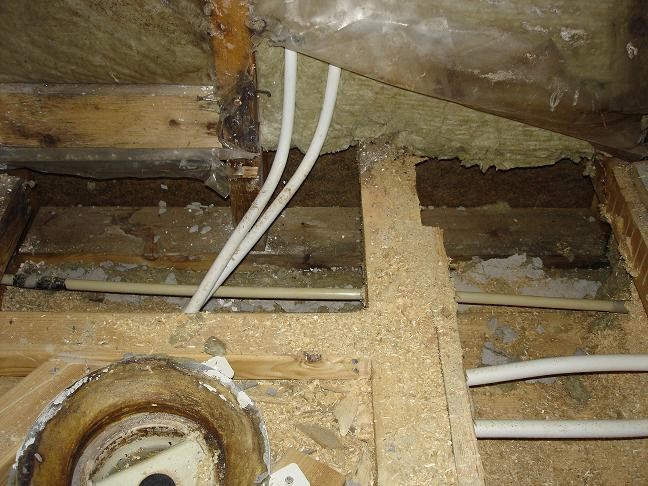
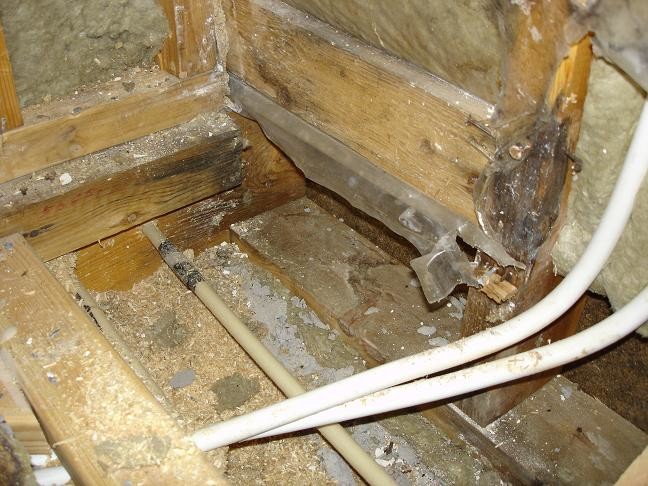
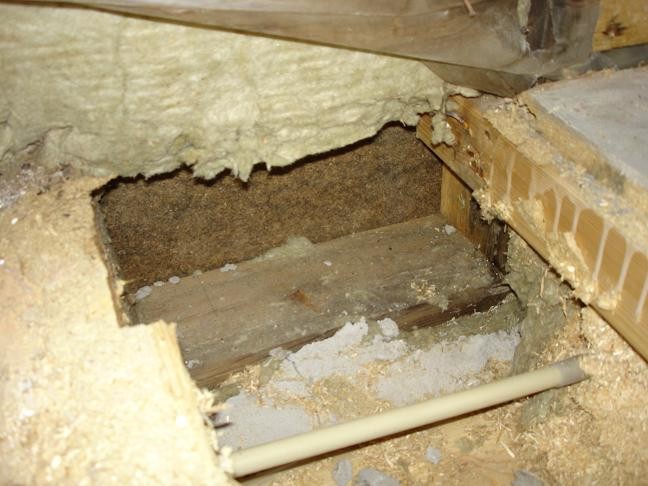
The sill rests on mineral wool on an outer basement wall of concrete blocks. Under the bathroom, there is a living room with a ten-centimeter strip of black mold up by the ceiling on the back of a wallpaper. The sill, beams, and studs do not seem to rot, and there is no particular smell. I wanted to hear from you what I should do about this: is it enough to carve away the black? Do you need to apply some anti-mold agent? Other options?
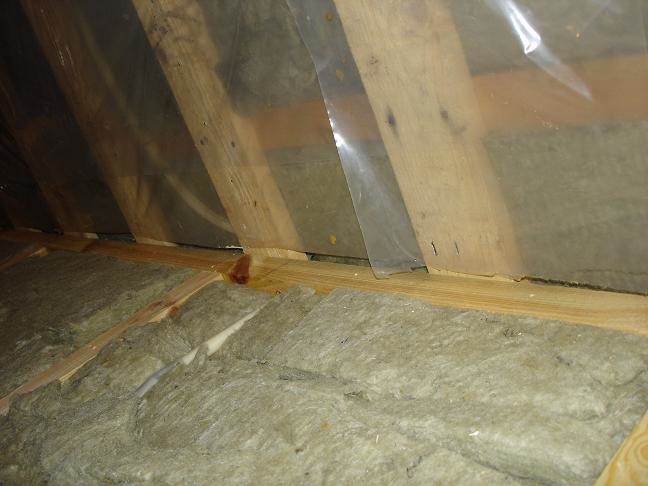
A general question: is it common for the vapor barrier to be so sloppily installed against an unheated attic space in a house built in '76? What you see in the picture is the vapor barrier in the ceiling that ends with a gap of a few centimeters against the interior wall:
A general question: is it common for the vapor barrier to be so sloppily installed against an unheated attic space in a house built in '76? What you see in the picture is the vapor barrier in the ceiling that ends with a gap of a few centimeters against the interior wall:

I don't know if I'm answering any of your questions, but can't this be claimed as a "hidden defect"? It feels like one of the most hidden defects I've ever read about. If it's possible, then just let the craftsmen go at the damage and do as much as needed.
I would personally replace as much wood as possible, because then you're building the details back in and can't keep track of them. Replacing them later in case of problems will just be more expensive...
I would personally replace as much wood as possible, because then you're building the details back in and can't keep track of them. Replacing them later in case of problems will just be more expensive...
The house is "declared" via Anticimex/Svensk Fastighetsförmedling. The damage is an insurance claim, so Anticimex does not cover it. The claims adjuster from Länsförsäkringar who was here said that the construction would be rebuilt in the same way as it was done before, regardless of how substandard it is by today's standards, i.e., if there was single drywall without a moisture barrier on cc60, that is how it will be done during the repair as well. He thought the damage looked limited and wanted to pay 5000:- as compensation - this was before the floor was taken up.
How strange that the insurance company recommends that the damage be repaired in the same way it was done! That will lead to new moisture damage and new insurance claims... While it's understandable that insurance companies don't want to pay for more expensive surfaces (tiles), you'd think they would at least want the underlying work to be first class...

I have replaced a lot of moisture-damaged, or rather rotten (due to moisture), wood in my house. As far as I understand Anticimex, after having a frequent customer card there over the summer, it should not be a problem as long as it's not rotten and mushrooms with mycelium (dry rot!) are found. If it only appears to be harmless mold, or just moisture stains, it should suffice to scrape it off the surface and ensure the moisture source is stopped. Most fungal attacks and mold can only survive and spread in a moist environment. If you ensure to address this, I can't see why you would have any problems.
So. If something is decayed, you can, if you feel it's necessary, scrape/carve it away and then build over it as long as you ensure it doesn't get wet again.
So. If something is decayed, you can, if you feel it's necessary, scrape/carve it away and then build over it as long as you ensure it doesn't get wet again.
ylven: I agree with you that it sounds strange, I sent a question to Länsförsäkringar today to get confirmation that it is this way - I will get back with an answer.
Häxhusrustarn: thanks for the answer. A carpenter said the same thing but added that to be safe you should apply some mold-preventive agent, for example boracol, on the wood that has been exposed to moisture.
Häxhusrustarn: thanks for the answer. A carpenter said the same thing but added that to be safe you should apply some mold-preventive agent, for example boracol, on the wood that has been exposed to moisture.
Click here to reply