
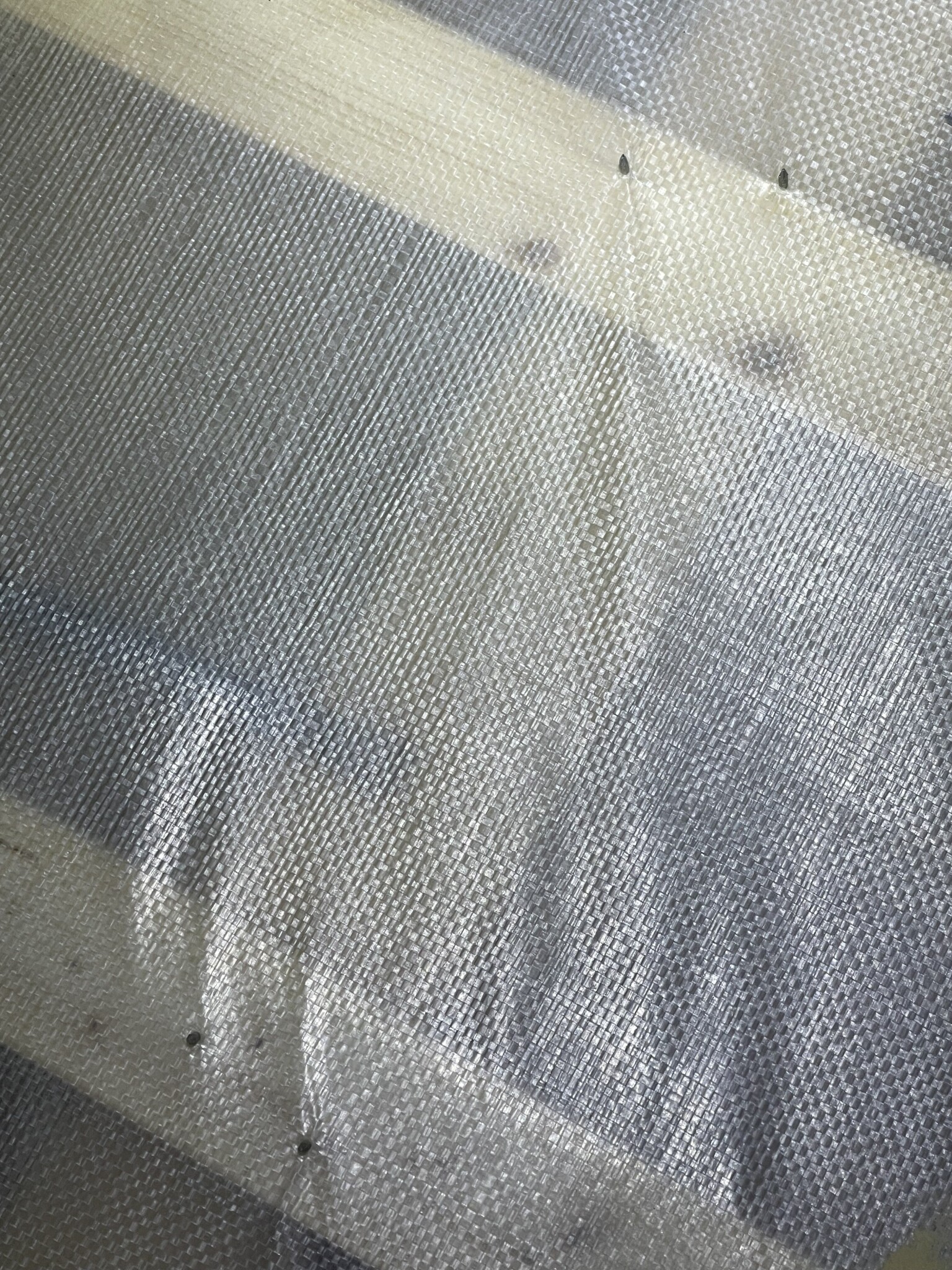
No, that's not a moisture barrier. In the picture, you see a roof membrane. It replaces the sub-roof. It can also be used as a wind barrier in exterior walls. Nailing into it doesn't matter. Normally, construction plastic is also stapled up. However, a waterproofing layer in a bathroom should never be punctured.
Is that really true? Is it not a membrane that is diffusion-tight? I.e., a membrane used instead of plastic?
There is no plastic elsewhere against the ceiling. Under the membrane in the picture (which is taken from the attic after the insulation has been removed), you see the nail battens and the framing to the interior wall. The interior wall is against the bathroom.
There is no plastic elsewhere against the ceiling. Under the membrane in the picture (which is taken from the attic after the insulation has been removed), you see the nail battens and the framing to the interior wall. The interior wall is against the bathroom.


It is a fall-through-proof vapor barrier, a so-called säkerhetsväv.A AG A said:No, that is not a moisture barrier. The image shows a roofing membrane. It replaces the underroof. It can also be used as a wind barrier in exterior walls. It doesn't matter if nails are used on it. Building plastic is also usually stapled up.
However, a waterproof membrane in a bathroom should never be perforated.
https://www.bygghemma.se/hus-och-by...sakerhetsvav-bison-2730-x-02-mm-25-m/p-851143

If you want, you can bend the nails and tape over them with tape intended for vapor barriers. As several have already pointed out, this is not a problem since the insulation will press down the plastic against the stud, preventing moisture from passing through as easily.
Yes, that's roughly what I meant when I said it was instead of underroofing. However, it's strange that it is said to be vapor tight and can be used as both a windbreak, building plastic, and as an underroof. You're not supposed to put a vapor barrier on the outside of the insulation.Rejäl said:
Roofing felt is also tight. It is the air gap in the roofing underlayment that makes it so you can't compare it to a wall.A AG A said:
Click here to reply