Yes, clarify with pictures and you might get an answer.......
Your question is very unclear.
If you have a brick wall, you probably don't need windproofing, and it's probably not optimal to erect a wooden stud wall on the inside.
Either steel studs or building up with inorganic material like brick, leca, or lightweight concrete. :x
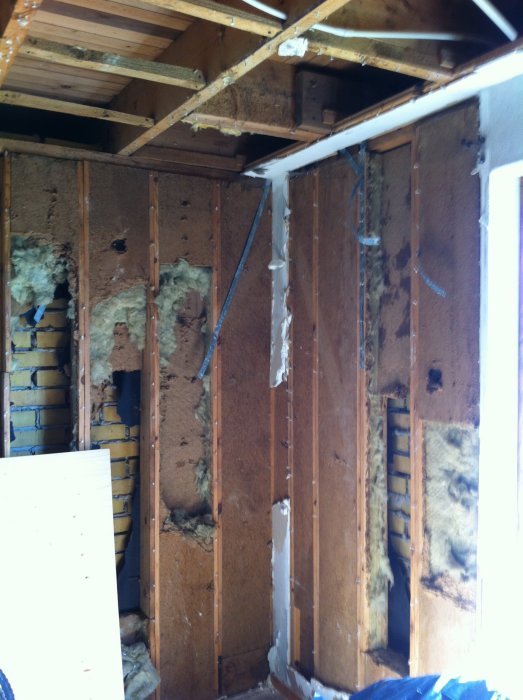
I am sending a picture of how it looked before.
The house was completed in 70, there is no moisture or mold in the house.
I wonder what I can "demand" from the construction company I hired to do the work, I mean to build correctly? The circumstances are if too much has been torn down and what that might entail.
Is it renovation that's happening, or some other reason for the demolition? It should otherwise be specified what is to be done and maybe even how. But if you have a construction company, as previously mentioned, they should put up new frames but not with wood
If it had been me, I would have (most simply) set up a metal stud wall with an air gap to the brick at least 20 mm.
Insulated to the desired thickness and covered with cement boards (fermacell or equivalent), - no moisture barrier - no paper-clad plasterboards.
or built an inner wall of lightweight concrete, leca (10-15 cm), or similar and possibly insulation (rock wool) of desired thickness in between.
I would also periodically fix anchors so that the brick wall and inner wall are anchored to each other for better stability. Naturally, the inner wall should be reinforced every 3rd or 4th course according to the manufacturer's instructions.
Make sure that the brick wall (outer facade) has open head joints in the 1st and 2nd courses, about 0.5-0.75 cm apart, for ventilation of any water that penetrates through bricks or joints that are loose or saturated from persistent rain.
I thought the regulations carried trusses and tiles were just a surface layer, but here they've torn away all the wood? (But I assume tiles should be able to bear a lot.)
There were no studs directly under the trusses distributing the force down to the ground?
When the house was completed in 1970, the roof was flat, then a roof elevation was done directly on the existing roof. So the construction you see in the picture supports a flat roof.
I also have many questions about how it works technically in terms of construction, how one can demolish and how to rebuild (renovation).
There are external corner studs that might be there to relieve.
Thank you for your engagement.
Vi vill skicka notiser för ämnen du bevakar och händelser som berör dig.


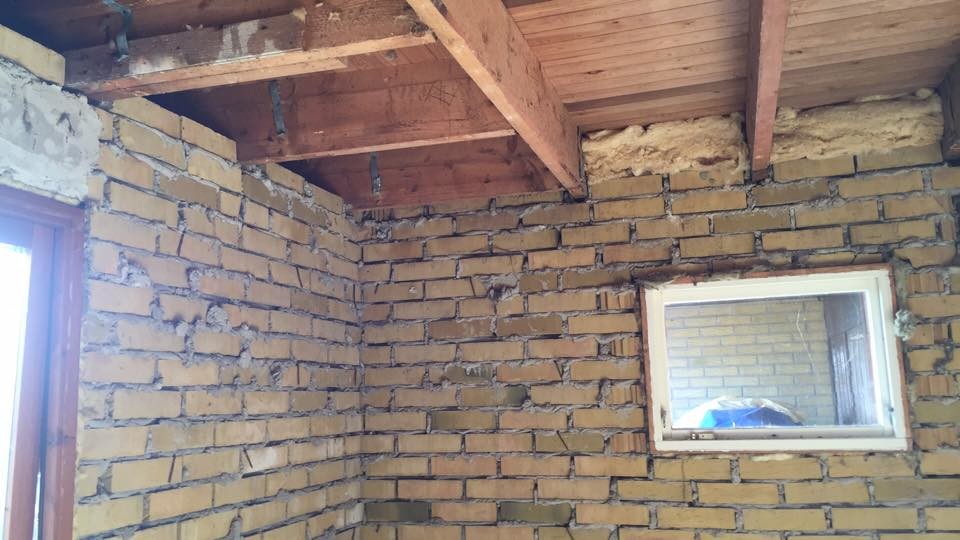
 ... and it's not wood in a brick building! See previous posts.