
Hello all pros.
I have some questions here regarding moisture barriers.. as you can see in the pictures, it seems they've done the room in two different ways: on the right they have wrapped the wall and ceiling in plastic, and on the left they have used some type of paper.. from what I know, you usually wrap in plastic, add battens, then drywall.. But in this case, they chose to plastic wrap, then drywall directly onto it, so the plastic is now damaged after I tore down all the drywall. The drywall was NAILED to the ceiling... How should I solve the problem with the moisture barrier? What is recommended in that situation?
Regards
I have some questions here regarding moisture barriers.. as you can see in the pictures, it seems they've done the room in two different ways: on the right they have wrapped the wall and ceiling in plastic, and on the left they have used some type of paper.. from what I know, you usually wrap in plastic, add battens, then drywall.. But in this case, they chose to plastic wrap, then drywall directly onto it, so the plastic is now damaged after I tore down all the drywall. The drywall was NAILED to the ceiling... How should I solve the problem with the moisture barrier? What is recommended in that situation?
Regards
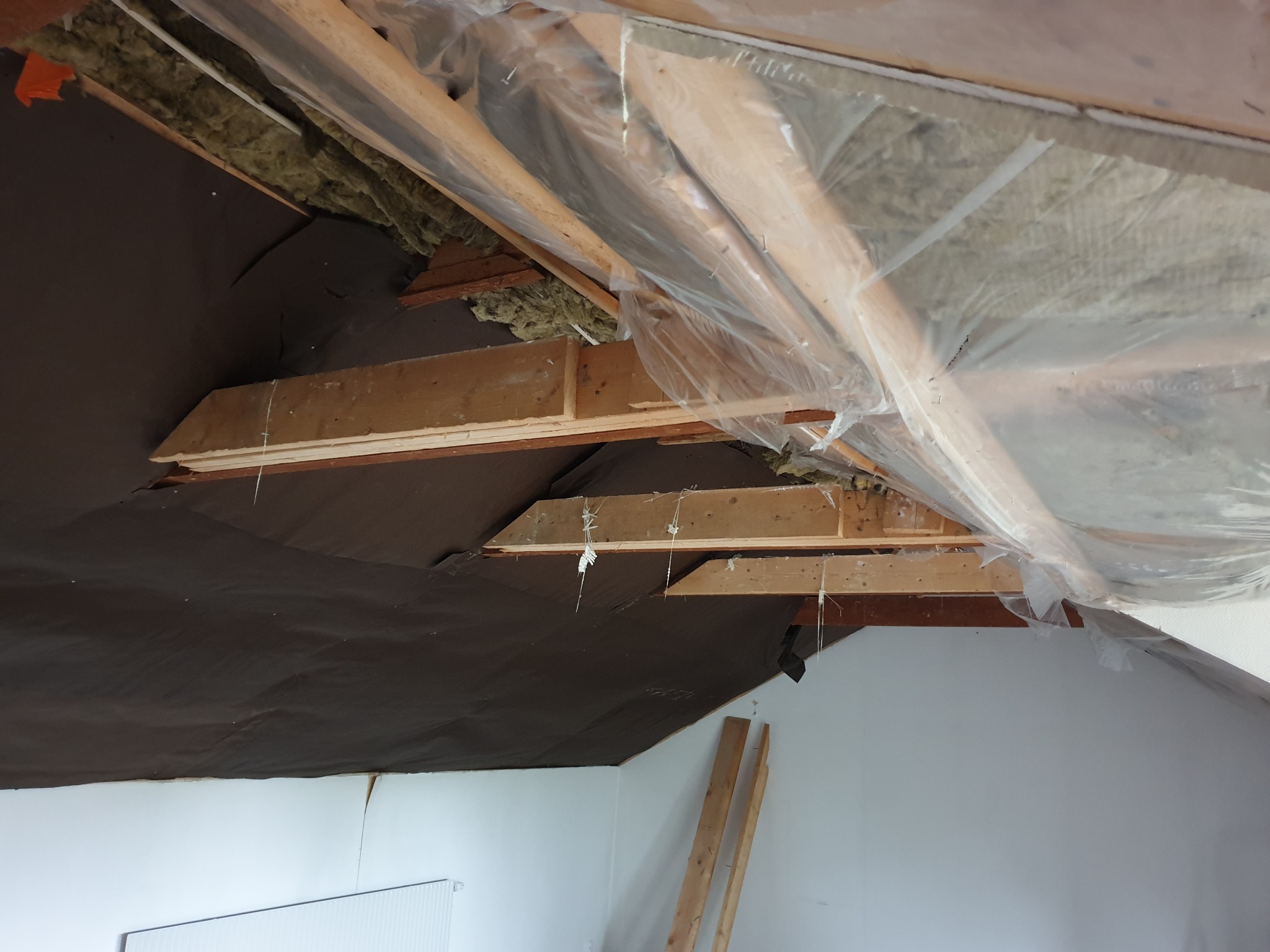
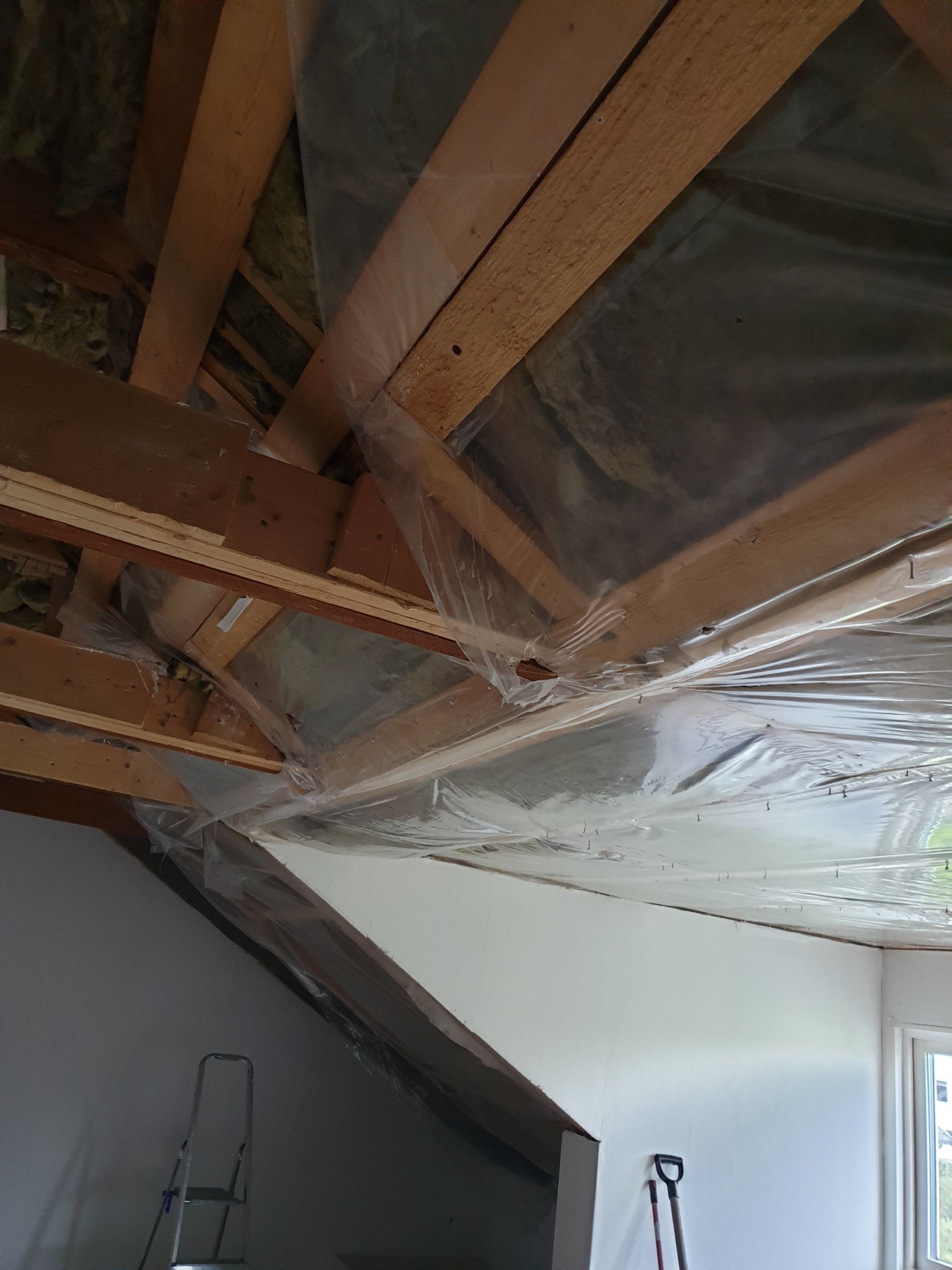

Do you have both paper and plastic on the same roof part? Up until a few years into the 70s, asphalt-impregnated paper (AC 350) was the most common form of vapor barrier. Then it was gradually replaced by plastic film. Plastic that is durable is quite a new invention, which many younger people today might not believe. I don't think paper and plastic were mixed on the same construction. At least not by professionals. It indicates a later renovation. In the past, only nails were used when building houses. Screws were slotted screws and power screwdrivers didn't exist. In principle, you shouldn't mix paper and plastic in the same house, but there may still be reasons for it if the amount of insulation has been significantly increased. It can be difficult to determine here how you should proceed.
J justusandersson said:Do you have both paper and plastic on the same roof section? Up until a few years into the 70s, asphalt-impregnated paper (AC 350) was the most common form of vapor barrier. Then it was gradually replaced by plastic film. Plastic that is durable is quite a recent invention, which many younger people today might not believe. I don't think they mixed paper and plastic in the same construction. At least not professionals. This indicates a later refurbishment. In the past, only nails were used when building houses. Screws were slot-head screws and screwdrivers didn't exist. In principle, one should not mix paper and plastic in the same house, but there may still be reasons for it if the amount of insulation has been significantly increased. It can be difficult to figure out here how you should proceed.
Seems like it's a refurbishment that has been added... wouldn't it work if I remove all the plastic and go with paper all over? Or remove the paper and plastic the whole thing... I don't know which is best
If it is a smaller part that has plastic and the amount of insulation (where the plastic is) is not much larger, I would choose cardboard throughout.
In the technical description of my house from '72, it states that they used "9mm Asfaboard," which is a type of soft board I've seen when I made a hole in the wall. Does it act as some form of moisture barrier?J justusandersson said:Do you have both tar paper and plastic on the same part of the roof? Until some years into the 70s, asphalt-impregnated tar paper (AC 350) was the most common form of vapor barrier. Then it was progressively replaced by plastic sheeting. Durable plastic is quite a recent invention, which many younger people today might not believe. I don't think tar paper and plastic were mixed on the same construction site. At least not by professionals. It indicates a later renovation. In the past, only nails were used when building houses. Screws were slotted screws and screwdrivers didn't exist. In principle, tar paper and plastic should not be mixed in the same house, but there might still be reasons for it if the amount of insulation has been significantly increased. It might be difficult to sort out here how you should proceed.
Asfaboard was mostly used on the outside of the wall as wind protection. It was a misconception that disappeared quite quickly. The wind protection on the outside should be diffusion-open.
I guess that most of the house's walls and roof have asphalt felt as vapor barrier. I think it is appropriate to use it everywhere, unless the insulation thickness has been increased from e.g. 15 cm to 30 cm.
I guess that most of the house's walls and roof have asphalt felt as vapor barrier. I think it is appropriate to use it everywhere, unless the insulation thickness has been increased from e.g. 15 cm to 30 cm.
Yes, not much was done right back then... Didn't they study building construction in schools at that time? Learn about moisture, etc. But then the question is how many mistakes we're making today regarding how we build now. Only the future will show =)J justusandersson said:Asfaboard was mostly used on the outside of walls as windproofing. It was a mistake that disappeared quite quickly. The windproofing on the outside should be diffusion-open.
I guess most of the house's walls and roof have asphalt paper as vapor barrier. I think it's appropriate to use it everywhere unless the insulation thickness has been increased from, for example, 15 cm to 30 cm.
But at the same time... my house has been standing in the same place for 47 years. I've made holes in the wall, etc. I don't detect any smell and don't see anything strange. So maybe it works with Asfaboard too?J justusandersson said:

I have also never heard of a house with asfaboard in the wall having major problems. I think the key issue is the amount of insulation in the walls. During the 1950s and 60s up until 1975, the standard was about 10 cm of insulation in the exterior walls and 15 cm in the floor joists.
There seem to be quite a few types of felt on the market, is there any particular type that is recommended?J justusandersson said:Asfaboard was mostly used on the outside of walls as windproofing. It was a misconception that disappeared quite quickly. Windproofing on the outside should be diffusion-open.
I guess most of the house's walls and roof have asphalt felt as vapor proofing. I think it's appropriate to use it everywhere, unless the insulation thickness has been increased from, for example, 15 cm to 30 cm.
It should have high steam resistance. Look at that task when you compare different variants.
Click here to reply