I'm working on a fence at the front of the house and have finally secured all the posts (drilled into a granite wall and used post shoes and anchor adhesive). I made the posts a bit longer than necessary and have now aligned them for cutting (I remove them from the post shoes and use my miter saw, then reattach them). Last year, I built a fence on the long side of the property, and the idea is now for the two sections to meet at a 90-degree corner. On the existing fence, I attached a top rail that slopes 5 degrees outward, and I want the new section's top rail to have the same slope.
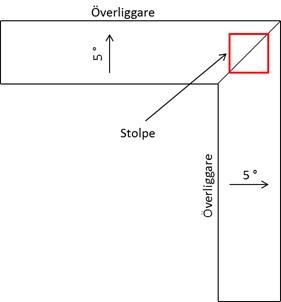
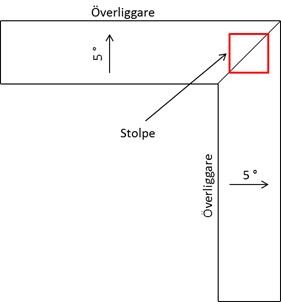
I would need some tips on the smartest way to miter cut the post that will be in the corner. It needs to be mitered from two sides, considering the top rails slope 5 degrees. I have made a simple sketch that I hope shows what I mean.
I would be very grateful for some wise advice on how to practically do this!
I’m working on a fence at the front of the house and have finally secured all the posts (drilled into a granite wall and used post shoes and anchor adhesive). I made the posts a bit longer than needed and have now leveled them for cutting (I detach them from the post shoes, cut them with my miter/compound saw, and then reinstall them). Last year, I made a fence along the side of the property, and the plan now is for the two parts to meet at a 90-degree corner. On the existing fence, I attached a top rail that slopes 5 degrees outward, and I want the same slope on the top rail of the new section.
I could use some tips on the best way to miter the post at the corner. It needs to be mitered from two angles considering the top rails slope 5 degrees. I’ve made a simple sketch that I hope shows what I mean.
I would be very grateful for some wise advice on how to practically do this!
Lasse
[image]
I don't think you should complicate it more than by taking some scrap pieces and experimenting. I mitered crown moldings between sloped ceilings and horizontal ceilings, and even though it's a brand new house with known angles, it doesn't always match exactly, so I made test pieces at different angles 17, 18, 19 degrees and tested which fit best and then used that angle on the miter saw to cut the actual moldings. So try it out with two short pieces until the corner looks nice and then use those settings for the real pieces.
You need to build a cradle so that you can place the post at 45 degrees under the miter saw. Then you need to set the cutting depth so that the cut ends at the drawn diagonal line. After that, you need to adjust the blade in a compound miter: with the blade angled and tilted. Best to practice on some scraps.
I don't think you should complicate it more than just taking some scrap pieces and experimenting. I mitered ceiling moldings between slanted ceilings and horizontal ceilings, and even if it is a completely new house with known angles, it doesn't always match exactly. So, I made test pieces at different angles 17, 18, 19 degrees and tried which fit best and then used that angle on the miter saw to cut the actual moldings. So, experiment with 2 short pieces until the corner looks nice and then use those settings on the actual pieces.
/Ola E.
Thanks Ola!
Regarding the handrails, I'll have to experiment. I saw a thread here earlier (which I can't find now) with a formula for calculating the miter angle and the blade tilt. My problem is more about cutting the top of the post as it involves two angles meeting in the diagonal.
You need to build a cradle so that you can lay the post at 45 degrees under the miter saw. Then you need to set the cutting depth so that the cut ends at the drawn diagonal line. Then you need to adjust the blade in dual miter: the blade turned and tilted.. Best to practice on some scraps.
I think it should be possible to adjust the tilt of the blade to 5 degrees (in the vertical plane) and make a cut with the post lying on the "right side" on the saw table. Then rotate the post 90 degrees around its long axis and make another cut in the same way. In this way, you will get a piece that fits your corner.
The two planes will intersect each other diagonally.
(Now it's quite late and I'm tired, but I *think* it should work)
I think it should be possible to adjust the blade tilt to 5 degrees (in the vertical plane) and make a cut with the post lying "correctly" on the saw table. Then rotate the post 90 degrees around its long axis and make another cut in the same way. This way, you will get a piece that fits your corner.
The two planes will intersect diagonally.
(Now it's quite late and I'm tired, but I *think* it should work)
Spontaneously, it feels like you might cut away material in the first miter that you want to keep for the second miter (and vice versa), but I must try it this weekend because it would be the absolutely smoothest solution. Thanks for the help!
Spontaneously, it feels like you might be cutting away material in the first miter that you want to keep for the second miter (and vice versa), but I have to try it this weekend because it would be the absolutely smoothest solution. Thanks for the help!
I did test it (a few years ago, should have updated the thread) and it turned out as I suspected that I sawed off too much material. But I solved it by first cutting the post straight and to the right length. Then I just sawed a few mm into the post on two sides with a 5-degree angle. After that, I drew a line on the diagonal on the top of the post and sanded down to the right level (following the markings I sawed with a 5-degree angle earlier).
Lasse (who is a bit ashamed for not replying earlier)
Click here to reply
Vi vill skicka notiser för ämnen du bevakar och händelser som berör dig.