
50,998 views ·
20 replies
51k views
20 replies
Math formula for hexagon

I am building a hexagon around the ugly concrete gray well in the garden. I want a hexagonal model with equally long sides.
The well's circular outer diameter is 86 cm, and I would like to get as close as possible to the well with the sides of the hexagon.
My math skills can't handle the formula to calculate how long the sides of my hexagon should be. :S
Can anyone do this here..?
Please share the formula in that case as it might come in handy another time.
The well's circular outer diameter is 86 cm, and I would like to get as close as possible to the well with the sides of the hexagon.
My math skills can't handle the formula to calculate how long the sides of my hexagon should be. :S
Can anyone do this here..?
Please share the formula in that case as it might come in handy another time.

Divide the circle into 6 parts then you have the angle (60°)
This then gives, with (relatively simple) trigonometry:
Diam=86cm
radius=86/2=43cm
Half the angle for right-angled triangle = 60°/2=30°
Tan 30° = x/43
x=24.83cm
24.83 is half the distance so if you multiply it by 2 you get the side:
24.82*2=49.64cm~50cm
Note that if you miter the boards, this is the inner measurement; if you want the outer measurement, you add the thickness of the planks in the calculation above.
Hope it's reasonably correct
This then gives, with (relatively simple) trigonometry:
Diam=86cm
radius=86/2=43cm
Half the angle for right-angled triangle = 60°/2=30°
Tan 30° = x/43
x=24.83cm
24.83 is half the distance so if you multiply it by 2 you get the side:
24.82*2=49.64cm~50cm
Note that if you miter the boards, this is the inner measurement; if you want the outer measurement, you add the thickness of the planks in the calculation above.
Hope it's reasonably correct
Now it has been a long time since I studied math, so there is surely someone who knows better; I suddenly feel even unsure about what a diameter is...
But if you divide the circle into 6 triangles, they become equilateral triangles with sides that are 43 cm long and an angle of 60 degrees at the tip.
If you then convert each triangle into two triangles with a 90-degree angle in the middle of the unknown side, you get a triangle with a hypotenuse of 43 cm and a 30-degree angle at the tip.
The length of the opposite side (the unknown side on the circle's outer edge) becomes sine 30 degrees = opposite leg / hypotenuse = x / 43 cm, which gives that x = sine 30 degrees * 43 cm. Then you have to multiply the result by 2 because we divided the side to get the right-angled triangle.
I don't have a calculator, so unfortunately, I can't calculate the result. And I should probably reserve myself for any misunderstandings since it was 10 years ago that I studied math, and now I only understand the page numbering in my old math books...
But if you divide the circle into 6 triangles, they become equilateral triangles with sides that are 43 cm long and an angle of 60 degrees at the tip.
If you then convert each triangle into two triangles with a 90-degree angle in the middle of the unknown side, you get a triangle with a hypotenuse of 43 cm and a 30-degree angle at the tip.
The length of the opposite side (the unknown side on the circle's outer edge) becomes sine 30 degrees = opposite leg / hypotenuse = x / 43 cm, which gives that x = sine 30 degrees * 43 cm. Then you have to multiply the result by 2 because we divided the side to get the right-angled triangle.
I don't have a calculator, so unfortunately, I can't calculate the result. And I should probably reserve myself for any misunderstandings since it was 10 years ago that I studied math, and now I only understand the page numbering in my old math books...

Will bevel cut studs that are 45 mm and if the forum guru can do another calculation adding this, that would be great.
There are math Einsteins here, and I can start cutting already today with your excellent help.
There are math Einsteins here, and I can start cutting already today with your excellent help.
54.85 cm
The calculation is the same as above, just adding 4.5 cm to the radius. Note that this is from tip to tip, i.e., where both ends are cut at an angle.
Byggankan: Sine doesn't work because it's the outer diameter (the radius is not the hypotenuse); if it were inner, it would be correct; sin(x)=opposite/hypotenuse. You can convert since you always know the sum of the angles is 180°, but in this case, tangent seems easier ( Sin(60°) = tan(30°) )
The calculation is the same as above, just adding 4.5 cm to the radius. Note that this is from tip to tip, i.e., where both ends are cut at an angle.
Byggankan: Sine doesn't work because it's the outer diameter (the radius is not the hypotenuse); if it were inner, it would be correct; sin(x)=opposite/hypotenuse. You can convert since you always know the sum of the angles is 180°, but in this case, tangent seems easier
( Sin(60°) = tan(30°) )
Last edited:
Then I understand even less, the cathetus/cathetus should be the same as the radius/radius of my circle which I divided into six pieces.
Thus 43/43=1
What am I not understanding here...how does it become 24.83
In my naivety, I see, no matter how I sketch, three equilateral hexagons in my circle with sides as the radius of 43 cm.
See attached image.
Thus 43/43=1
What am I not understanding here...how does it become 24.83
In my naivety, I see, no matter how I sketch, three equilateral hexagons in my circle with sides as the radius of 43 cm.
See attached image.
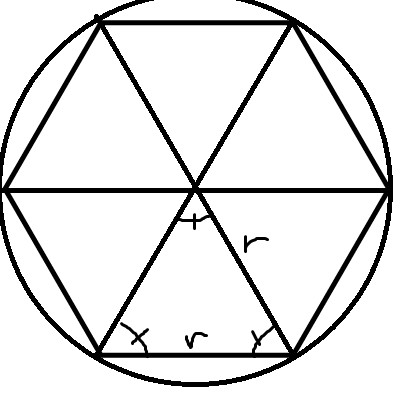

Member
· Västra Götaland
· 2 589 posts
I think the hexagon should be outside the well in this case.Forrest said:Then I understand even less, cathetus/cathetus should be the same as radius/radius of my circle that I divided into six pieces.
Thus 43/43=1
What am I not getting here... how does it become 24.83
In my naivety, I see, no matter how I sketch, three equilateral hexagons in my circle with sides as the radius 43 cm.
See attached image.
Sure, but if I add the thickness of the timber to the outer radius of the well, won't I get the same thing? I'm getting so unsure now...
To the diameter at the outer edge of the well, 86 cm, I place beams around the well of 4.5 cm each and on top of that, boards of 2.8 cm.
So it's 4.5 x 2 = 9 cm and 2.8 x 2 = 5.6 Total 14.6 cm
86 + 14.6 = 100.6
Radius = 100.6 / 2
Radius = 50.3
Then isn't it the same with six equilateral triangles with sides of 50.3?
To the diameter at the outer edge of the well, 86 cm, I place beams around the well of 4.5 cm each and on top of that, boards of 2.8 cm.
So it's 4.5 x 2 = 9 cm and 2.8 x 2 = 5.6 Total 14.6 cm
86 + 14.6 = 100.6
Radius = 100.6 / 2
Radius = 50.3
Then isn't it the same with six equilateral triangles with sides of 50.3?
Member
· Västra Götaland
· 2 589 posts
I think what you are calculating is the distance from the center of the well to the middle of the straight sides in the hexagon. And it was the length of the sides that was asked. That is not equal to the radius.Forrest said:Sure, but if I add the thickness of the wood to the outer radius of the well, would I get the same thing? Damn, I'm getting so unsure now...
To the diameter at the outer edge of the well, 86 cm, I place beams around the well of 4.5 cm each and boards of 2.8 cm on top of this.
So, it comes to 4.5 x 2 = 9 cm and 2.8 x 2 = 5.6 totaling 14.6 cm
86 + 14.6 = 100.6
Radius = 100.6 / 2
Radius = 50.3
Isn't it the same then with six equilateral triangles with sides of 50.3.
Nah, I'm starting to suspect I'm on the wrong track. But now I've also specified here the thickness of the timber I'm using around the well.
If then Tan = opposite side / adjacent side.
The side should be the radius in this case???
50.3 / 50.3... I'm hopeless said the grasshopper without one leg...
If then Tan = opposite side / adjacent side.
The side should be the radius in this case???
50.3 / 50.3... I'm hopeless said the grasshopper without one leg...