
Hi, I'm planning to cast a roof approximately 4x7m (20cm thick), which will rest on walls (made with leca) on 3 sides, with the last side hanging in the air.
I have plenty of information on reinforcement, etc., so everything is clear on that front.
However, I have some concerns about what material to use for the mold.
Should I use formply, or some kind of timber?
How is it best to seal joints?
Suggestions on how I attach the mold to the wall?
Distance between props?
Or can one as well use beams, and if so, what dimensions?
I have plenty of information on reinforcement, etc., so everything is clear on that front.
However, I have some concerns about what material to use for the mold.
Should I use formply, or some kind of timber?
How is it best to seal joints?
Suggestions on how I attach the mold to the wall?
Distance between props?
Or can one as well use beams, and if so, what dimensions?
The simplest method is to use plywood laid edge to edge without any sealing in between, just make sure they are tight during installation. Underneath, there are 45x95 on edge with 300mm c/c, and under the 45x95, there are bockryggar or planks 45x220 on edge across the 45x95 framework. You start these approximately 300mm from the wall and then about 1200c/c between bockryggarna depending on the room's measurements, divide it evenly so everything between 1000-1200mm works well. Then, whether you want to rent/buy props that stand under the bockryggarna or use 45x95 is up to you. The props are easy to adjust to the correct height, while wooden posts require more precise and time-consuming work.
Thanks for the very quick response!Rejäl said:You start with plywood laid edge to edge without sealing in between, just make sure they are tight when laying. Underneath that, there is 45x95 on edge with 300mm c/c, and under the 45x95, there are purlins or planks 45x220 on edge across the above 45x95 framework. Start these about 300mm from the wall and then space them about 1200c/c depending on the room's dimensions to divide it evenly, so anything between 1000-1200mm is good. Then, whether you choose to rent/buy supports that stand under the purlins or use 45x95 is up to you; supports are easy to adjust to the right height, whereas wooden posts require more nails and time-consuming work.
When you say plywood, do you mean regular construction plywood or formwork?, 12 or 15mm?
You mention that sealing isn’t needed, but I assume I should still fasten the outermost 45x95 into the wall with nail plugs or similar, so the whole form doesn't collapse!?
So, in other words, looking at it from above:
Plywood
45x95 cc300
45x220 cc1000-1200
Supports/45x95 (how close should these be?)
You don't need to attach so much to the walls as it locks itself in since you have walls on three sides, but when you start with the props and the lateral supports, those need to be braced.M MarkusTo said:Thanks for the very quick response!
When you say plywood, do you mean regular construction plywood or formwork?, 12 or 15mm?
You also say that sealing isn't needed, but I assume that I should still attach, for example, the outermost 45X95 into the wall with nail plugs or similar, so the entire form doesn't give way!?
So in other words, if you look at it from above:
Plywood
45x95 cc300
45x220 cc1000-1200
Props/45x95 (how close should these be?)
I made a very quick sketch, hope it helps you😊
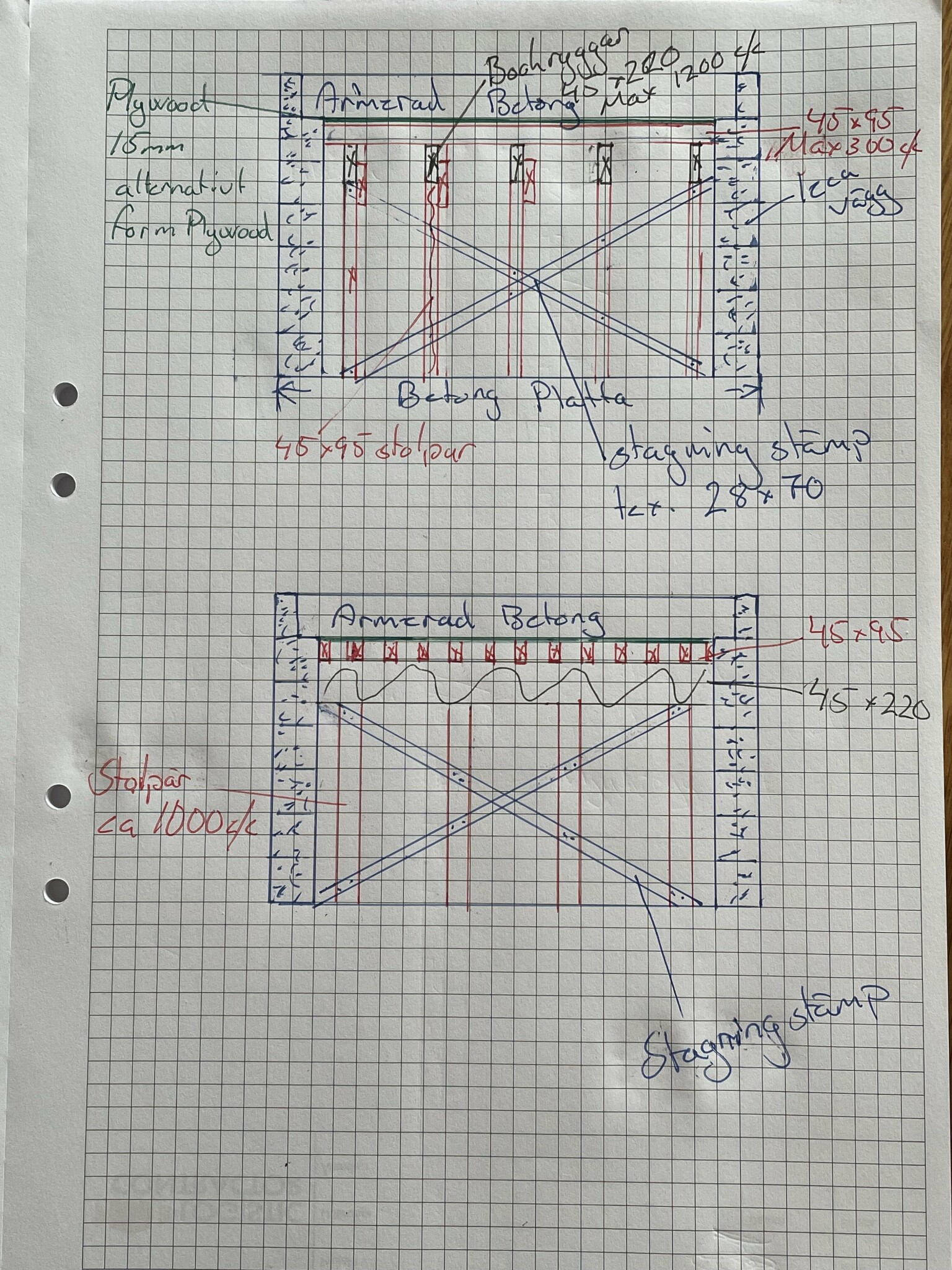
Wonderful, thank you so much for the help!Rejäl said:
I've noticed that there's no thicker form plywood at Byggmax than 12mm. Is this sufficient?
For bracing, is there usually a hole in the stamp to run a screw through, or what's the best way to do it?
If you have a steel formwork, there's a special metal piece you put around the formwork..M MarkusTo said:
In my sketches, there are 45x95 posts where you see the bracing...

Floors are always nice to have thicker...M MarkusTo said:
 How long should a mold for such casting stay in place before being removed?
Click here to reply