
Construction. Material question:
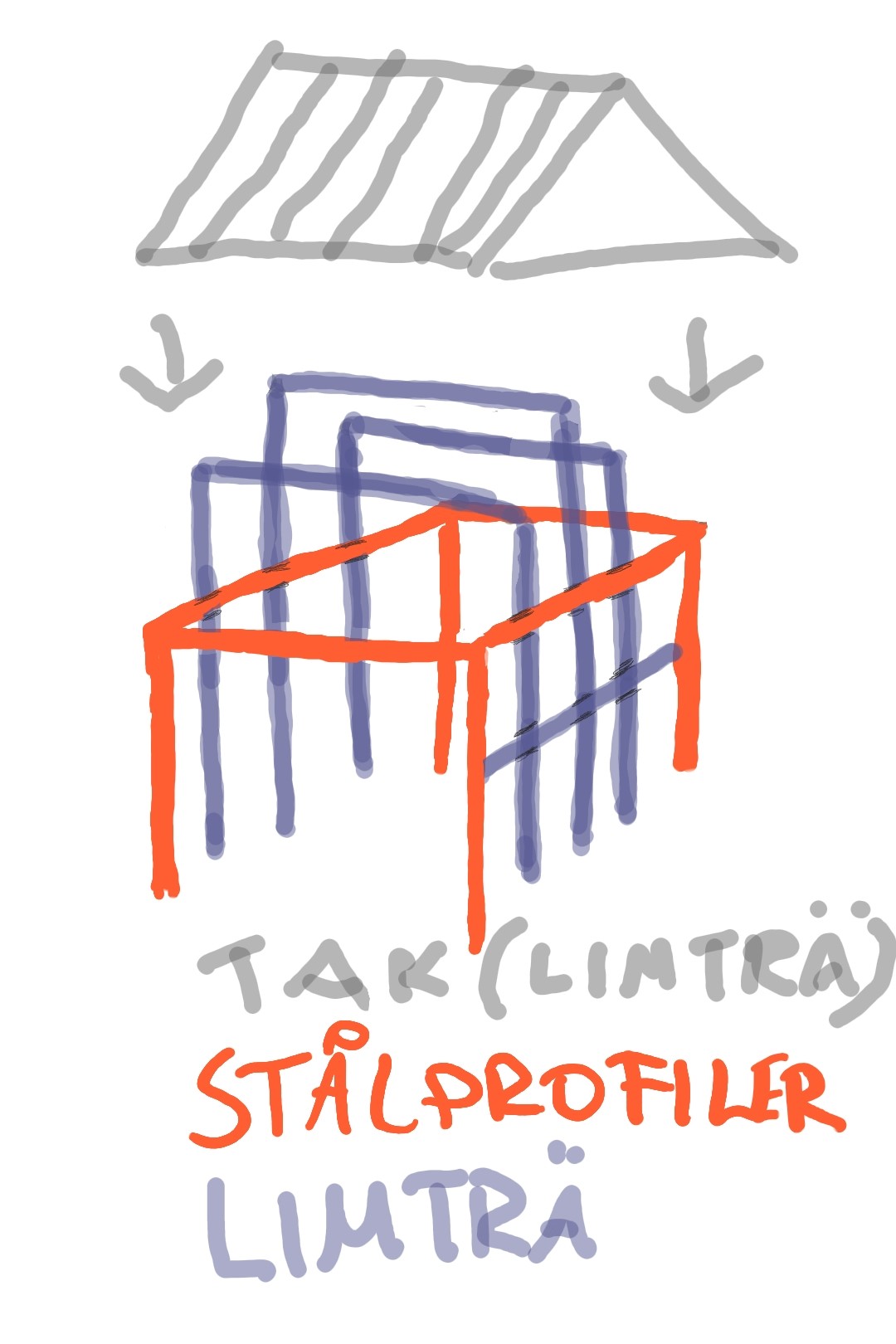
Is it structurally unwise and bad to mix steel beams into a glued laminated timber frame? In other words, mix steel profiles and glulam beams/columns in load-bearing exterior walls? The reason I'm asking is that wood and steel have different properties at different temperatures. (Though least parallel to the wood fibers.) The idea is that the glulam columns should support the 13-meter steel beams at three places on each steel beam. Is it possible? See drawn image below. Blue is glulam, red is steel profiles, gray is the roof with glulam beams. (More columns will be added to the model on, for example, the short sides, but I chose not to show them due to clutter.) Thanks in advance!
Ps. Only using glulam is not possible due to unfavorable horizontal loads and entirely open floor plan without stabilizing partition walls. This is not what the question is about either.
Is it structurally unwise and bad to mix steel beams into a glued laminated timber frame? In other words, mix steel profiles and glulam beams/columns in load-bearing exterior walls? The reason I'm asking is that wood and steel have different properties at different temperatures. (Though least parallel to the wood fibers.) The idea is that the glulam columns should support the 13-meter steel beams at three places on each steel beam. Is it possible? See drawn image below. Blue is glulam, red is steel profiles, gray is the roof with glulam beams. (More columns will be added to the model on, for example, the short sides, but I chose not to show them due to clutter.) Thanks in advance!
Ps. Only using glulam is not possible due to unfavorable horizontal loads and entirely open floor plan without stabilizing partition walls. This is not what the question is about either.
Member
· Västernorrland
· 12 073 posts
I'm not a constructor, but probably a bit more information is needed about the idea. There is no problem building with both, but there must be a thought behind everything.
Exactly.S Stefan1972 said:
 I could specify the entire build, but I think it would not be relevant, as I am only wondering if from a construction standpoint, it is possible to mix steel and wood in a load-bearing structure. Since steel and wood are directly against each other and together statically function as load-bearing elements within the construction. (For example, you shouldn't mix concrete and wood because of the moisture risk from freshly poured concrete.) Wood shrinks/expands with varying temperatures and humidity. Steel with varying temperatures, but under completely different conditions. I think the movements are marginal, so it should still be possible to combine these two materials? Does anyone know?
 Yes, you can absolutely mix them, and it is quite common. Especially when it comes to constructions where you want larger spans open floor plans.J jossan1986 said:Exactly.
The risks with wood and concrete seem like you're misunderstanding/mixing them up a bit. Wooden structures on a concrete slab are actually one of the most common constructions we have. Of course, you should protect wood from direct contact with moist concrete. This can be done easily with something like a sill gasket. Nowadays, new concrete foundations are generally always insulated and have capillary-breaking layers underneath. So the "risk" of moisture is really only during the construction phase, then the structure is considered dry. It was worse in the past with uninsulated slabs where the concrete continued to absorb moisture from the ground indefinitely.
Member
· Västernorrland
· 12 073 posts
Yes, but the vague part is what you mean by the glulam should brace the metal construction... It should be simpler to dimension/calculate the sides/walls/roof in such a way that they cooperate correctly. That self-supporting trusses just stand on normal load-bearing supports. You can't have a poorly constructed roof that stands on walls that have to be reinforced for that reason.J jossan1986 said:Yes, exactly.
Statically, the entire framework can handle vertical loads in the form of dead loads, live loads, snow, etc., without a problem. In an all-wooden design, that is. From the roof down to the foundation. It's when we get to the horizontal wind loads that the construction becomes too skewed. Of course, we can size it with large arched glulam beams or custom-made columns, but that will likely be costly compared to a few steel profiles. That's why we've opted for steel to stabilize against the wind. Wind braces of wood or steel could also work, but we don't want them as they aesthetically ruin part of the view.S Stefan1972 said:yes, but the vague part is what you mean by the glulam having to brace the metal construction....It should be easier to size/calculate the sides/walls/roof in a way that they work together correctly. Self-supporting trusses just rest on normal bearing supports. You can't have a poorly designed roof resting on walls that need to be reinforced for that reason.

It is perfectly fine to mix structural elements of steel and wood in the same construction. It is more or less standard in larger buildings than villas. For example, ridge beams made of steel together with roof beams made of wood are very common to keep the height of the ridge beam down.
Click here to reply