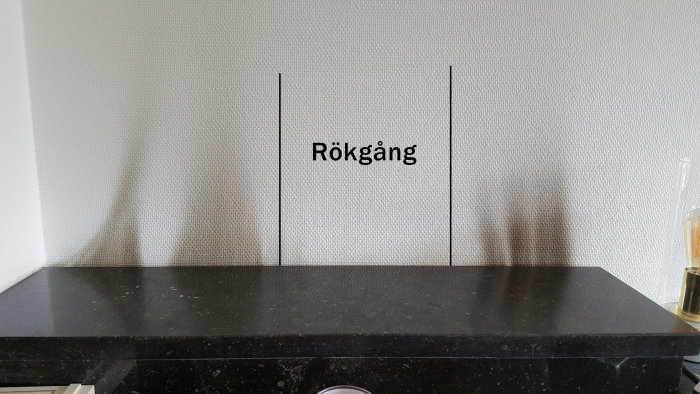
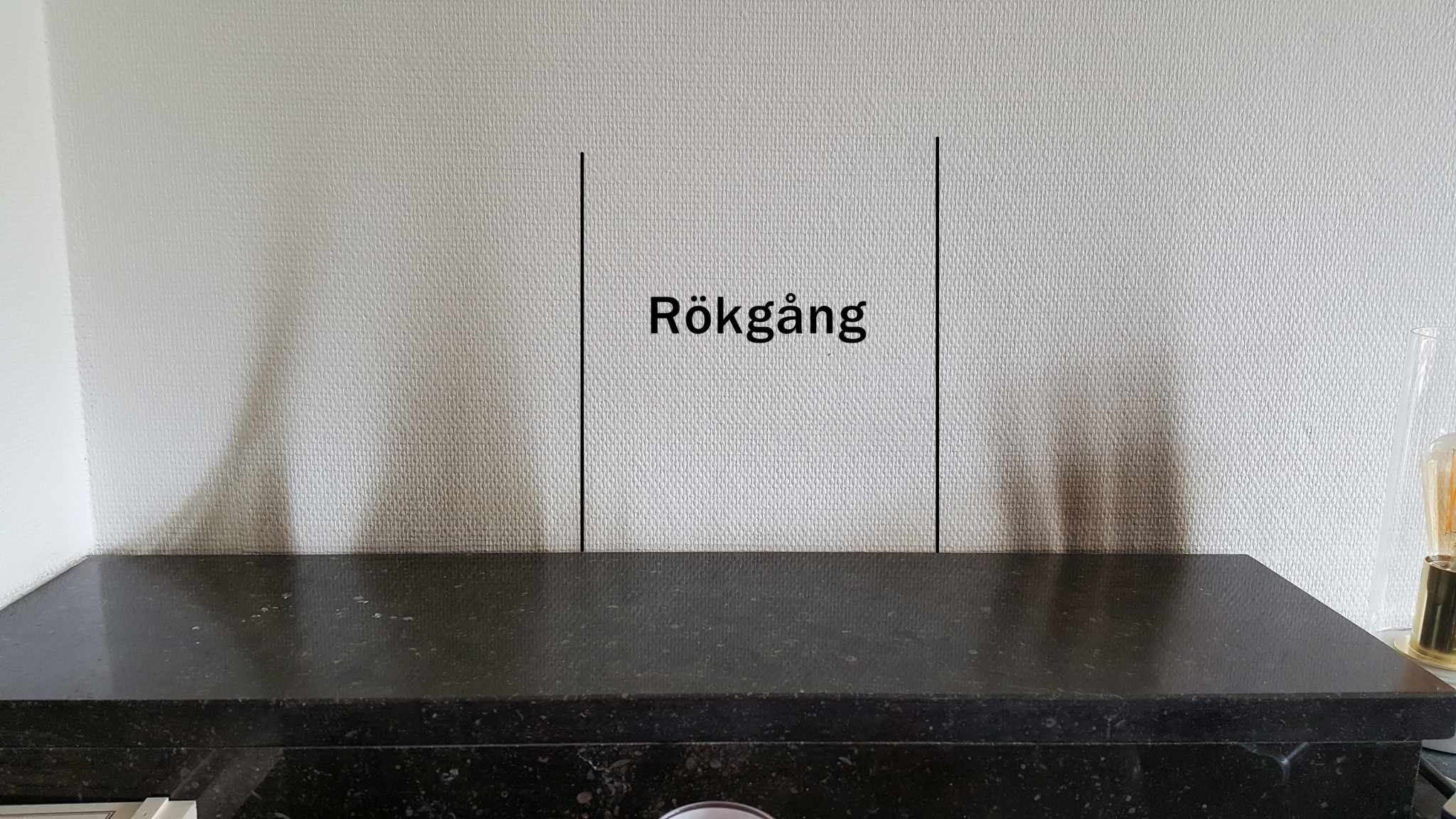
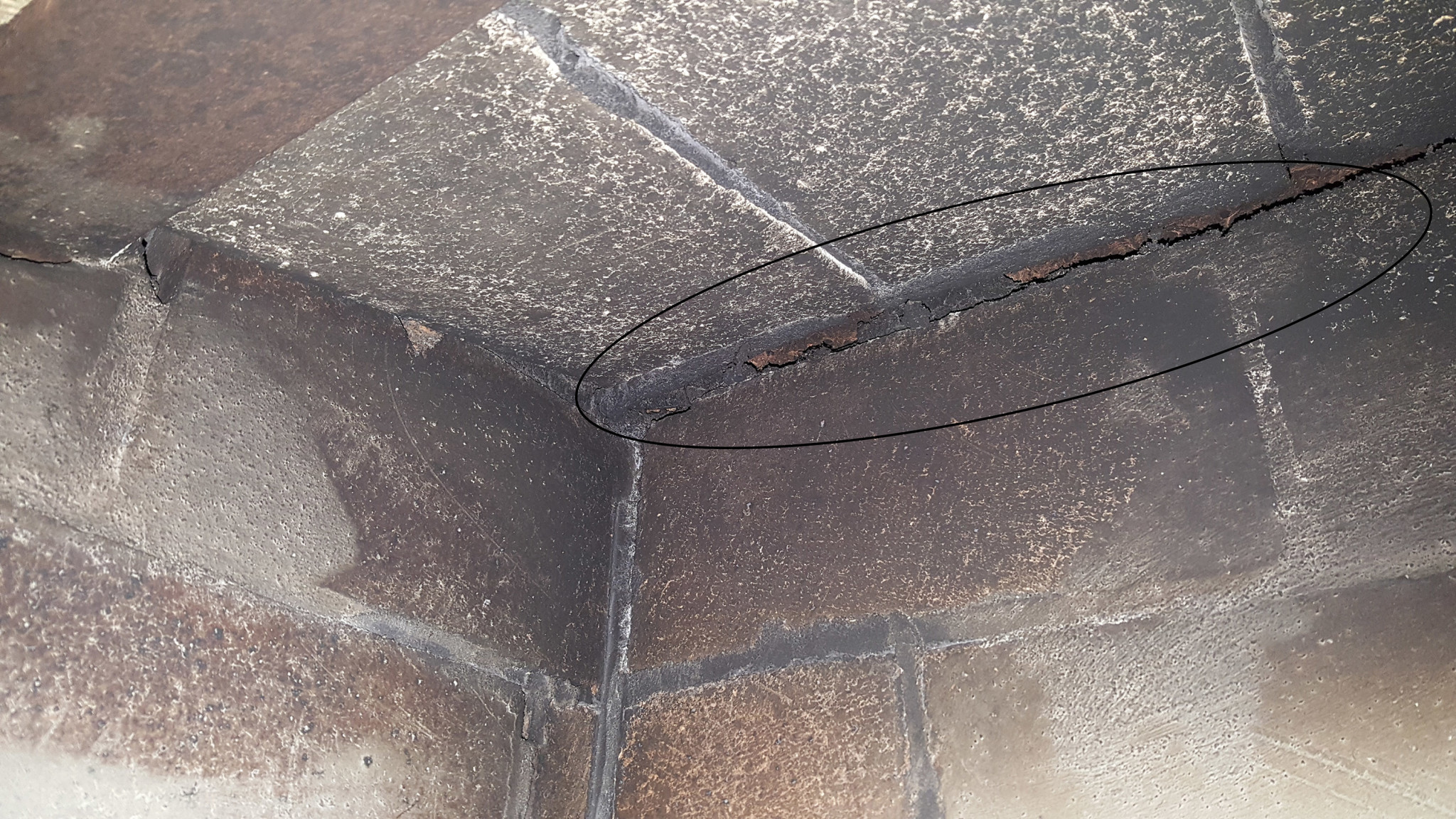
I pondered for a while on where to actually place this question, but since it primarily concerns brick joints, I'll try here. We have a brick fireplace in our apartment, built in the mid-30s. According to information, the flues should have been swept and inspected without remarks just over a year ago, but noticed during the last fire in winter that it leaks smoke "backwards" into the apartment at the top sides of the flue:
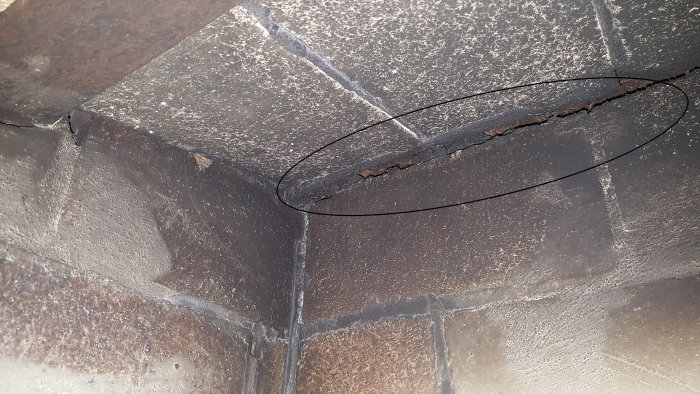
Looking inside the fireplace, you can see that the upper rear joint (which constitutes the transition between the fireplace's "ceiling" and rear wall) is quite eroded:
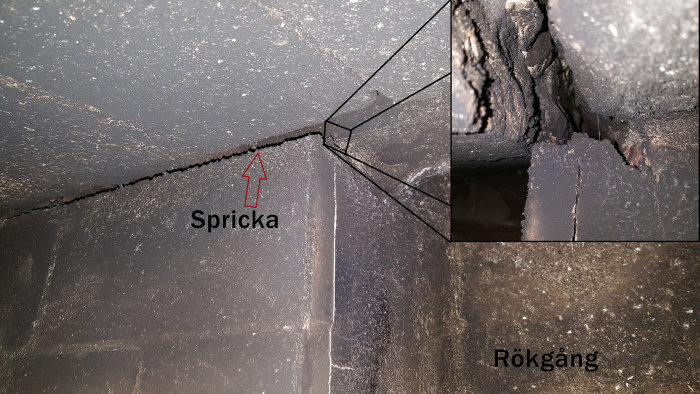
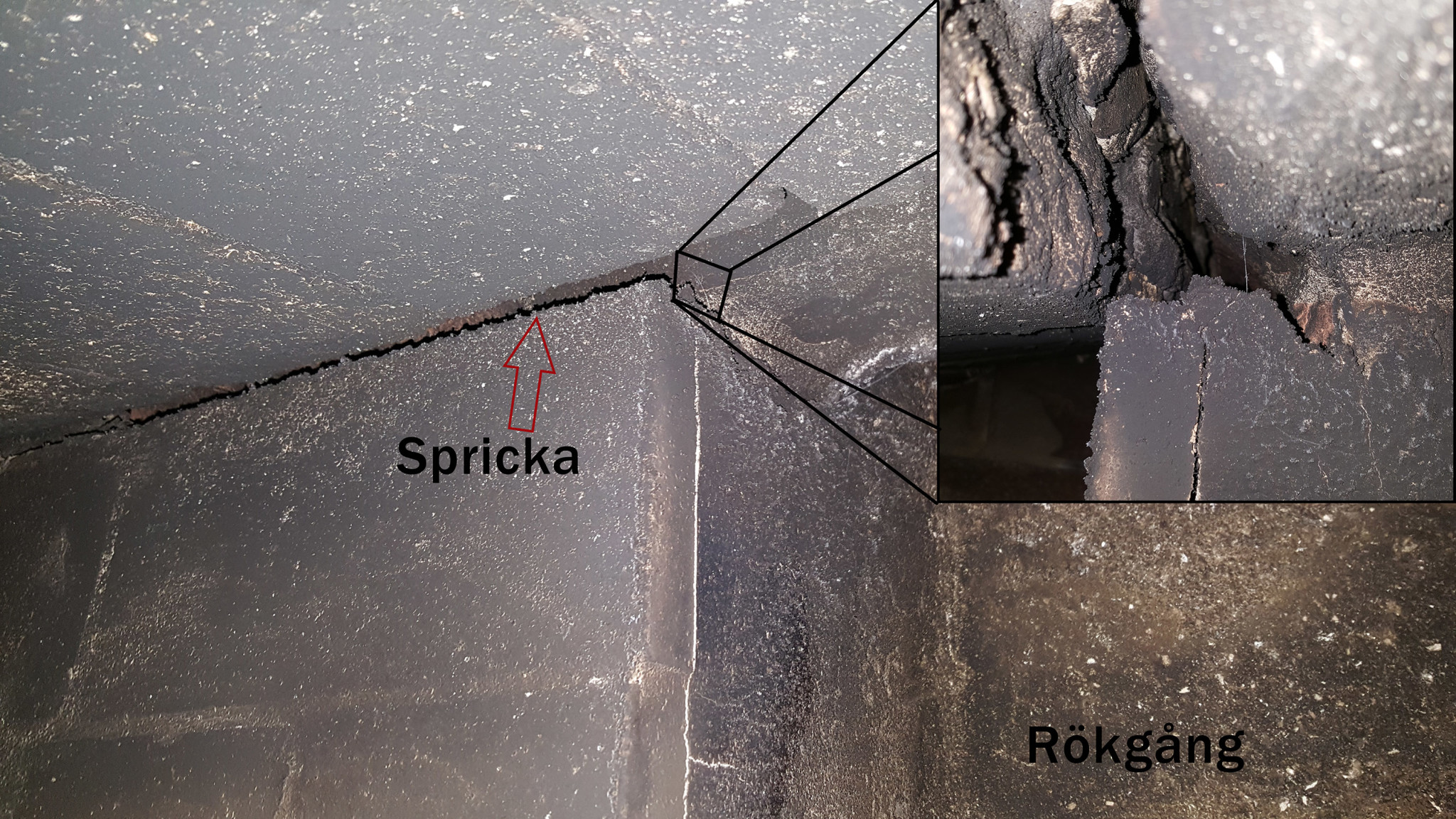
Seen from the flue, there's a fairly wide cracking where the joint is missing all the way to the edge of the fireplace. The flue itself, however, looks completely fine as far as I can see from here.
So - after this pictorial odyssey - how do you repair this in the best way? I would like to take the chance to do this now during the summer so that it's possible to fire when autumn comes. My spontaneous thought is to clean the crack from soot and loose material as well as possible with a small steel brush in pipe cleaner form and then press in as much fire-resistant joint compound as possible all the way around. I have seen that this is available in cartridges, which feels like a convenient solution to get it deep in. How does this sound to someone with a bit of perspective on things? Objections, additions, ideas?
Yes, that was my next question - which professional category such work falls under. Then I'll do a quick search for chimney masons. Does anyone happen to have tips on a good one in the central/southwestern Skåne?
Addition: Of course, I will also talk to our BRF, if nothing else considering that similar stoves in other apartments might be at risk of experiencing similar issues. When it comes to electrical and water lines, the BRF is responsible for them if they serve more than one apartment, and based on the same reasoning, I assume I am responsible for my own fireplace and the BRF for the smoke flues? Or is it different in this case considering fire safety?
Whether you do it yourself or not is more a matter of interest. If you're handy, it's not difficult, but you need to be thorough and acquire knowledge. You don't take chances with fireplaces. You also don’t want a craftsman who takes chances, so it’s advisable to choose a "kakelugnsmakare".
Maintenance of fireplaces is not required to be reported to the municipality, so you can just go ahead. For the sake of self-preservation, you can bring home a chimney sweep to conduct an inspection after the repair. It might be beneficial if you hire a craftsman whose work needs to be checked by an independent party.
How it works with the association versus the condominium owner regarding fireplaces is something someone else will have to describe.
Practically, what needs to be done is to dismantle the open fireplace from the top. From the pictures, it seems there is a decorative marble slab that should first be lifted off (without cracking it!). Underneath lies (fire-resistant?) brick resting on the back wall and an iron. After dismantling the top, it is rebuilt very carefully with completely filled joints. Suitable mortar is clay mortar (1 part kakelugnslera + 3 parts sand). The job is messy.
Handy or not, a little more is required when it comes to chimneys, why has it cracked? Something has settled, it must be checked or did it explode inside, then it can crack.
There hasn't been any blasting during my time in the apartment, and I believe previous owners might have also struggled to achieve such temperatures considering the stove's/apartment's somewhat poor design in terms of draft. However, I have looked closer at other parts of the stove, and along the outer edges where the stove meets the background, there are also cracks (though significantly smaller). It doesn't seem unlikely that the flooring has settled a bit, especially considering that the floors in the rest of the apartment are quite wavy as well...
In summary, I need to find the nearest tile stove maker/chimney mason I can to review the conditions before we do anything. If anyone thinks of anything we should particularly investigate, I would gratefully accept any tips; otherwise, thank you for all the input so far!
swept and inspected means nothing if they didn't pressure test at the same time.
Such damages shouldn't be fixed in the simplest possible way, better to rebuild the damaged part completely.
Start by buying a smoke bomb, not sure exactly where, try googling it, then go up on the roof and seal your chimney, light the bomb, and back into the fireplace with the doors, wait; if there are cracks, you will not miss seeing the smoke, that's how the chimney sweep checks for cracks, when you've seen it, go up on the roof again and remove the seal, the smoke can smell a bit bad so it vents out via the chimney.
It probably depends on how cracked and where the leak is in terms of character. I wouldn't recommend anyone to seal the chimney stack themselves; it's a craft that not many can handle. However, you can use a smoke bomb to see how serious the damage is, to ascertain the facts.
But now, as I understand it, it is not the chimney itself that is leaking but the fireplace, which is also already visible on the wall. More tests are probably unnecessary.
Just as Stefan1972 says, the soot streaks on the wall leave no questions - it's leaking. As I've tried to illustrate in the image in the first post, the soot streaks are only seen on either side of the flue, which in turn looks fine (so fine that it feels like it has been renovated at some point since the house was built). Everything indicates that the leak is coming from the cracked joint at the top of the stove. So the question is really just whether fire-resistant sealant in this joint constitutes a fire-safe solution, or if more should be done/examined?
Fireproof sealant is not a suitable solution. Without re-mortaring, it is unlikely that the entire joint will be filled, and naturally, this increases the risk of future leakage the day the rigid fireproof sealant also gaps. And it will likely gap as soon as the joint moves due to heating.
1. I believe that fireproof sealant will do the job, not forever but for the time being. Unless setting movements occur.
2. If the chimney is functional, it's only a problem during the startup phase of burning, which IS BAD ENOUGH (i.e., you can't ignore this and continue burning!) but worth keeping in mind.
3. The fireproof sealant is fireproof, it should obviously be applied to a cleaned surface on the inside, pressed into the gaps, and then applied generously.
4. It IS sensible to regularly check the condition of the stove with smoke sticks because the only sustainable long-term solution is to build an entirely new stove.
5. The cause of the white vertical crack in the last picture should be investigated, if it's settling, it may suffice to seal it for the time being. But if there are problems due to other reasons, this must be addressed!
6. Inclined to agree with a mix of previous writers, it is possible to DIY this BUT if you are not knowledgeable, you should get qualified help. Setting the house on fire is not something you should take a chance with.
All masonry stoves or tiled stoves move over time and eventually need to be rebuilt. This is unavoidable, and it's hardly a solution to cover the cracks with something temporary. Sure, it might seal it for the moment, but the problem remains. Otherwise, it would be like covering rust damage on a car with cardboard and spraying body on it.
Click here to reply
Vi vill skicka notiser för ämnen du bevakar och händelser som berör dig.