
14,098 views ·
6 replies
14k views
6 replies
Manufacture wainscoting/wall panel
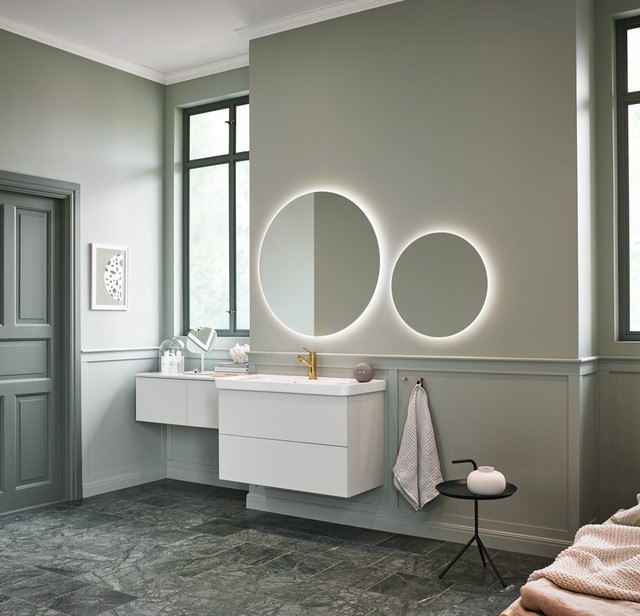

Is there any panel at all really?
I think it looks like they've just put up some decorative "frames" to break up the monotonous light gray wall surfaces.
That is, some moldings that don't frame anything other than parts of the underlying wall surface.
I think it looks like they've just put up some decorative "frames" to break up the monotonous light gray wall surfaces.
That is, some moldings that don't frame anything other than parts of the underlying wall surface.
What you're describing is exactly what a dado rail is. How the infill between frame/molding is executed varies virtually infinitely. A simpler variant is, as in the picture, painted wall surfaces.KnockOnWood said:
A dado rail extends from the floor up to the windowsill.
A wainscoting extends from floor to ceiling. Often very ornate.
A base panel from the floor halfway up to the windowsill.
The "modern" dado rail that became popular in the late 1800s extended to just chest height.


It is possible to call frames and moldings wainscoting. It's a sliding scale from painted wallpaper to simple raised panels to milled mirrors in solid wood. No one can say where the boundary is in all languages and dialects. The recipient will understand what you mean if you call it wainscoting. Thus, the communication efficiency requirement is satisfied and everything flows 
Regarding TS's question. Some opinions.
The top molding and baseboard are subject to wear and therefore MDF is an unsuitable material for these. Solid wood is recommended.
If the panel is to be painted with simple paint, like regular wall paint with a roller, then the rest can be made in MDF. The grain from the roller will hide most of it. If the panel is to be painted, oak is unsuitable. Pine is better. Especially in humid rooms, oak can form acids that will cause black spots. The acids eat up the galvanization on the nails. When the galvanization gives out, the nail starts to rust and the rust eats up the oak. Maybe not a big risk in a well-functioning bathroom. But for those dealing with old ships or exterior joinery (like entrance areas), it's a constant problem.
In terms of work, there's a downside to MDF. If you want to profile the edges, MDF wears tools very hard. Solid wood is much gentler. Pine board from Jula is sufficient. The wood grain will shine through a bit, so with solid wood, the result is more "alive."
The advantage of MDF is that it is a bit more "dead." Less risk of movements that cause cracks over time. It has a slightly lower price. If you want to save a few hundred crowns and avoid some repairs, those are the arguments.
Without level difference, the panel looks "cheap." Desired results can be achieved with an extra layer of plasterboard. Plyfa can be considered if you want a bit of wood texture. An aspect that can also be important is fire safety. In public environments, like restaurants, consideration is given to the proportion of surfaces that are flammable. Therefore, painted panels are often made of plasterboard. Sometimes grain-painted to look like paneling.
Best regards, Findus
Regarding TS's question. Some opinions.
The top molding and baseboard are subject to wear and therefore MDF is an unsuitable material for these. Solid wood is recommended.
If the panel is to be painted with simple paint, like regular wall paint with a roller, then the rest can be made in MDF. The grain from the roller will hide most of it. If the panel is to be painted, oak is unsuitable. Pine is better. Especially in humid rooms, oak can form acids that will cause black spots. The acids eat up the galvanization on the nails. When the galvanization gives out, the nail starts to rust and the rust eats up the oak. Maybe not a big risk in a well-functioning bathroom. But for those dealing with old ships or exterior joinery (like entrance areas), it's a constant problem.
In terms of work, there's a downside to MDF. If you want to profile the edges, MDF wears tools very hard. Solid wood is much gentler. Pine board from Jula is sufficient. The wood grain will shine through a bit, so with solid wood, the result is more "alive."
The advantage of MDF is that it is a bit more "dead." Less risk of movements that cause cracks over time. It has a slightly lower price. If you want to save a few hundred crowns and avoid some repairs, those are the arguments.
Without level difference, the panel looks "cheap." Desired results can be achieved with an extra layer of plasterboard. Plyfa can be considered if you want a bit of wood texture. An aspect that can also be important is fire safety. In public environments, like restaurants, consideration is given to the proportion of surfaces that are flammable. Therefore, painted panels are often made of plasterboard. Sometimes grain-painted to look like paneling.
Best regards, Findus
Click here to reply