
Hello,
I'm completely new here and would like to discuss a question. I have a small project where I would like to move/remove a number of walls and build a new wall. My question is whether the walls that are not perpendicular to the roof trusses might be load-bearing in this case? There is a concrete slab between the basement and the first floor.
I apologize for my poor drawings, but the areas marked in red are what I want to demolish, and the blue line represents a new internal wall that I plan to build with 45x70 cc 60 with OSB + gypsum? What do you think?
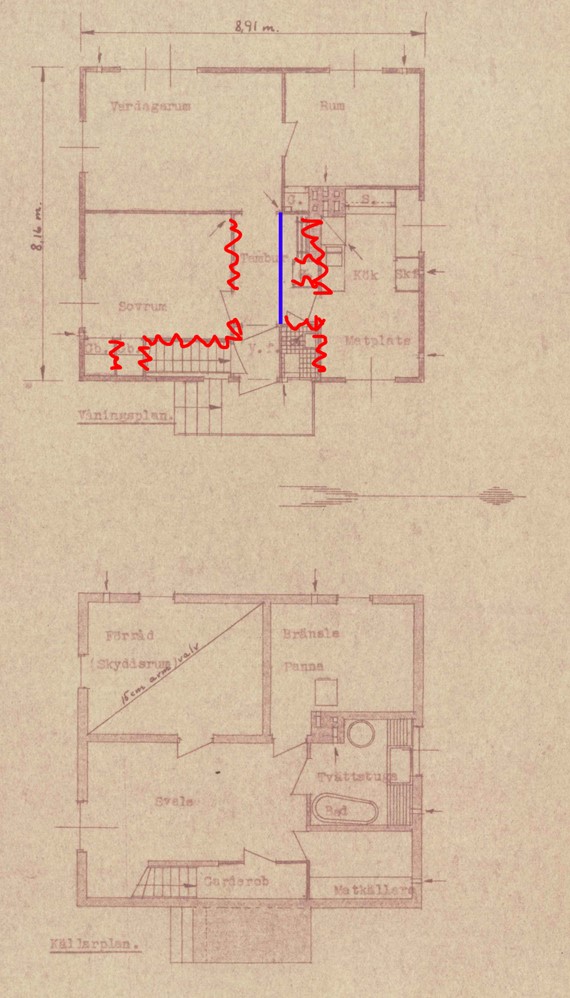
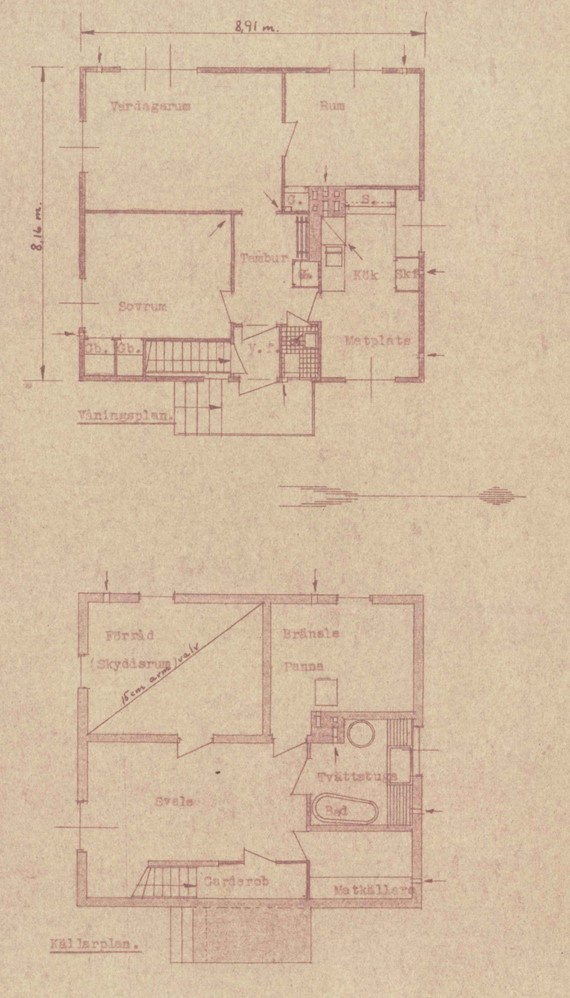
Original:
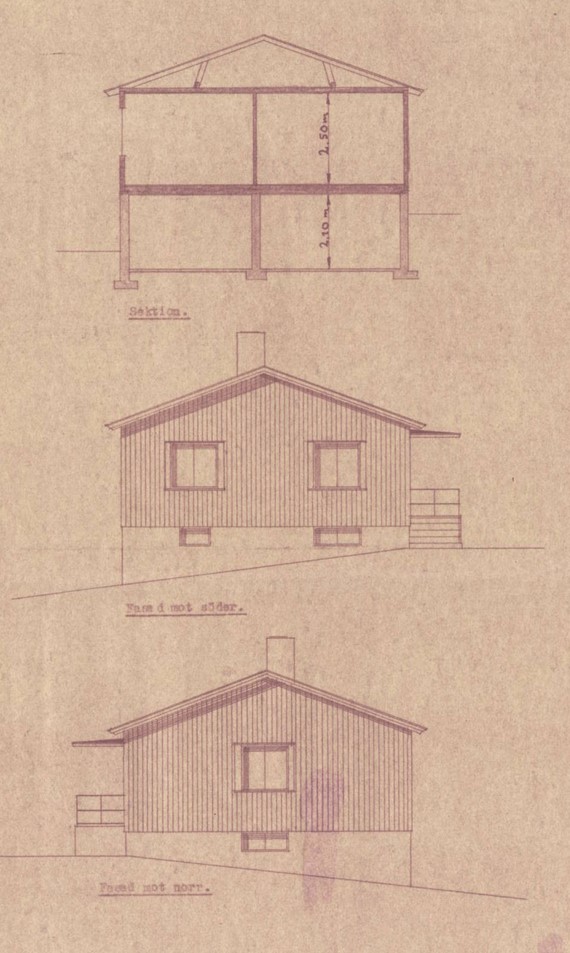
Section drawing:
Thanks a lot for any comments!
I'm completely new here and would like to discuss a question. I have a small project where I would like to move/remove a number of walls and build a new wall. My question is whether the walls that are not perpendicular to the roof trusses might be load-bearing in this case? There is a concrete slab between the basement and the first floor.
I apologize for my poor drawings, but the areas marked in red are what I want to demolish, and the blue line represents a new internal wall that I plan to build with 45x70 cc 60 with OSB + gypsum? What do you think?
Original:
Section drawing:
Thanks a lot for any comments!

The red walls are likely not load-bearing. However, this does not automatically mean you can remove them without issues. It depends on the construction method. When was the house built?

The house was built in 1945.
The staircase down to the basement is completely self-supporting/hanging free in the concrete floor slab's opening with two separate wooden stringers. So I had hoped it would be possible to open it up there.
The walls are built with tongue and groove wooden planks 45x145 but that's exactly how all the walls are built. They sure built things properly in the past
The staircase down to the basement is completely self-supporting/hanging free in the concrete floor slab's opening with two separate wooden stringers. So I had hoped it would be possible to open it up there.
The walls are built with tongue and groove wooden planks 45x145 but that's exactly how all the walls are built. They sure built things properly in the past
Yes, as I suspected, it was a plank house. The dimension is probably more like 50x150; back then, an inch was an inch! A characteristic of plank houses is that all walls are somewhat load-bearing. For example, one might have skipped putting a full-height floor beam above an interior wall. Then you've marked in red a wall section that connects to the chimney. That seems a bit doubtful. Overall, you should be cautious around chimneys because there are reinforcements that are not visible on the drawings. So, you need to proceed and refine your investigation before you can be sure that the desired demolitions can be carried out.
Thanks for the comments justusandersson!
Yes, exactly, it's a wooden house. This is how it looks in the hallway towards the entrance door. There, in the ceiling, you can see how the wall was attached to the ceiling.
That is, the partition wall between the hallway and the current kitchen, which I have opened up about 1.2 meters to have a larger opening there. The question now is if the walls around the current WC can be removed as well.

Yes, exactly, it's a wooden house. This is how it looks in the hallway towards the entrance door. There, in the ceiling, you can see how the wall was attached to the ceiling.
That is, the partition wall between the hallway and the current kitchen, which I have opened up about 1.2 meters to have a larger opening there. The question now is if the walls around the current WC can be removed as well.

It's almost "feeling" that's important: hand-sawing the boards. Is the saw pinching? Then the wall is bearing.
According to the drawing, you should have a heart wall, and you don't, but the blue should be able to replace the red ones, except for the chimney which you probably need to keep, I suspect that the joists on floor 2 might be hung on this wall.
According to the drawing, you should have a heart wall, and you don't, but the blue should be able to replace the red ones, except for the chimney which you probably need to keep, I suspect that the joists on floor 2 might be hung on this wall.
I perceived it as going in the same direction as the blue wall?
Edit: checked where the staircase is, you're right, and then none of the red ones (except the wall) should be a problem at all, but as noted they can still be "a bit load-bearing," which you notice if you cut with a regular handsaw.
The staircase is to the basement and not to the upper floor (which doesn’t exist), so the wall against the staircase on the floor level can't have to do with the stringers.
Edit: checked where the staircase is, you're right, and then none of the red ones (except the wall) should be a problem at all, but as noted they can still be "a bit load-bearing," which you notice if you cut with a regular handsaw.
The staircase is to the basement and not to the upper floor (which doesn’t exist), so the wall against the staircase on the floor level can't have to do with the stringers.
If the attic floor lacks flooring, it might be easier to examine the conditions from there. Especially how it looks around the chimney. I'm not a proponent of the method to cut first and check later.
Click here to reply
Similar threads
-
Load-bearing interior walls in a villa from 1936?
Building Materials and Construction Technology -
Restore old opening in load-bearing wall
Building Physics -
Är denna vägg bärande mellan kök och vardagsrum?
Kök -
Bärande innerväggar,eller
Attefallshus, friggebod, garage & andra småhus -
This wall is not load-bearing, is it?
Building Materials and Construction Technology