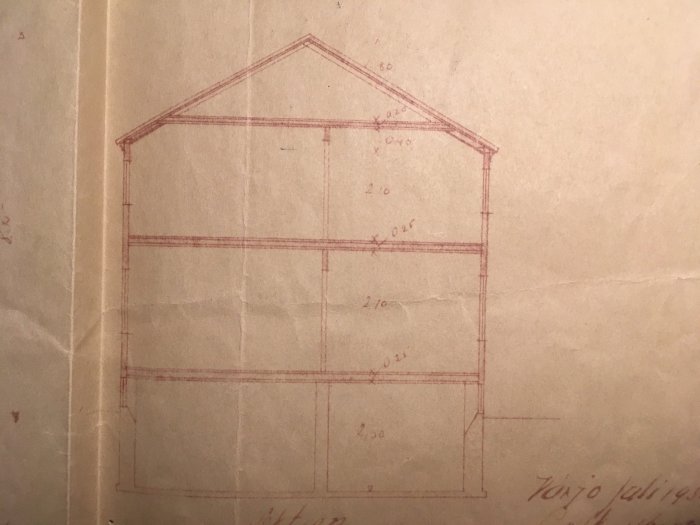
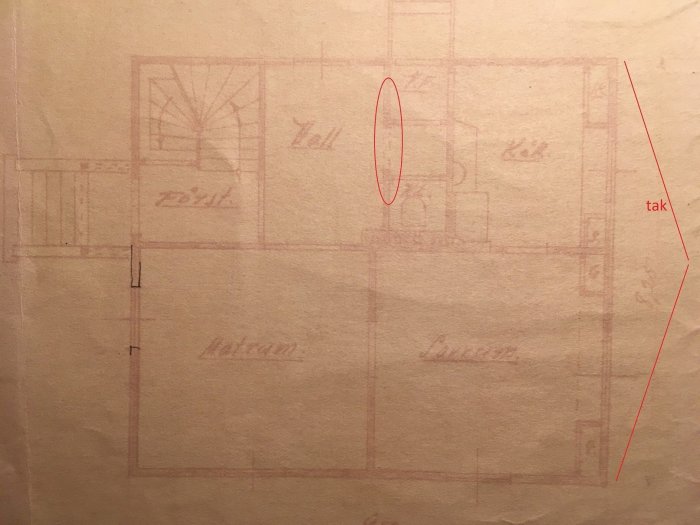
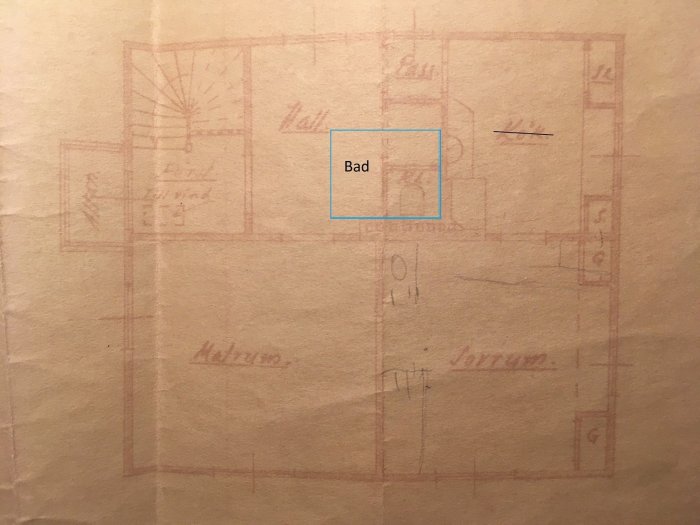
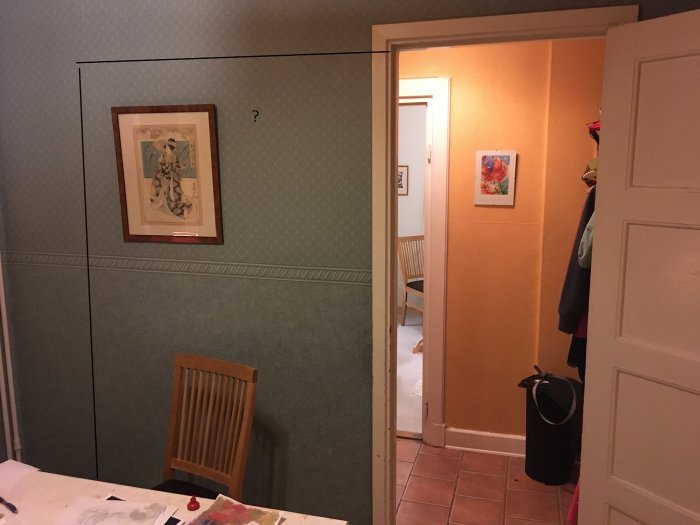
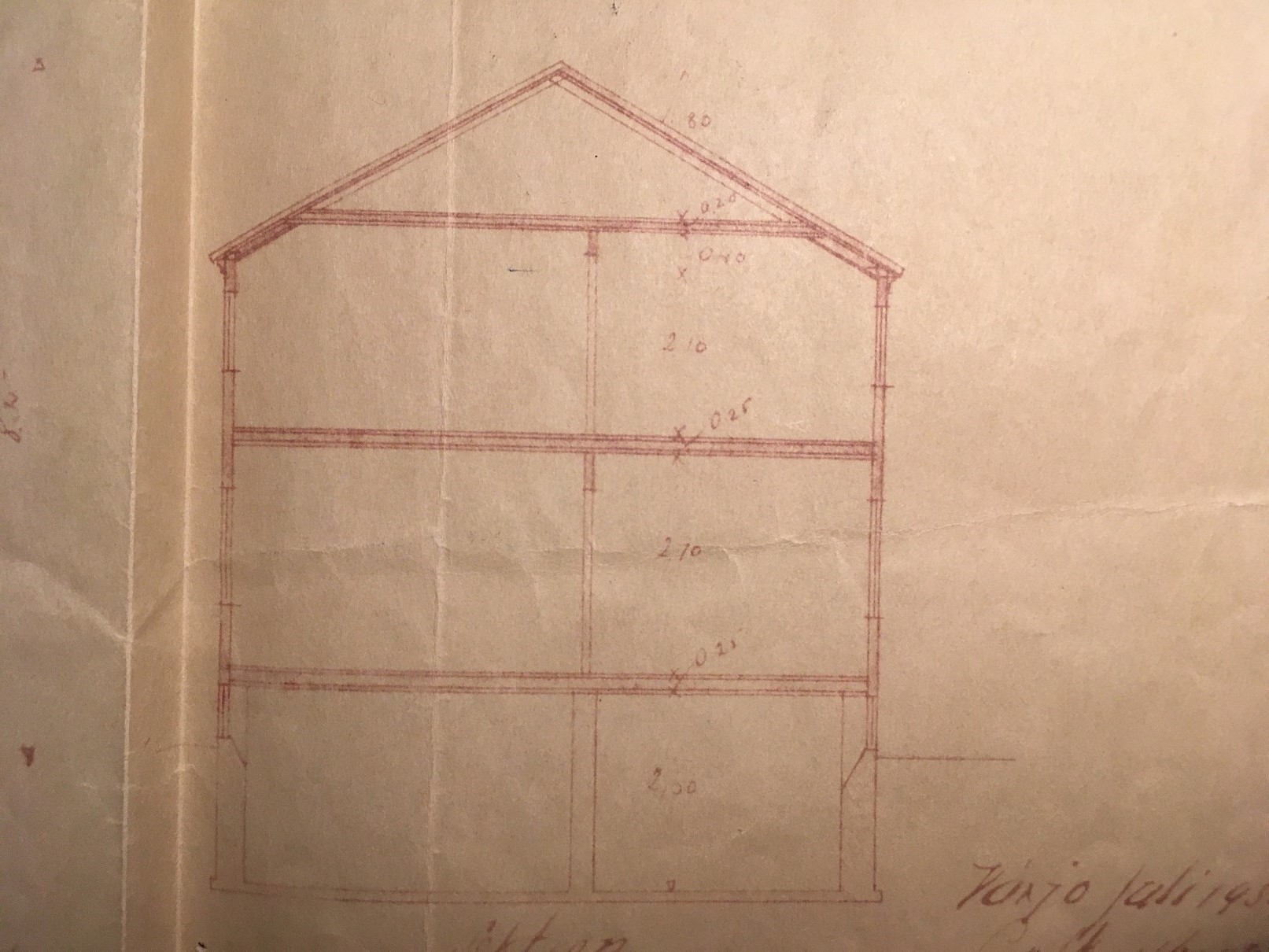
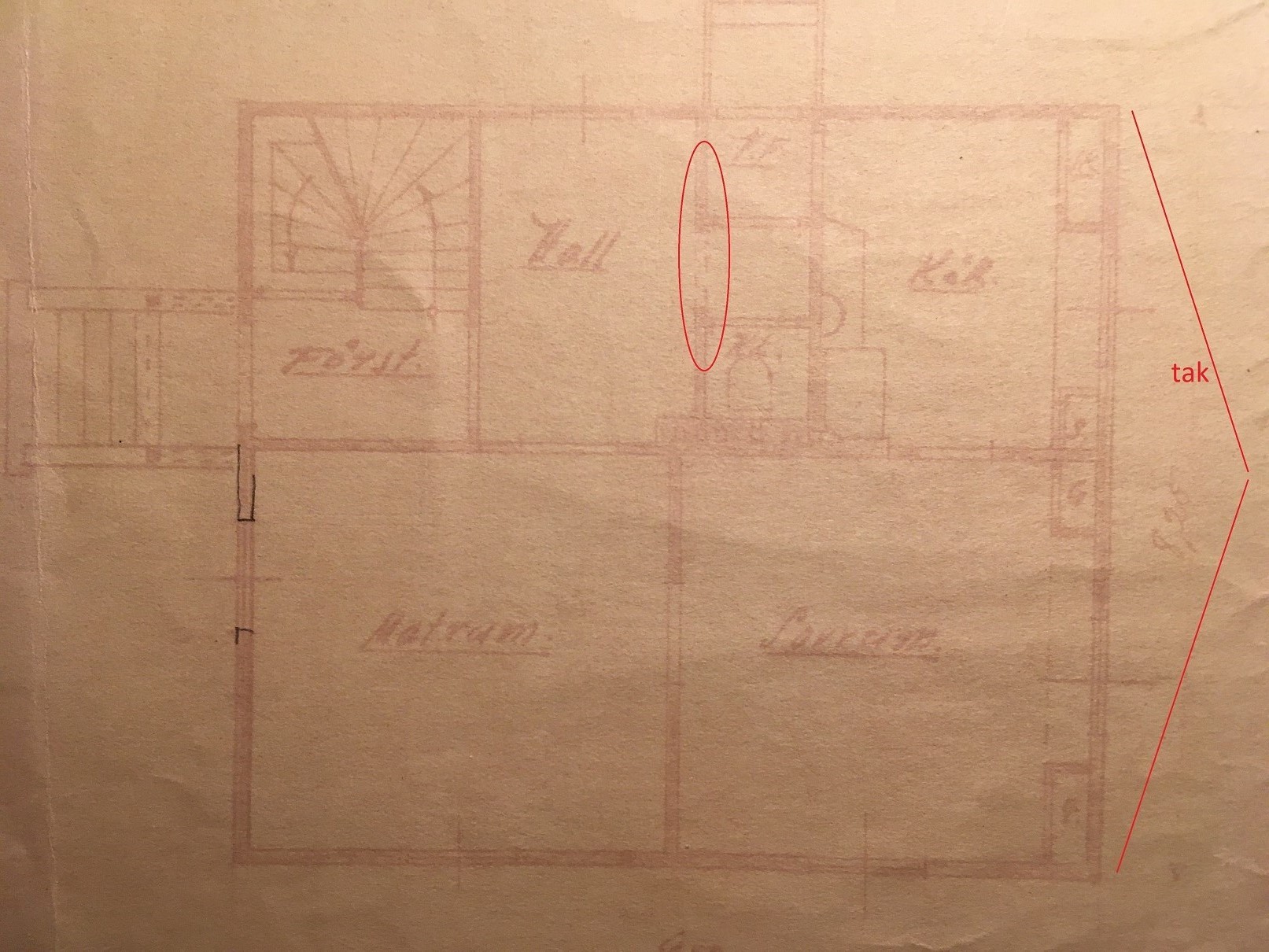
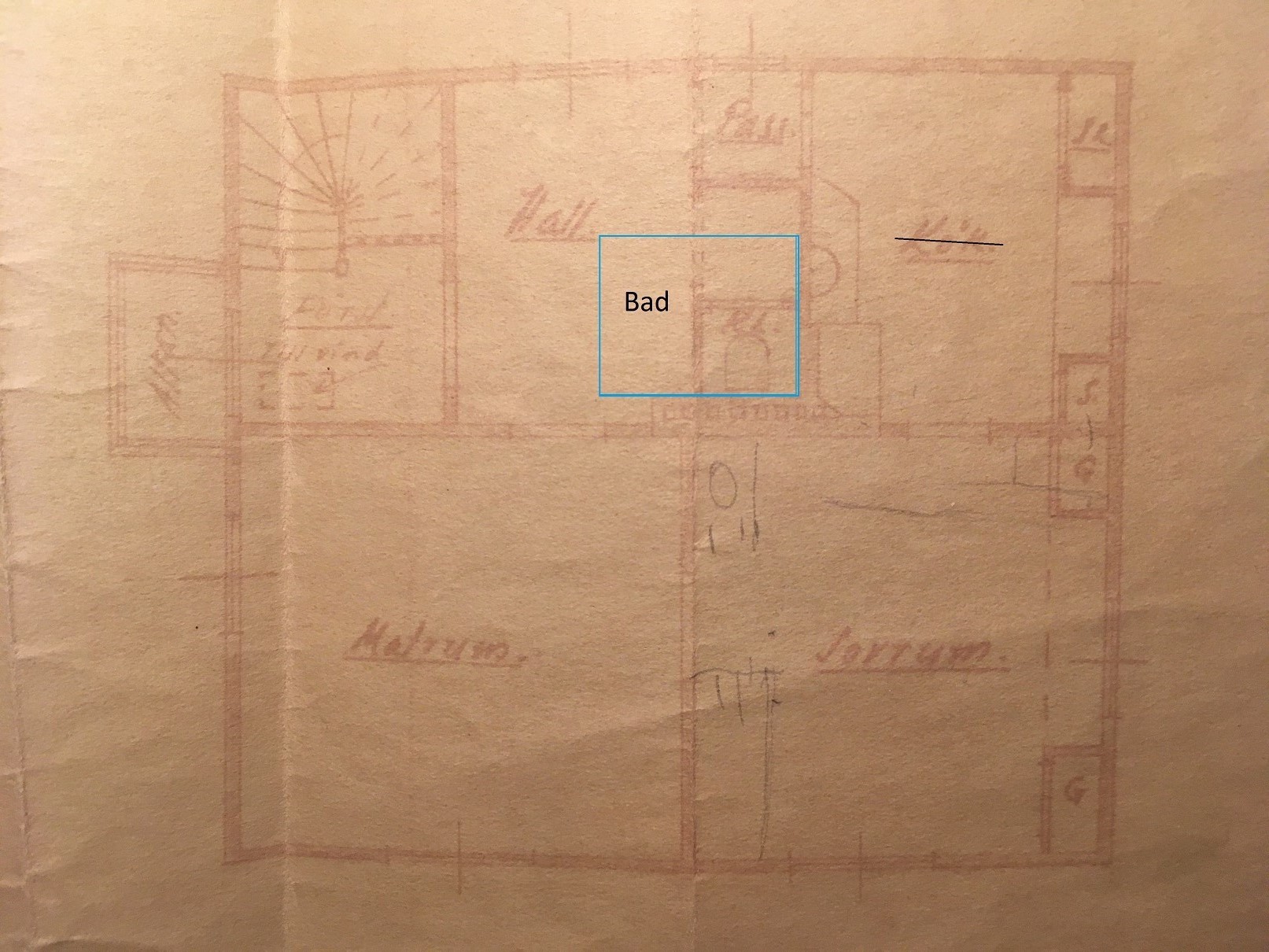
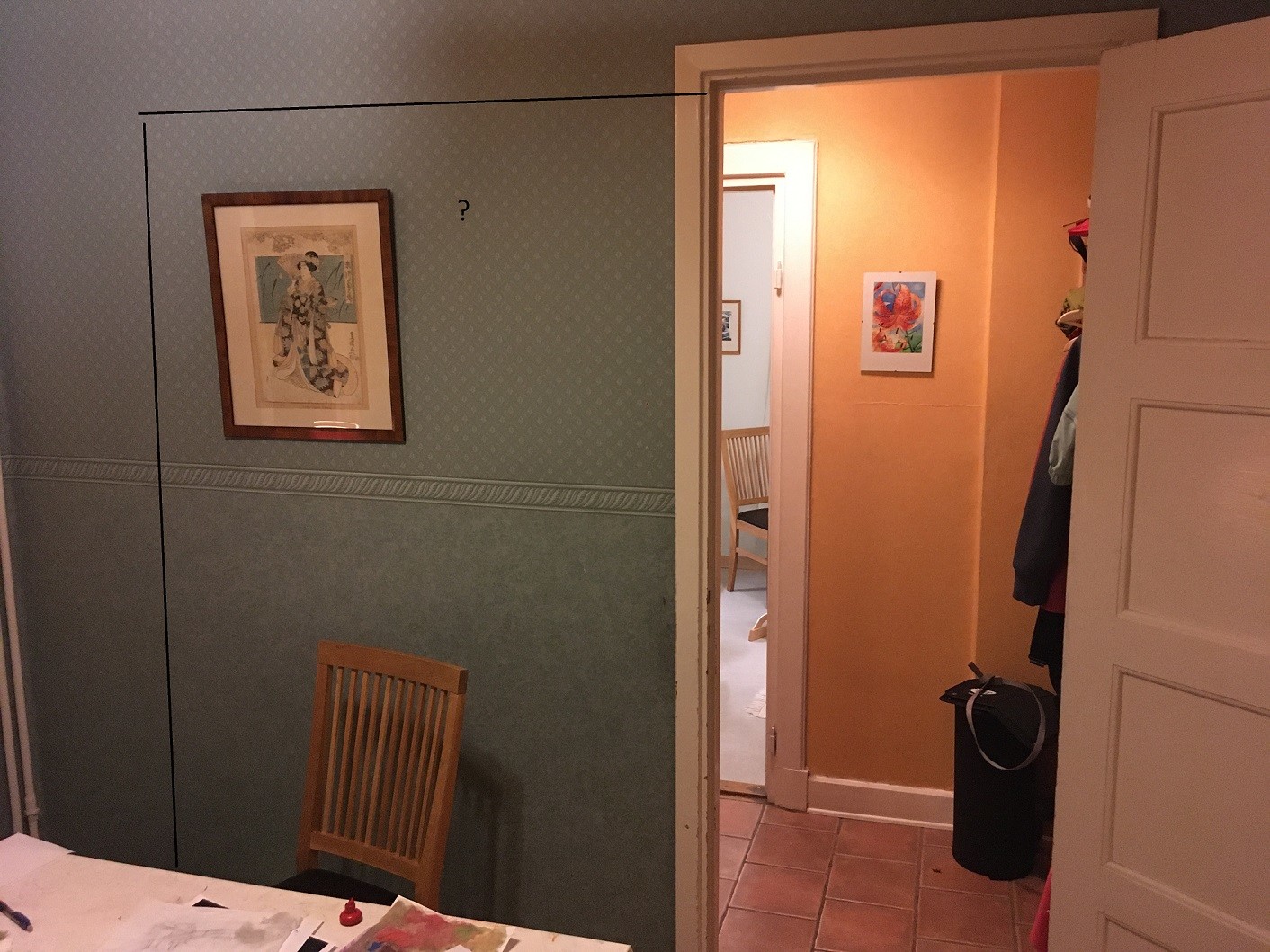
To create a more open floor plan, I am considering removing or at least significantly opening up a wall between the hallway and the dining room.
However, I am not sure if it is load-bearing or not. Perhaps someone in this eminent forum can provide an opinion? And maybe even give me an indication of what dimension a potential beam should be?
The house was built in 1932 in Småland, originally as a multi-family house, and over the years has been modified here and there. For example, the bathrooms have been added, and the kitchen on the ground floor has been slightly expanded. So now it's my turn to contribute to the alteration/development.
The house has a plank frame (plank = 2-3 inches thick and 6-8 inches wide tongued and grooved standing "boards"). With plank frames, you can never be completely sure which walls are load-bearing. A good principle is to assume that all walls have a greater or lesser load-bearing function. The wall between the dining room and the hall has the character of a central wall and is certainly load-bearing. The existing opening is already supported by a horizontal plank over the opening. To widen the opening, you need to remove the existing support and replace it with a stronger beam, probably made of glulam. The size of such a beam depends partly on its span (length) and the loads it needs to support, but also on the need for dimensional adaptation to the existing wall. Since the house was built in 1932, the existing wall probably consists of 3-inch planks plus plaster on reed (wattle) on both sides. Total thickness about 105 mm, which means that 78 or 90 mm thick glulam can be used.
Thank you so much for the detailed answer, Justus! Then it will have to be a beam. I guess the next step for us is to decide how wide we want the opening and then tear a little superficially in the wall to more closely examine how it is constructed, but it's probably best for family peace to wait until after Christmas with that.
I recently finished renovating the kitchen. It took about a year. So I have no illusions that the wall project will go quickly. It's best to think carefully before the crowbar comes out, even if I'm a little eager.
If we're considering a span of 240cm, is it possible to estimate what dimension the beam should have?
I have recently finished renovating the kitchen. It took about a year. So I make no illusions that the wall project will go quickly. So it's best to think carefully before the crowbar comes out, even if I am a bit eager.
If we consider a span of 240cm, is it possible to estimate what dimension the beam should have?
We have a house built in 1926 and faced a similar problem.
However, we started by tearing down to get some overview of how the beam construction should be. But when we opened it turned out that there was an opening there before and they had just used small pieces of 3-inch plank to cover the hole.
So when we removed the chipboard, we could just remove the planks and the opening was ready.
As I wrote earlier, plank houses are a bit tricky. I can say straight away that the calculation tools available online are not useful here. They are designed for houses with frame structures. 240 cm is not that long. I guess you end up in the range of 90x225 - 90x270 mm, but that's just a guess, albeit a fairly qualified one.
As I mentioned earlier, plank houses are a bit tricky. I can say right away that the calculation tools available online are not useful here. They are designed for houses with frame structures. 240 cm is not that long. I guess you'll end up in the range of 90x225 - 90x270 mm, but that's just a guess, albeit a fairly qualified one.
Well noted, I was a bit too quick to throw in a ready-made program. Completely agree.
The house has been remodeled a bit here and there. I think some bigger changes were made sometime in the 50s. There's quite a lot that doesn't match the original plans. So it might be quite exciting to see what's hiding behind the wallpaper.
I can hope for the same luck as you @Chrlen
I'll check with the municipality as well, thanks for the tip @BirgitS.
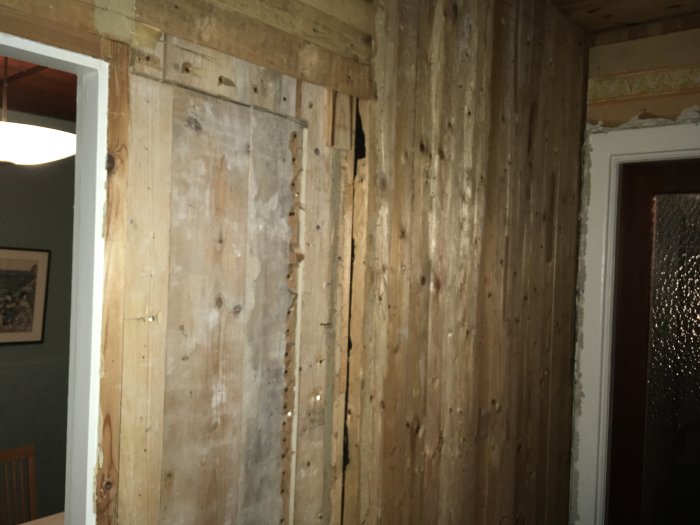
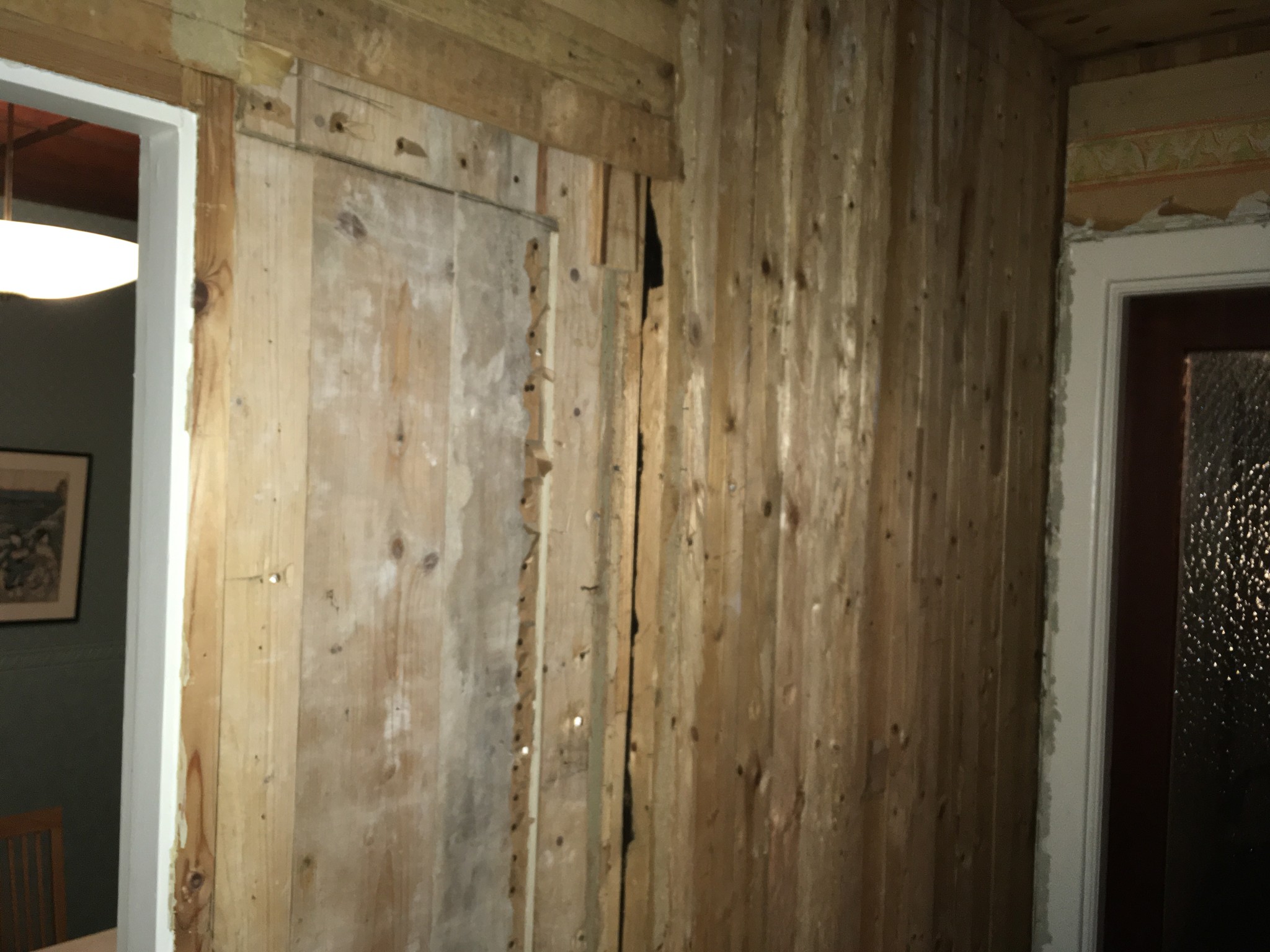
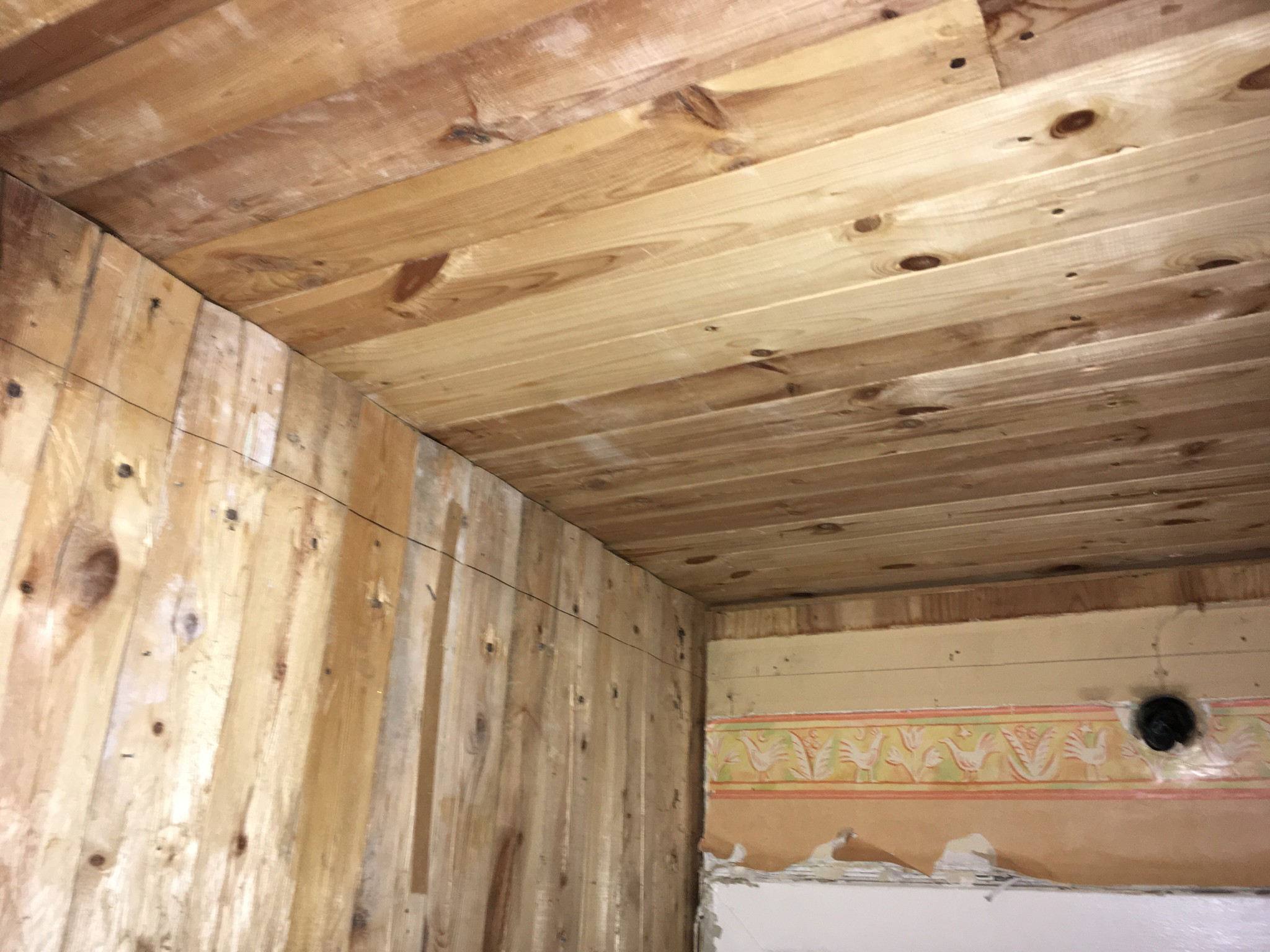
Yes, so this is what it looks like under the Masonite. Not sure if I've gotten much wiser.
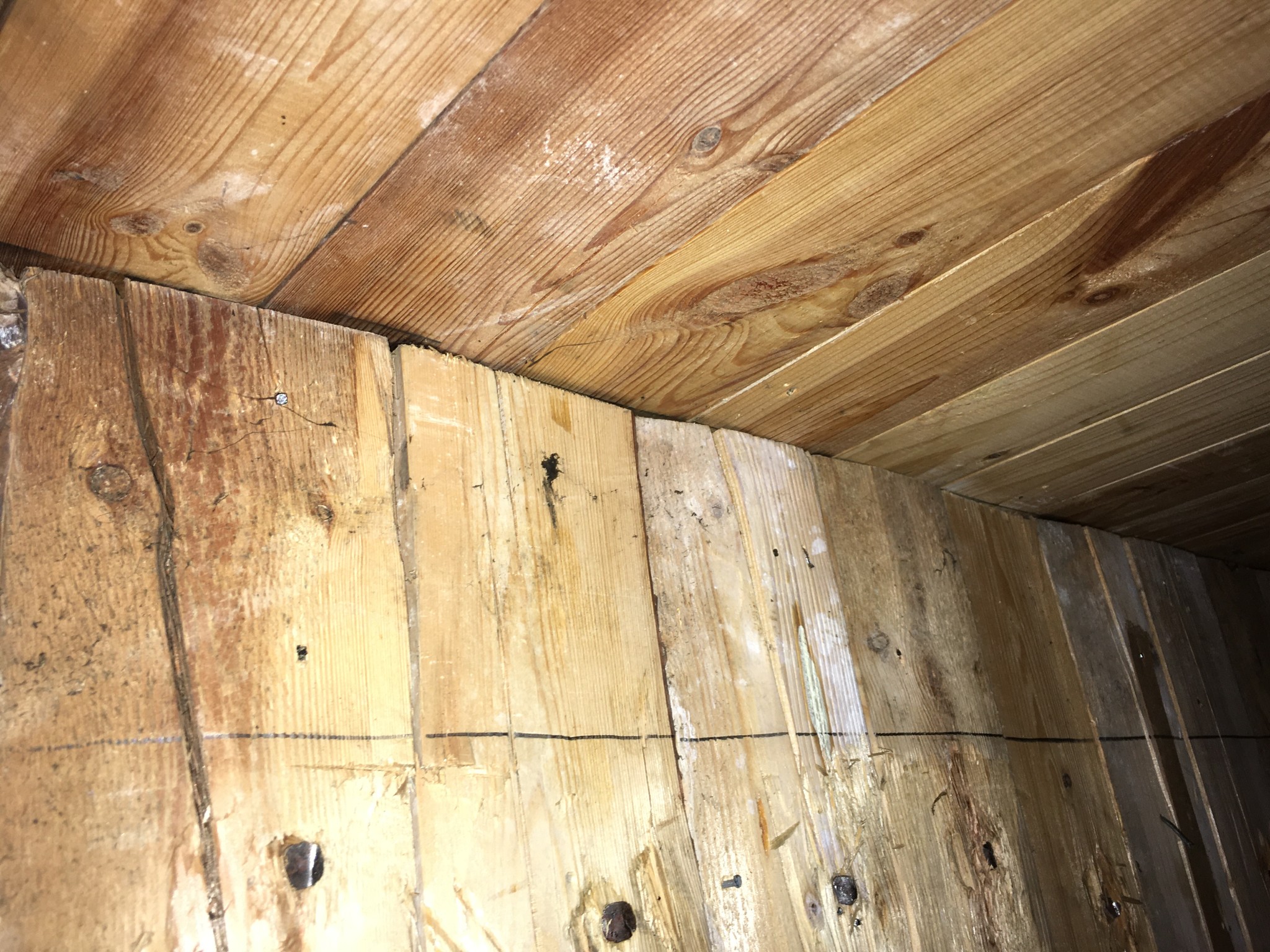
Apparently, the door was wider at some point, or moved, so that part is probably free to tear down. The rest of the wall seems to consist of a row of 85x85mm posts. Solid stuff but I'm not quite sure how it's constructed.
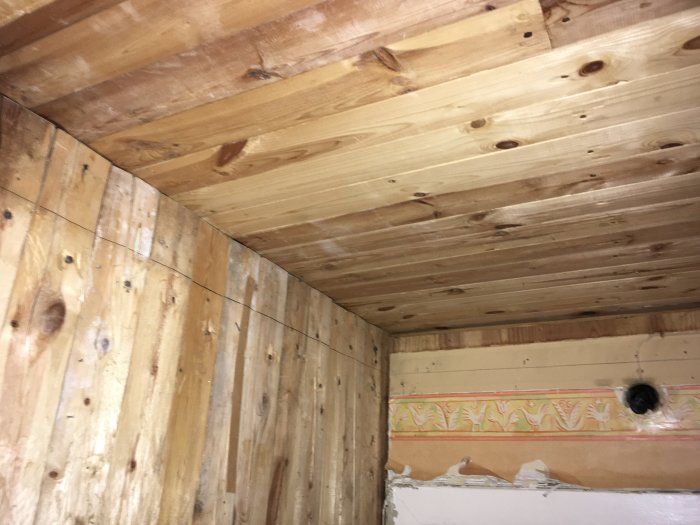
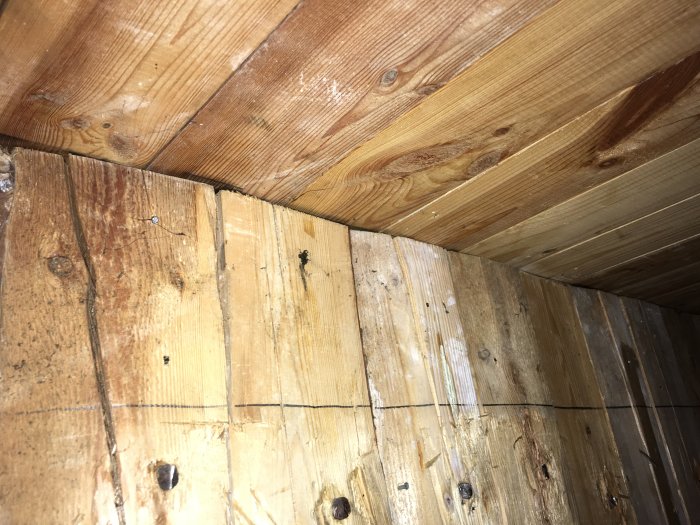
Observation 1: Judging by the nail heads, the ceiling beams seem to run parallel to the wall I want to tear down. In that case, it should argue against the wall being load-bearing.
Observation 2: The sub-roof tongue and groove (or whatever it might be called) goes on top of the posts, which I find strange. Shouldn't they have put up the (possibly) load-bearing wall first and then put the sub-roof (if it is load-bearing).
Observation 3: There is no wall underneath. Under this wall you end up in the laundry room. But the basement was heavily remodeled at some point (probably the 50s), so it probably looked different originally.
Hi @andersgrebin! Thanks for the pictures and thoughts, very useful as I'm facing a similar problem. Did you get any clarity on whether the wall was load-bearing? And how did you solve it in the end?
Inner walls at a 90° angle to the ridge are rarely load-bearing but often serve to stiffen the house and provide stability against, for example, wind loads, etc.
Replacing such stiffening walls with beams doesn't work.
Vi vill skicka notiser för ämnen du bevakar och händelser som berör dig.