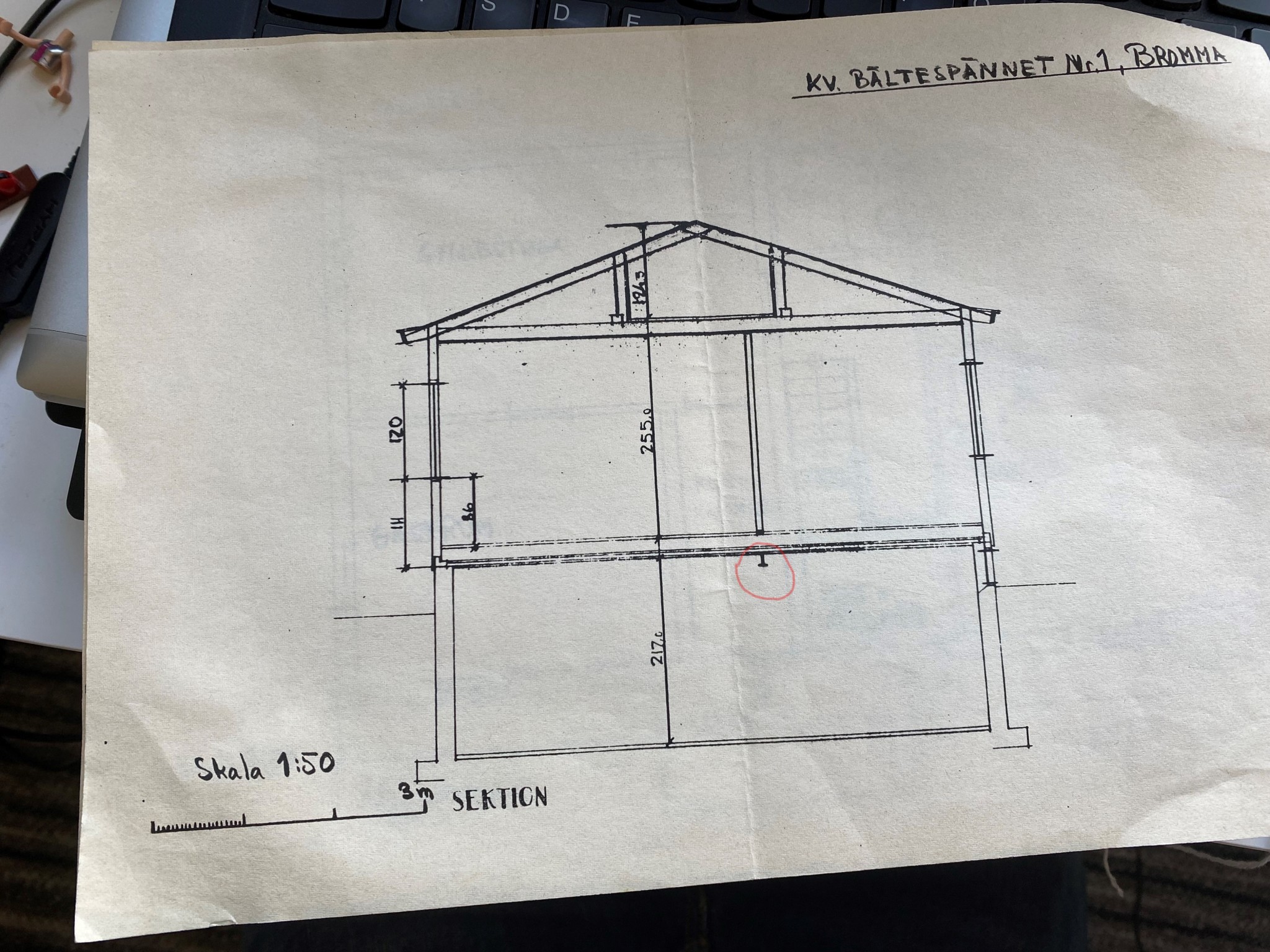
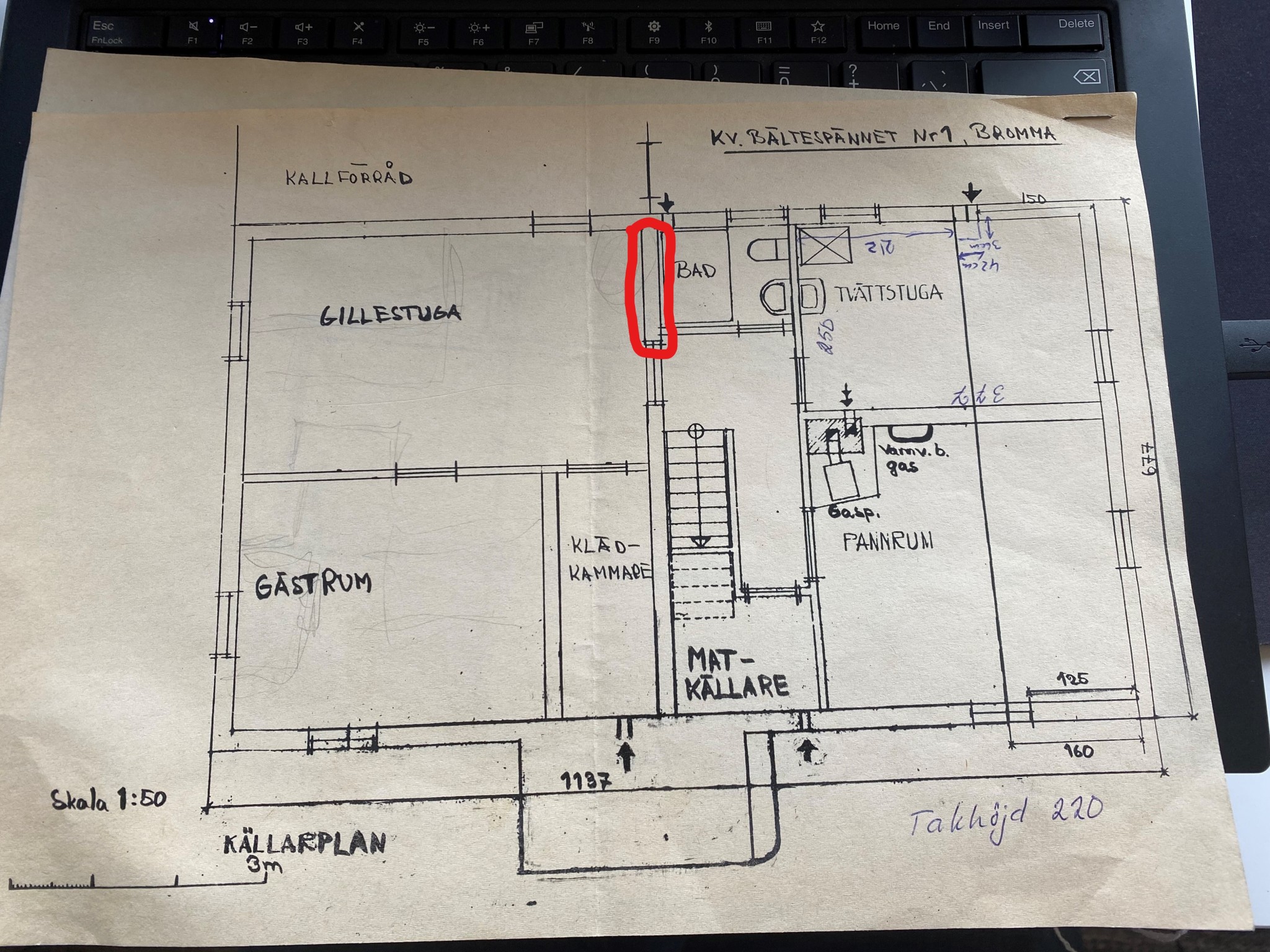
I'm working on my basement and encountered a wall that I'm unsure if it's load-bearing or not.
I previously assumed it wasn't, as there are beams running through the ceiling in the basement, but the thickness of the wall made me uncertain.
The joists in the basement and ceiling run from long side to long side.
The wall I want to take down is in the basement and circled in red.
In the basement, there are two steel beams that I suspect support the joist.
In the picture named "källare," I've marked the beam.
In the picture named "övervåning" (home showing the basement), I've marked the wall I want to take down.
In the third picture, I've marked the wall that's directly above the wall I want to take down.
Is it possible to determine from this if the wall I want to take down is load-bearing?
I suspected it was a 1930s house, but I'm not as knowledgeable about Stockholm's buildings. The layout in the basement has been changed in some way. Maybe they've just renamed the rooms? The term "gillestuga" didn't exist in 1937 and I'm doubtful that it was allowed to have bedrooms in the basement even then. Since the outer walls are made of masonry concrete hollow blocks, I don't think the red-marked wall can be taken down. As @BirgitS writes, it is needed as counterforce support.
@justusandersson these are updated drawings after an extension made in the 90s. The basement is extended beyond the intended wall. The extension is also bricked and extends 3 meters out. It should then take the earth pressure, right?
It is rather an argument for not touching the red-marked wall. The extension means that the joint between the old and new outer wall is not built in bond.
I misspoke, it's not an extension. Outside the wall I want to take down is the basement staircase going down. It is fully cast and about 1.20 meters wide. It continues past the wall by about 2 meters.
This is roughly what it looks like.
The black marking is the staircase down to the basement and the red wall is the one we were planning to take down.
Is there a way to unload in another way to create a larger opening, if nothing else?
Does the staircase lead down to an excavated space? If the answer is yes, you can remove the red wall. This highlights the importance of accounting for the whole from the start.
Does the staircase lead down to an excavated space? If the answer is yes, you can remove the red wall. This highlights the importance of considering the entirety from the beginning.
That's correct, it is excavated. It's a utility entrance with a reinforced base plate.
Thanks for the help!
Click here to reply
Vi vill skicka notiser för ämnen du bevakar och händelser som berör dig.