
1,813 views ·
5 replies
2k views
5 replies
Load-bearing interior wall (?) 1930s house
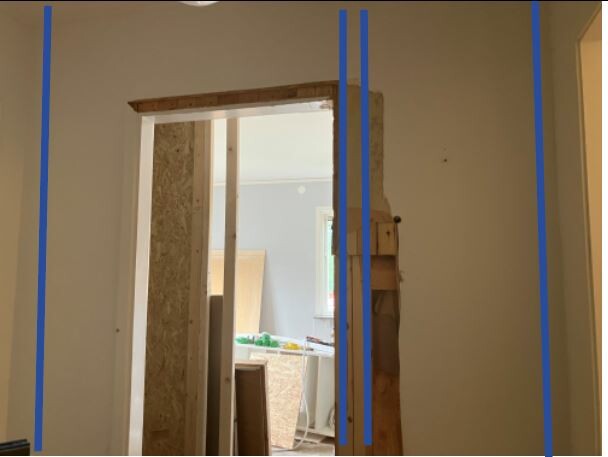
The latest part of the project is to make a doorway slightly larger. The house has a hipped roof with the ridge in the same direction as the wall in question. I have previously been quite sure that the wall is non-load-bearing, but when I started opening it up, I became a little confused when I saw how it was constructed. Directly to the right of the opening are two 55x70mm studs, which feels a bit excessive if they're not supposed to support anything...
I climbed up into the attic and checked the roof beams and made a small sketch. The green ring marks the opening. Other colors represent the attic floor. The purple roof beams are connected to the dark blue beam, and the question is whether the dark blue is only supported by the continuous light blue beams, or if it also rests on the wall I want to open up by 30 cm?
Then the question is, of course, what should I do... The safest is to do nothing and put it back together. Should I proceed and hope for the best? Install two new posts directly to the right of the new opening?
In the photo, you can see how the vertical studs are distributed in the wall, all 70x55mm.
I climbed up into the attic and checked the roof beams and made a small sketch. The green ring marks the opening. Other colors represent the attic floor. The purple roof beams are connected to the dark blue beam, and the question is whether the dark blue is only supported by the continuous light blue beams, or if it also rests on the wall I want to open up by 30 cm?
Then the question is, of course, what should I do... The safest is to do nothing and put it back together. Should I proceed and hope for the best? Install two new posts directly to the right of the new opening?
In the photo, you can see how the vertical studs are distributed in the wall, all 70x55mm.

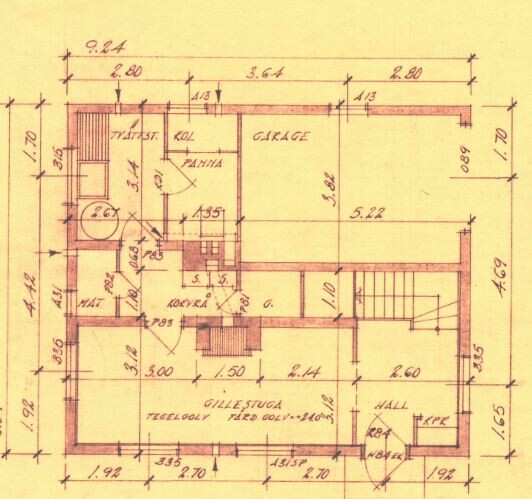


I can only guess, and in that case, I guess that the dark blue beam is there so that the two purple ones don't hang in the air, i.e., the two purple ones are supported by the dark blue one, which in turn is supported by the light blue ones. But construction at that time was not as standardized as it has been since the 1950s. If you don't have construction drawings, it's really best to let a structural engineer check how it's standing.
One should probably not rely on the size of the beams, as many slender beams together can bear a large load.
One should probably not rely on the size of the beams, as many slender beams together can bear a large load.
Thanks for the input! Yes, asking an engineer would have been good. But we're in the middle of vacation and I have a deadline on Friday 
Unfortunately, I think it ends up with me having to open up the wall more than I thought and go with both belt and suspenders, and install two 90 glulam posts and either a 45x220 or even a glulam beam 56x225. Then I'll probably sleep well at night...
Unfortunately, I think it ends up with me having to open up the wall more than I thought and go with both belt and suspenders, and install two 90 glulam posts and either a 45x220 or even a glulam beam 56x225. Then I'll probably sleep well at night...

I also had that thought, but I also think that it doesn't directly sag in 2 days, and as I said I want this fixed this week. I went to the building supply store this morning and bought laminated wood beams and a 220-stud. The engineer I have worked with prescribed a 220-stud when I installed new windows on the exterior wall, so this can hardly require anything more. The laminated wood beams are probably overkill, but the wall is so thick that the dimension fits very well.
Click here to reply