Unfortunately, I didn't get an answer to the question below, but I think it's because I asked the question in the wrong forum. I thought I'd try again and hope that someone with a bit more knowledge can answer the question...
We are in the process of furnishing our upstairs in a Smålandsvilla (Kalmar) and will be building a bathroom where we want to install a bathtub.
The house documentation states that if you want a bathtub with a total weight (bather + water) exceeding 250kg, you should reinforce with an extra beam anchored in the outer wall and heart wall. Due to various circumstances, it is quite impossible to do such an anchoring.
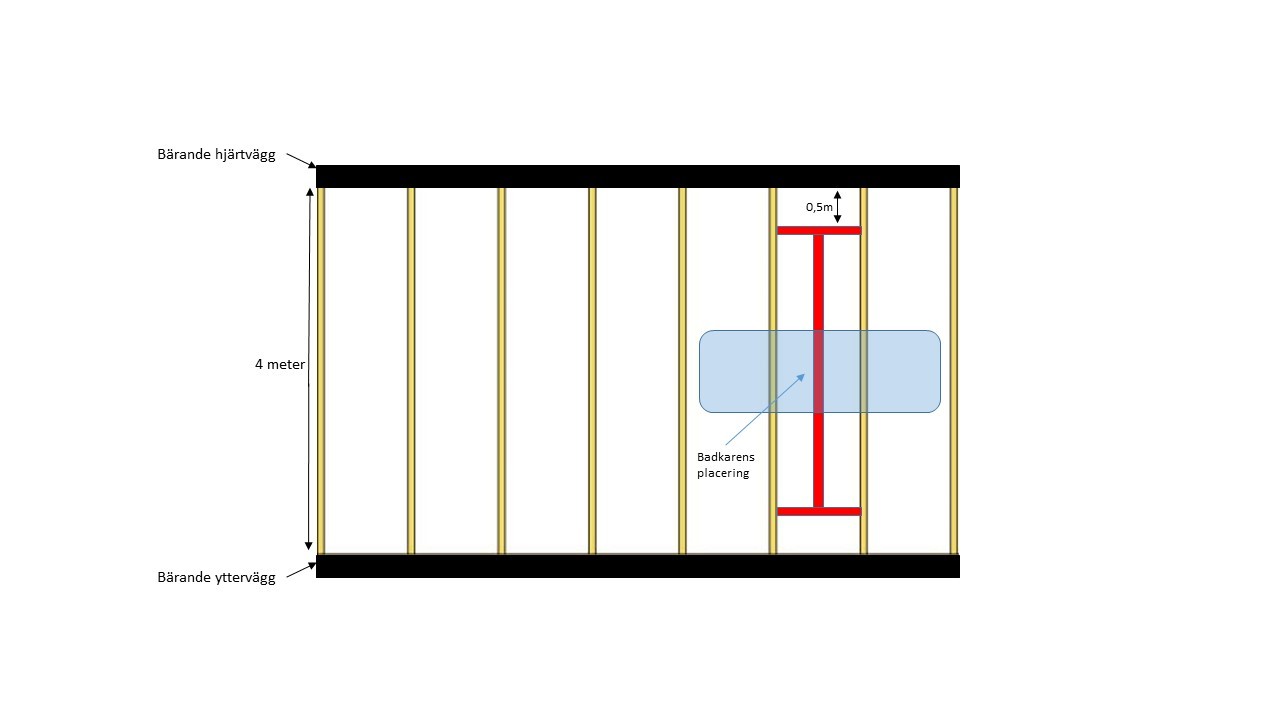
What we can do, however, is set transverse beams about 0.5m from the load-bearing parts and then anchor the new beam to it. The question is - will this be sufficient? The total weight of the bathtub we plan to install is about 350kg (i.e., 100kg above the threshold for the manufacturer's recommendation to install an additional load-bearing beam.
To make it easier, I've made a fairly simple but clear image of what we have in mind.
All beams are C24 220x45 and are currently spaced at cc 600. The new red-marked beams will also have the same dimensions. The distance between load-bearing walls is 4 meters.
What do you think? Are there any good answers, comments, or suggestions for this challenge?
If one assumes that the total load of the bathtub exclusively lands on the new red central beam, it is acceptable from a deflection standpoint if the beam's fastenings to the short red beams can handle the load. The four point loads of 87.5 kg that end up on the surrounding beams also lead to limited deflections. However, 4 meters is too long a span for your 45x220 C 24 to meet today's floor vibration standards, even without a bathtub. With screwed and glued particle board it is better but not perfect. What do the instructions say? Is this a newly built house?
If we consider that the total load of the bathtub exclusively lands on the new red central beam, it is acceptable from a deflection standpoint if the beam's attachments to the short red beams handle the load. The four point loads of 87.5 kg that land on the surrounding beams also lead to limited deflections. However, 4 meters is too long a span for your 45x220 C 24 to meet today's floor deflection requirements, even without a bathtub. With screw-glued particle board, it gets better but not perfect. What do the instructions say? Is this a newly built house?
Thanks for the reply! Yes, it is a newly built (2015) Smålandsvilla Kalmar. There is a screw-glued particle board that I have had to saw open to install the beams. The instructions say exactly as in the attached image.
I interpret that text as 1 beam, directly under the bathtub. I only assume they are C24 beams, however, I can measure that the dimension is 220x45.
I have also updated the sketch so that the bathtub's position is included. So you think this solution might work?
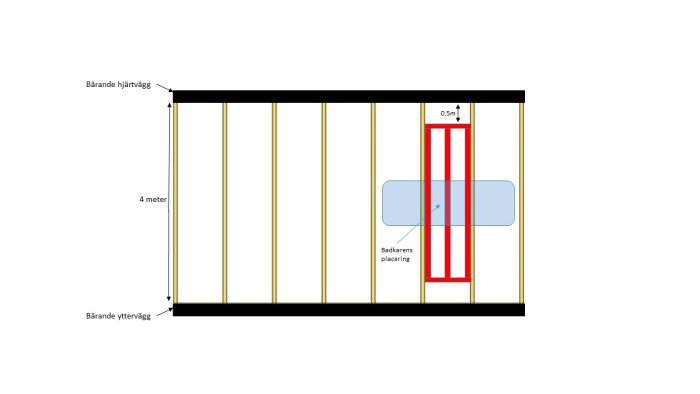
Another suggestion, which should be even stronger and can be easily implemented, is that I also glue/screw 2 longitudinal beams of the same dimension (220x45) to the existing beams. Once again, these will not reach all the way to the load-bearing points but will cover 3m of the length. That should help with the flexing anyway, right?!
Maybe a bit overkill, I don't know. It can at least be done... See the picture of this proposal below.
I think it's a bit of a tricky placement for the bathtub. What determines it? If it were up to me, I would have reinforced all the floor joists with screw-glued 45x220s that extended all the way to the hearth wall and outer wall respectively.
I think the placement of the bathtub is a bit tricky. What dictates it? If I could decide, I would reinforce all the floor joists with screw-glued 45x220 that went all the way out to the heart wall and outer wall.
Can't place joists all the way due to electrical cables that are laid very inconveniently The placement of the bathtub is dictated by space (slanted wall and window) and is therefore not possible to change either.
See the picture of the floor assembly and you'll understand the problem with placing them all the way.
You can reinforce the beams at the top and bottom so they become like I-beams. If you can screw-glue a 45x70 regel on both sides at the top and bottom, you can drive a tank on the floor.
I've also considered using nogging instead, but that probably doesn't help with load-bearing in the same way...
Jjustusandersson said:
You can reinforce the beams at the top and bottom so they become like I-beams. If you can screw-glue a 45x70 board on both sides at the top and bottom, you can drive a tank on the floor.
I didn't know this, so I can basically forget about complicated constructions and just screw-glue a 45x95r at the top and bottom of the existing beams?! I think I have room for 95s...
Two follow-up questions - Does it have to be on both sides of the existing 220 beams? Isn't one side enough?
And one more thing, how important is the attachment to the load-bearing walls? Does it matter, or is it solely the screw-gluing along the length that makes the beam strong even if it rests on the existing attachment?
Here is a profile picture of the solution, the question is if it's enough like in figure 1? I want to cut up as little of the floor as possible. But of course, if needed, it's just a matter of doing it...
Short pieces (like cross bracing) can reduce flexing problems by distributing point loads better, but they do not help at all against excessive loads or too long spans. For full effect, they should be on both sides, but one side is much better than none. Your figure 1 is sufficient even if it is not as elegant. Glue as far in as possible; it is the new cross-section that makes the beam much stiffer. "My" solution is better than Smålandsvillan's.
Kortlingar (like cross ties) can reduce deflection problems by distributing point loads better, but do not help at all against too heavy loads or spans that are too long. If you want full effect, they should be on both sides, but one side is much better than none. Your figure 1 is sufficient even though it's not as elegant. Glue as far in as possible; it's the new cross-section that makes the beam much stiffer. "My" solution is better than Smålandsvillan's.
I also think your solution is better than theirs! More practical too
Then I don’t need any type of joist hanger or bracket at the end to attach to the outer wall; instead, I should aim to screw and glue as far as possible, correct?
Also, is normal wood glue fine or should I go with something like PL400?
Then I don't need any type of beam hangers or brackets at the end to attach to the exterior wall, instead I should just aim to screw and glue as far as possible, correct?





 The placement of the bathtub is dictated by space (slanted wall and window) and is therefore not possible to change either.
