
10,899 views ·
17 replies
11k views
17 replies
Load-bearing capacity in steel beams ?
Hello,
Since it seems utterly impossible to get hold of a structural engineer in Stockholm, I am trying with the skilled forum members.
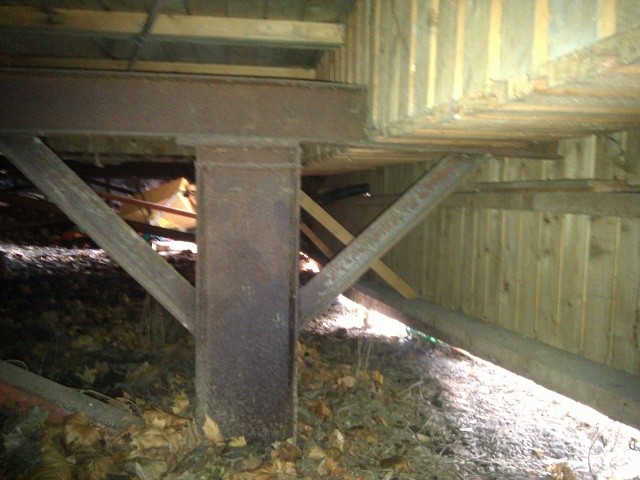
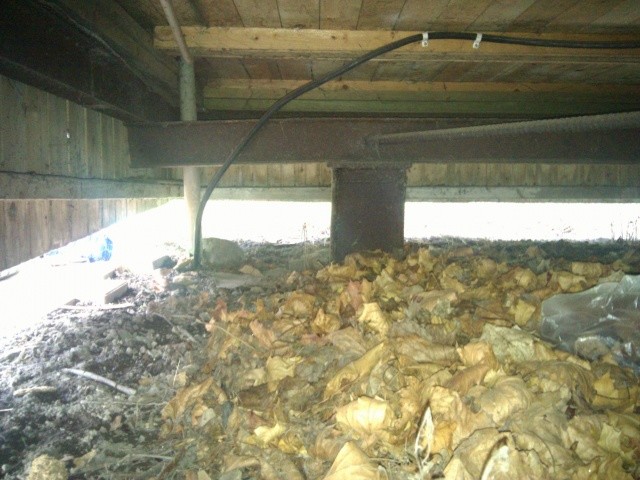
I have a one-story house from '73 with a piled foundation. Steel pillars extend down to the rock, and these support longitudinal steel beams on which the floor joists rest. The steel pillars are positioned slightly in from the house’s outer walls, which means that the weight from the house's outer edges rests on the ends of some H-beams. After making some interior modifications, especially the TV room with flooring, tiles, installation of a geothermal heat pump with a water heater + expansion tank, the weight has probably increased by about 0.6 - 1 ton in this part of the house. Now when I inspected the foundation, the ends of the beams flex about 2-3 cm from the steel pillars’ height. All beams have a support brace to help with the weight, except for the last one, which probably was too close to the ground during construction. Please see the attached images.
Now to the question, how worried should one be? Personally, I want to implement some reinforcing structure to relieve the weight a bit, if I manage to find someone who can help with that. But how urgent is this? I can live with the flexing, but if a beam were to fail, the house would probably crash down. The new kitchen is also underway in the adjoining part of the house, which will add some more weight...
Since it seems utterly impossible to get hold of a structural engineer in Stockholm, I am trying with the skilled forum members.
I have a one-story house from '73 with a piled foundation. Steel pillars extend down to the rock, and these support longitudinal steel beams on which the floor joists rest. The steel pillars are positioned slightly in from the house’s outer walls, which means that the weight from the house's outer edges rests on the ends of some H-beams. After making some interior modifications, especially the TV room with flooring, tiles, installation of a geothermal heat pump with a water heater + expansion tank, the weight has probably increased by about 0.6 - 1 ton in this part of the house. Now when I inspected the foundation, the ends of the beams flex about 2-3 cm from the steel pillars’ height. All beams have a support brace to help with the weight, except for the last one, which probably was too close to the ground during construction. Please see the attached images.
Now to the question, how worried should one be? Personally, I want to implement some reinforcing structure to relieve the weight a bit, if I manage to find someone who can help with that. But how urgent is this? I can live with the flexing, but if a beam were to fail, the house would probably crash down. The new kitchen is also underway in the adjoining part of the house, which will add some more weight...
Last edited:

Spontaneously it is hard to believe that the beams have bent since the supports are not deformed. Are you sure they weren't bent from the beginning, i.e., constructed that way?
Has the house settled? Are all floors level?
Has the house settled? Are all floors level?
Thank you for your response.
No, not all floors are level. They weren't when I inspected the house, but I get the impression that the slope has increased since we moved in. Or maybe it's that the more you think about the flex, the more it seems to slope.
I don't know if they were bent from the start. It's nothing I noticed when I inspected it myself when we took over last year, but I am a layman and probably didn't inspect it 100%. The inspector didn't mention anything.
However, maybe I can reach out to the builder and ask the question.
No, not all floors are level. They weren't when I inspected the house, but I get the impression that the slope has increased since we moved in. Or maybe it's that the more you think about the flex, the more it seems to slope.
I don't know if they were bent from the start. It's nothing I noticed when I inspected it myself when we took over last year, but I am a layman and probably didn't inspect it 100%. The inspector didn't mention anything.
However, maybe I can reach out to the builder and ask the question.

Why would they be bent in the first place?
If the trusses are on that outer wall, I would say it's definitely not good and that they have bent. Can't you try with a level outside by the wall and see what it looks like? It should give a clue at least.
It should be possible to lift and reinforce quite easily. Make it oversized, it doesn't hurt. Over the years, it will probably sink even more.
If the trusses are on that outer wall, I would say it's definitely not good and that they have bent. Can't you try with a level outside by the wall and see what it looks like? It should give a clue at least.
It should be possible to lift and reinforce quite easily. Make it oversized, it doesn't hurt. Over the years, it will probably sink even more.
Last edited:
Well, I don't know, but the supports should be broken, which they are not.Suhagg said:
If you then look at the standing beams, they are extended about as much as the horizontal beams are sagging. Maybe they made a modification so the construction wouldn't hit the rock further in or something like that?
I simply need to try to get in touch with the builder. But my gut feeling is that they have bent over the years, on the other side of the villa the beam ends are still straight.
What I am most worried about is whether there is a risk of breakage in any beam? I will certainly add about 1 ton more in weight to the house after the upcoming interior renovation. It might just be a marginal increase in total weight, not really sure. I understand that the beams should be inspected more closely, but I find it difficult to assess how urgently I should address it?
What I am most worried about is whether there is a risk of breakage in any beam? I will certainly add about 1 ton more in weight to the house after the upcoming interior renovation. It might just be a marginal increase in total weight, not really sure. I understand that the beams should be inspected more closely, but I find it difficult to assess how urgently I should address it?
My initial thought is first that the dimensions are quite small and if they have the measurements you specify, it is an I-beam and not an H-beam, but that's besides the point now.
But it looks like mycke_nu wrote that they have been bent and then corrected with support braces and lifted where they lie on the piles, so I would guess that the rust does much more in weakening the beam than the little extra weight you added. Just to give a reference, the load you increased in your laundry room is approximately as much as is calculated for a 2 sqm roof area to bear snow load. So IF it has worsened in recent years (the last two winters), it is very likely caused by the fact that we've had a lot of snow and the I-beams are rusty as they are.
So as a measure that I can think of is to cut off the supports that are supposed to hold up the overhang and lift the house with jacks and apply heat to the underside of the bent beam so you can straighten them out. Once everything is as good as you are satisfied with, you place a new brace and insert plate iron about 60-100cm long that you weld on both the web and the flanges (after they are metal clean), so you won't have to worry about it happening again and have support on ALL overhangs.
Then if you're going to contact the builder anyway, ask him if it is a friction pile or pointed pile because if it's a friction pile, they can sink over time while if the tip is against rock, at least it's not that the piles have yielded.
But it looks like mycke_nu wrote that they have been bent and then corrected with support braces and lifted where they lie on the piles, so I would guess that the rust does much more in weakening the beam than the little extra weight you added. Just to give a reference, the load you increased in your laundry room is approximately as much as is calculated for a 2 sqm roof area to bear snow load. So IF it has worsened in recent years (the last two winters), it is very likely caused by the fact that we've had a lot of snow and the I-beams are rusty as they are.
So as a measure that I can think of is to cut off the supports that are supposed to hold up the overhang and lift the house with jacks and apply heat to the underside of the bent beam so you can straighten them out. Once everything is as good as you are satisfied with, you place a new brace and insert plate iron about 60-100cm long that you weld on both the web and the flanges (after they are metal clean), so you won't have to worry about it happening again and have support on ALL overhangs.
Then if you're going to contact the builder anyway, ask him if it is a friction pile or pointed pile because if it's a friction pile, they can sink over time while if the tip is against rock, at least it's not that the piles have yielded.
In one of the pictures, there aren't even supports, so that feels more dangerous.mycke_nu said:Well, I don't know, but the supports should be snapped, which they are not.
If you look at the standing beams, they are extended approximately as much as the horizontal beams are sagging. Maybe a modification was made so that the construction wouldn't hit the rock further in, or something like that?
But as you say, it's strange that it looks like the sag is about the same.
I wouldn't add another kilo in weight before I had full control over this.
I don't think it will crash and break, but I would reinforce it before it happens and not after d^_^b
I think miry is on the right track.
It is not constructed with bent beams as I speculated; rather, the beams have yielded, and then the standing beams were extended afterward and the supports were welded on.
It is not constructed with bent beams as I speculated; rather, the beams have yielded, and then the standing beams were extended afterward and the supports were welded on.
Carbon fiber is a good material in some situations, but in others, it is very poor. I tried earlier to get in touch with some people who worked with it, and they still couldn't tell me how to calculate these constructions, even though they built many things in carbon fiber. One thing to keep in mind is that carbon fibers are a very thin thread that is strong, but on the side where you press it, the epoxy is what bears it, and the crossing fibers can resist a little if there's no even deformation, so the fibers handle many times the tensile strength of steel, which is good, but the epoxy or polyester that binds it can only handle 1/100 of what steel can, so it's important to think carefully about where and how you use it.cheavy said:
And perhaps I should add that when I wrote that you should lift the house with jacks, I meant the old reliable model where you push a hydraulic cylinder straight up because they have no weak parts like regular car jacks do, which have an arm. These are even available at Biltema, handling 30 tons, but 10 tons would probably suffice. To be on the safe side, take some that can handle 20 tons and pump up at all points and prop it with concrete slabs or maybe make a large slab with something like 2x7-8'' x2 in width, then one that distributes the pressure on them and then load up underneath so you're satisfied when you lower the jack to lift the next place.
(lift on 2-3 beams at the same time, so you pump up the outermost completely first and decrease inward, and when the first is completely propped, move it to the one next to the innermost jack and pump a bit more on the next, so there's an even elevation of the longitudinal beam)
But also thought that if the floor is sagging, it should be because the span of the beams between the piles is a bit too long—how long is it between them??
Many thanks for all the responses and tips.
The funny thing is, if the supports were welded on after the beams bent, they must have been bent for quite a while now because the supports look just as timeworn as the beams themselves. It doesn't look like it was done recently.
Many thanks to miry for the action tips, I find it a bit difficult to understand all the steps but will try to address it in the future. What do you mean by blanjärn? Misspelling?
Your theory about the snow sounds plausible. I have a roof covering about 120m2 and that would mean the snow during recent winters has probably added ten times more weight than my upcoming interior renovations.
I think the sagging more comes from the wooden joists that are spaced 60 cm apart over the longitudinal steel beams, which rest on the bent beams (very inventive construction). There's one of those beams on each long side, as well as one in the middle of the house, which makes the span for the wooden joists about 4 m between the beams. And the sagging towards the sunken part of the house feels a bit like a slope, a greater incline starting from the middle of the house leveling out towards the exterior wall.
The funny thing is, if the supports were welded on after the beams bent, they must have been bent for quite a while now because the supports look just as timeworn as the beams themselves. It doesn't look like it was done recently.
Many thanks to miry for the action tips, I find it a bit difficult to understand all the steps but will try to address it in the future. What do you mean by blanjärn? Misspelling?
Your theory about the snow sounds plausible. I have a roof covering about 120m2 and that would mean the snow during recent winters has probably added ten times more weight than my upcoming interior renovations.
I think the sagging more comes from the wooden joists that are spaced 60 cm apart over the longitudinal steel beams, which rest on the bent beams (very inventive construction). There's one of those beams on each long side, as well as one in the middle of the house, which makes the span for the wooden joists about 4 m between the beams. And the sagging towards the sunken part of the house feels a bit like a slope, a greater incline starting from the middle of the house leveling out towards the exterior wall.
Yes, there was a typo, it should say bladjärn with a suitable width.
And you can do a few different things to stabilize the floor, from attaching a bladjärn about 30-40mm wide and say 3mm thick so that the rotation point in the wood is moved down from the middle to just above the iron, which will lead to you getting double the strength in the floor and roughly double the elasticity to counteract the flex, but since it can be a bit complicated if you’re not experienced, you can glue and screw a 45x95 regek onto the underside. If you place it lying down, you can screw through it easily with a bit longer and sturdier screws, screwing every 20cm or so, so it looks like an upside-down T profile. Such a change gives a significant increase in stiffness in the floor joists, making it worth considering. You get a fairly inexpensive solution to the problem, and you can start by setting up joists like that in about 3-4 spans and see if you think it's sufficient for you or if it's still flexing too much; then use wider joists or steel, either flat iron or angle profile.
And you can do a few different things to stabilize the floor, from attaching a bladjärn about 30-40mm wide and say 3mm thick so that the rotation point in the wood is moved down from the middle to just above the iron, which will lead to you getting double the strength in the floor and roughly double the elasticity to counteract the flex, but since it can be a bit complicated if you’re not experienced, you can glue and screw a 45x95 regek onto the underside. If you place it lying down, you can screw through it easily with a bit longer and sturdier screws, screwing every 20cm or so, so it looks like an upside-down T profile. Such a change gives a significant increase in stiffness in the floor joists, making it worth considering. You get a fairly inexpensive solution to the problem, and you can start by setting up joists like that in about 3-4 spans and see if you think it's sufficient for you or if it's still flexing too much; then use wider joists or steel, either flat iron or angle profile.