Sitting and figuring out how the load scenario will be for the upcoming construction and have partly used Moelven's beam calculation. The construction is based on an essentially self-supporting roof structure with a glulam beam at the ridge and then glulam columns that support this. I ended up in a conversation with my structural engineer who believes that I need to significantly reinforce the middle column which is supposed to take a load of 104kN. This column stands (is to stand) on a Lecamur wall that is built on a foundation footing that will be reinforced beneath this wall.
The engineer's proposal was to replace the top row of the Lecamur wall with a steel beam, a fully cast beam equivalent to distribute the pressure. When I look at Weber's product sheet for 200mm Leca blocks, it states that they have a nominal compressive strength of 3N/mm2.
When I calculate the middle column, it has an area of 4.14dm2 (115*360mm) and carries a load of 104kN. This should mean I get a pressure of about 2.5N/mm2.
I also understand that reinforcement may be appropriate to not lie so close to the limit value, but my question is whether I am completely off track or on the right path?
Your constructor is right.
You should reinforce.
A small reinforced casting on top of the leca might be enough.
Otherwise, a small beam piece.
Suitable size is double that of the pillar's section.
Place the pillar centrally on the foundation.
Then you get about half the pressure compared to what you calculated.
Your constructor is right. You should reinforce. A small reinforced casting on top of the leca might be enough. Otherwise, a small beam piece. Suitable size is double the section of the pillar. Place the pillar centrally on the base. Then you get about half the pressure compared to what you calculated.
Why would the placement of the pillar on the base reduce the pressure?
Why would the placement of the column on the substrate reduce the pressure?
Sloppily written by me. That line should have come higher up.
Like this:
A suitable size is double the section of the column.
Then you get about half the pressure against what you calculated.
Place the column centrally on the substrate.
Now it became a bit inaccurate for another reason too. I chose TS's term "pressure" when it actually concerns tension.
Also, the placement has a significant impact. If you place the column at one edge of the substrate, the stress distribution becomes trapezoidal, with the highest stress right at the edge.
Trying to put the follow-up question in my old thread.
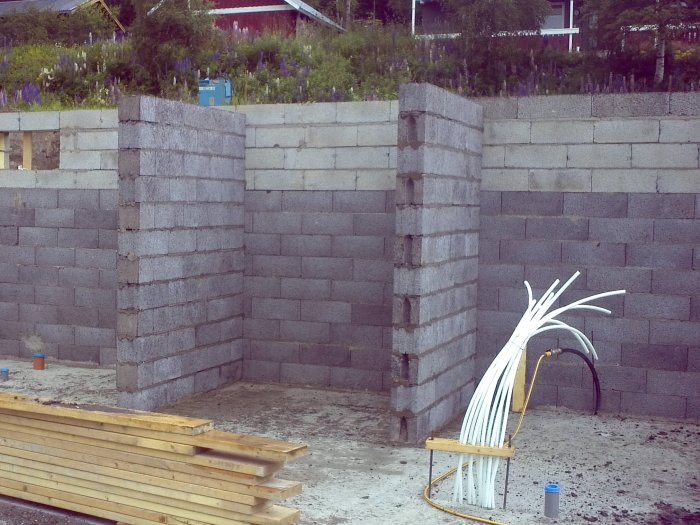
Now the construction has become a reality and my thought was that one would skip the top row on the right support wall in the picture below and instead cast a ledge for the glulam column/post to stand on to distribute the pressure.
Now this was missed, but at the same time, I see that there is a lack of about 50-100mm in height on this wall to align it with the outer wall. Could it be enough to cast a ledge with this height, or should it be higher to handle the pressure (tension)?
Click here to reply
Vi vill skicka notiser för ämnen du bevakar och händelser som berör dig.