I currently have a floating floor with chipboard and vinyl in the guest toilet and am now planning to install tiles and electric underfloor heating. The area is only 2.7m2, and the floor creaks a lot when walked on, so I'm wondering what the smartest approach is now. Should I take the opportunity to redo the construction in some way, or leave it as it is and self-level on the existing chipboard? The creaking should disappear if the surface becomes stable, right? How thick a layer of self-leveling compound is needed on this area <3m2 to avoid further reinforcing the floor?
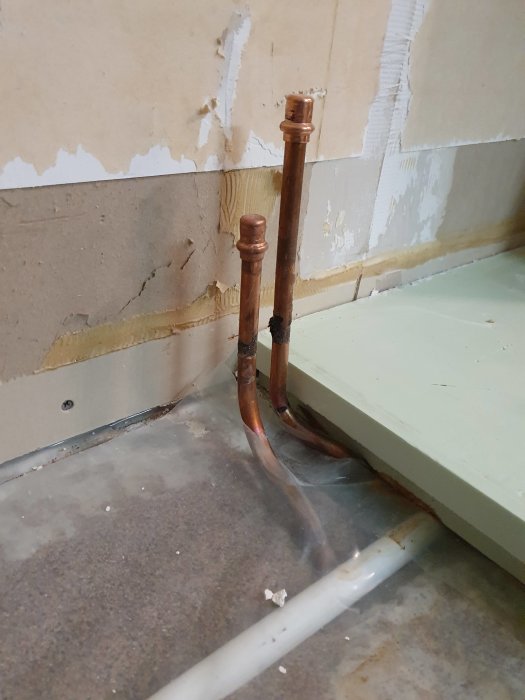
Have now opened up the floor for the toilet (only toilet and sink, no shower/drain) in a house built in '91 and from what I can assess, there is an uninsulated concrete slab at the bottom, plastic film, 50mm cell foam, 22mm chipboard, and then a waterproof mat on top.
Does anyone have any thoughts on this plan? Is there anything that would be considered risky or deviate from standard practice?
Seal the radiator pipes under the cell foam (plumber)
Would have used eps-concrete instead of foam plastic and sawdust.
Thanks for the answer, what is the reasoning? What is the disadvantage of foam plastic and sawdust, and what speaks for eps? Eps seems to be more expensive and have less insulating ability when I google, and I already have the foam plastic so I don't have to buy it...
Do you need to worry about moisture migration with underfloor heating in my case? Everything looks dry and fine today, and since the house was built, there's underfloor heating in the bathroom and hall. However, I don't know how it is constructed in these rooms and what distinguishes it, apart from the fact that there is waterborne underfloor heating there.
Perhaps the thread title is too vague, but I thought there should be plenty of people who have renovated 90s bathrooms with floating floors on a concrete slab and installed underfloor heating who have experiences to share..
I agree, I would also go with EPS. What makes you think the slab is uninsulated if it was made in '91? If it is insulated, maybe it's better to float directly on the slab?
Also, if possible, I would have fitted the pipes closer to the heat source/in a non-embedded location. It seems foolish to embed a joint if it can be avoided.
Agree, I would also go for EPS. What makes you think the slab is uninsulated if it was made in '91? If it's insulated, maybe it's better to float directly on the slab?
Also, if possible, I would plug the pipes closer to the heat source/on an undeveloped site. It seems unwise to cast in a joint if it can be avoided.
I think that if the slab were insulated, you wouldn't place foam on top but instead lay the floor on the concrete? Is it common to have insulation on insulation?
Regarding the plugging, it is the radiator pipes passing through the room to the whole house that are being plugged, so it probably can't be done any other way than plugging at the pipe connections as far as I can see.
Please explain why you recommend EPS, I don't really understand the advantage over the foam and how to attach the underfloor heating loop conveniently without using floorboards...?
Aha- maybe the upper foam compensates for level differences for some reason? There should be insulation under the concrete if I understand correctly - villa slab from -91? Check the drawings, for example.
No problems with the foam, I think the chipboard is a bit odd.
Forget the eps, didn't realize you have foam at home. With foam: so-called root mesh (thin reinforcement mesh) that the loop is zip-tied against. Pour a few spots of flow in some places an hour before casting so it stays in place.
Click here to reply
Vi vill skicka notiser för ämnen du bevakar och händelser som berör dig.





Stefan N said:
