
11,181 views ·
45 replies
11k views
45 replies
Level floor structure with shims?
Yes, the frame is the part where the joist ends are attached, under this there should be a sill..J JohnMW said:
How far along is the construction?
Thanks for the clarification. There is no sill then. They have built the entire floor structure and framed the walls, i.e., a skeleton. The next step is trusses.Rejäl said:
In that case, I would have explained to them in writing that they have constructed the framework incorrectly, which will have significant consequences for the house…J JohnMW said:
It's time to stop and correct the framework to prevent any settling in your house...
Hello
Now I don't know exactly how everything looks.
I would have cut off the assumed attachment in the house and cut off the corners of the walls and set these aside.
Repaired the foundation and leveled it completely and prepared to lay the floor joists on the foundation as I guess there might be some trouble with the floor height.
Then lift the walls back and secure them well.
Feel free to send a couple of pictures of the whole thing.
/Workingclasshero
Now I don't know exactly how everything looks.
I would have cut off the assumed attachment in the house and cut off the corners of the walls and set these aside.
Repaired the foundation and leveled it completely and prepared to lay the floor joists on the foundation as I guess there might be some trouble with the floor height.
Then lift the walls back and secure them well.
Feel free to send a couple of pictures of the whole thing.
/Workingclasshero
Hello! Thanks for the incredible enthusiasm! @Workingclasshero how do you specifically mean to cut the supposed fastenings? Posted pictures of the entire construction.
The picture didn't work on my veteran computer.J JohnMW said:
But without seeing the whole thing, take down the walls and fix the foundation and floor joists in the correct way.
/W
It looks like there are two layers of cardboard... I wonder if there's a sill board between the layers that the rest rests on, and the wedges were just driven in to level the floor joists before screwing them from the outside...?
Either way, it's strange that the floor joists don't rest stably on anything in the entire cut-out... There's a risk that it will give way if they're only held with through screws... I wouldn't want to accept that at least.
If they are only on the wedges, it's completely wrong, both that the joists have so little support, that the wedges aren't secured, and that chip wedges were used...
Check if there's a sill under the cardboard and talk to your KA or read the construction drawing for how it should look because this doesn't look good.
Either way, it's strange that the floor joists don't rest stably on anything in the entire cut-out... There's a risk that it will give way if they're only held with through screws... I wouldn't want to accept that at least.
If they are only on the wedges, it's completely wrong, both that the joists have so little support, that the wedges aren't secured, and that chip wedges were used...
Check if there's a sill under the cardboard and talk to your KA or read the construction drawing for how it should look because this doesn't look good.
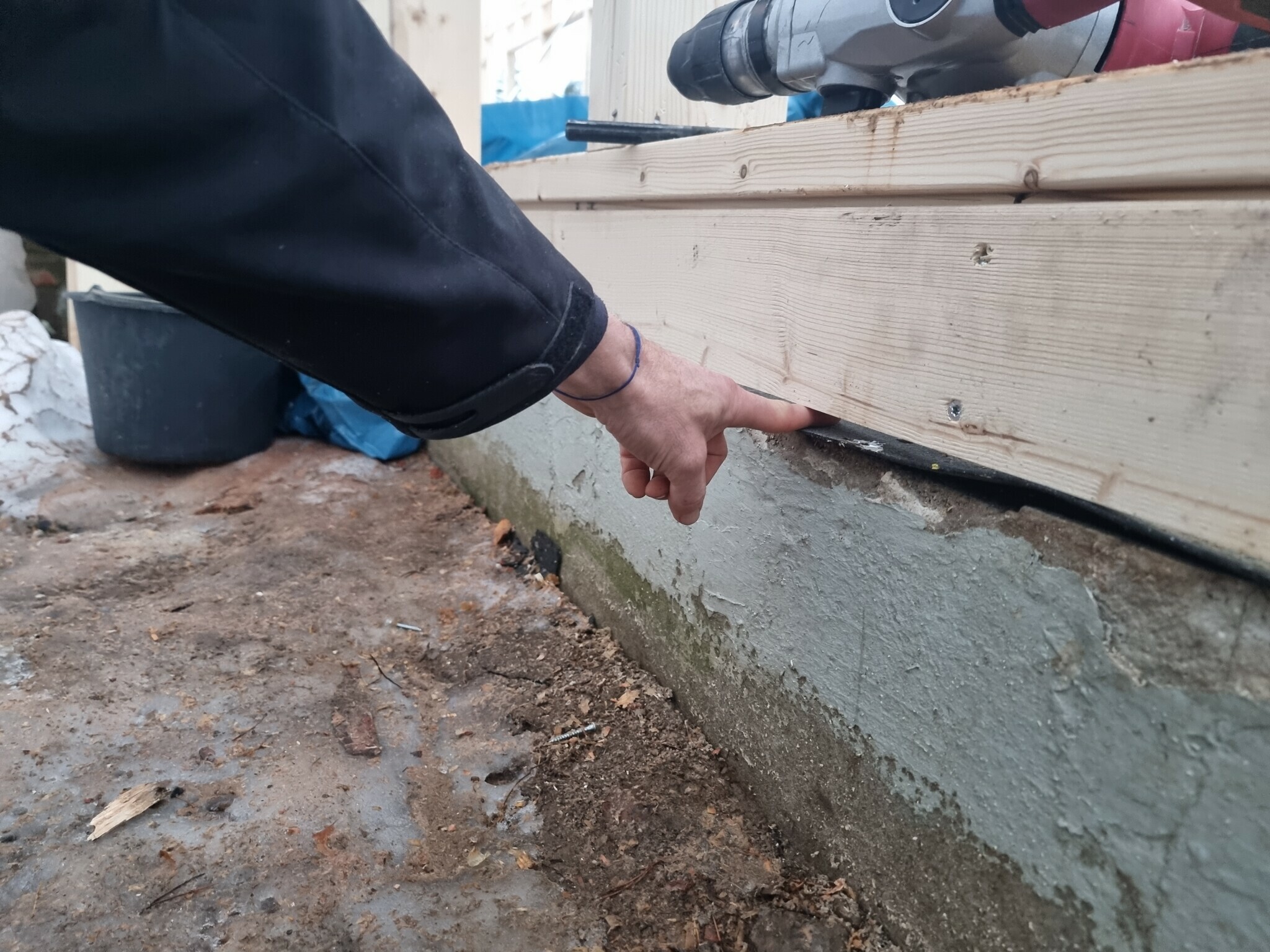
Workingclasshero said:
Hi! I have talked to the structural engineer and he has omitted the lower sill because it won't fit in some places due to large height differences. So the builders have probably taken that as a cue not to have a lower sill anywhere... But that still doesn't mean that the frame and floor joists should float in the air over long distances?Rejäl said:
One could question why the top course in the masonry hasn't been removed, who made this decision? Then a leveling could have been cast so that the entire floor structure gets support, letting the loads be evenly distributed on the masonry.J JohnMW said:Hi! I have spoken with the constructor, and he has omitted the lower sill because it doesn't fit in certain places due to large height differences. So the builders have probably taken that as a reason not to have a lower sill anywhere. But doesn't that still mean that the frame and floor beams shouldn't be floating in the air for long stretches?
It might be wise to have these decisions documented for future disputes in case there are settlements.
Last edited by a moderator:
OK, that's an explanation for why there's no bottom sill plank at least.J JohnMW said:Hi! I spoke with the builder, and he omitted the bottom sill because it doesn't fit in certain areas due to large height differences. So the builders probably took that as a reason not to have a bottom sill anywhere... But that still doesn't mean that the frame itself and the floor joists should be floating in the air over long distances?
It seems a bit unlikely that it will work. When constructing houses with point support (pillar foundation), you dimension the joists accordingly, but if it looks like this, it feels like they (the builders) should have cast or built up with mortar so there was support all the way. The alternative would have been to double the frame or have another stronger dimension.
The floor joists shouldn't just hang on two screws at least... that feels a bit flimsy.
I think the builder and the construction supervisor should look at it and provide an assessment, and then the builder might have to adjust. Whether that means lifting "everything" and casting, or if it's possible to add support under each upright and floor joist, I'll leave unsaid.
That it works right now is one thing, but how will it look in 10-20 years...?

Self-builder
· Stockholm
· 8 765 posts
Agree with testarn - get the constructor/KA there (or at least send pictures) so they can have a look at it. Just propping up the entire structure on a few wedges doesn't seem reasonable. Moreover, if you need to prop up in certain points, but it's otherwise okay, one should probably lay sill paper so it doesn't attract moisture over time. Wedges in shavings are just to level it during construction, I would say, not something you want to keep there afterward. And it's cheaper to fix it now than when more weight is added/more needs to be torn down... right now you should relatively easily be able to lift the framework and mortar/lay sill paper, or place timber of suitable dimensions so you achieve better contact.J JohnMW said:Hello! I spoke with the constructor, and he omitted the lower sill because it doesn't fit in certain places due to large height differences. So the builders have likely taken this as an excuse not to have a lower sill anywhere. But that still doesn't mean the frame and floor joists should be floating in the air over long distances?
The choice of wedges here clearly indicates that the thought processes have not gone entirely right. These spånkillar will dissolve within a few years with changing humidity. If they had been shimming plates intended for long-term load, one might think there was some thought behind this, but the execution combined with the choice of materials is collectively a hole in the head.
The wall will obviously settle if it hovers over long distances, which is completely wrong. This will obviously increase with the weight of the structure. The notching of the floor joists must also be checked with the engineer. If the height only allows for such a recessed placement, the notching may be unavoidable, but then the fastening should be adapted accordingly with, for example, a joist hanger against the foundation wall or equivalent.
Having an engineer on-site is a strong position too!
The wall will obviously settle if it hovers over long distances, which is completely wrong. This will obviously increase with the weight of the structure. The notching of the floor joists must also be checked with the engineer. If the height only allows for such a recessed placement, the notching may be unavoidable, but then the fastening should be adapted accordingly with, for example, a joist hanger against the foundation wall or equivalent.
Having an engineer on-site is a strong position too!
Constructor omitting the sill?J JohnMW said:Hello! I have spoken with the constructor and he has omitted the lower sill because it doesn't fit in certain places due to large height differences. So the builders have probably taken that as a reason not to have a lower sill anywhere.. But doesn't that still mean that the actual frame and floor beams shouldn't be floating in the air over long distances?
This isn't even difficult!
The rest of the house and all hundreds of thousands in costs will rest on loose ground, it's like throwing money down the drain.
Start over from scratch and do it right.
Take down the walls, or maybe redoing everything from the beginning is the best, cheapest, and most serious suggestion so far.
Chip away a bit of the foundation and shape the inside or whatever is best in this case and make a proper foundation and place the extension on it.
Yes, it's tough to stand your ground now, but it will benefit you in the long run.
Good luck.
/W
Last edited: