
11,157 views ·
45 replies
11k views
45 replies
Level floor structure with shims?
Hi! We are currently renovating and expanding the cabin partially on the existing crawl space foundation. The company building it was supposed to align the wall if needed. They didn't do that, so now there are regular wooden or wood chip wedges under the sill to compensate for unevenness in the wall. Will these wedges really withstand the pressure and keep the levels maintained when walls, roof, and kitchen are in place and will it hold over time in a humid crawl space without the wedges slipping out of place? Very grateful for your thoughts on this! Regards, John
Do you have a picture showing how they are positioned?J JohnMW said:Hi! We are currently renovating and extending the cabin partly on the existing crawl space wall. The company that's doing the construction was supposed to level the wall if necessary. They didn't, and now there are regular wooden shims or chipboard shims under the sill to compensate for irregularities in the wall. Will these shims really withstand the pressure and maintain the levels when walls, roof, and kitchen are in place, and will they hold up over time in a damp crawl space without sliding out of their positions? Very grateful for your thoughts on this! Best regards, John

Hi, a picture would be good.
Fixing the foundation is probably tricky.
Lifting with a jack and inserting spacers of the correct thickness is probably what I would do.
I guess just wedging it up will give point loads that are greater than what the wedges or the sill can handle, think 40cm snow and wind loads.
/W
Fixing the foundation is probably tricky.
Lifting with a jack and inserting spacers of the correct thickness is probably what I would do.
I guess just wedging it up will give point loads that are greater than what the wedges or the sill can handle, think 40cm snow and wind loads.
/W
So it's a brand new joist. I don't understand how these wedges are supposed to withstand a long life without giving in.
Oh no, that won't hold, the support must be even under the entire beam, and the outer frame should be propped up as the weight of the wall transfers into it, otherwise, there will be too much point pressure on the beams placed 60 c/c. Usually, there is a sole plate under the beams...J JohnMW said:
If this had been done properly from the start, the wall plate should have been evened out first with mortar, but that chance is no longer available, so you need to support it...
Note that chipboard is not recommended in this case...
Last edited by a moderator:
If I'm interpreting the pictures correctly, it's aligned horizontally, not vertically.J JohnMW said:
The wedges don't seem to be secured in any way.
If you secure the wedges (preferably driving them in from both sides as well), I think it's okay.
No, it's not okay with a wedge from each direction; there should be a sill under the beams and under that, sill paper to prevent moisture rising... the beams should be flush so that the entire beam and outer frame distribute the weights evenly. Otherwise, you risk settling due to the point pressure of the wedges...Nissens said:
There are several errors here, I think. If I interpret the images correctly, it is oriented horizontally, not vertically.
Firstly, the wedges do not appear to be secured in any way, but an equally serious error is that there is nothing to prevent moisture from being absorbed by the wood from the stones. The wedges and maybe the beam can suffer moisture damage/rot over time.
If you secure the wedges (preferably driving them in from each direction as well) and block the moisture, I think it will be okay.
Yes, but there's a sole, and a moisture barrier is between the wedges and the stone. How it looks under the sole can't be seen.Rejäl said:No, it's not okay with a wedge from each direction. There should be a sole under the beams and under that, a moisture barrier that prevents moisture seepage. The beams should be flush so the entire beam and outer frame distribute the weight evenly; otherwise, you risk settling issues due to the point pressure from the wedges…
The sole isn't under the entire standing stud. Whether that's okay, I don't know; it needs someone to calculate.
Yes, a sole plate in the wall that's above the floor structure..
Adding a schematic illustration that shows how a floor structure should be constructed..which is taken from TräGuiden…
Wedges are not okay!
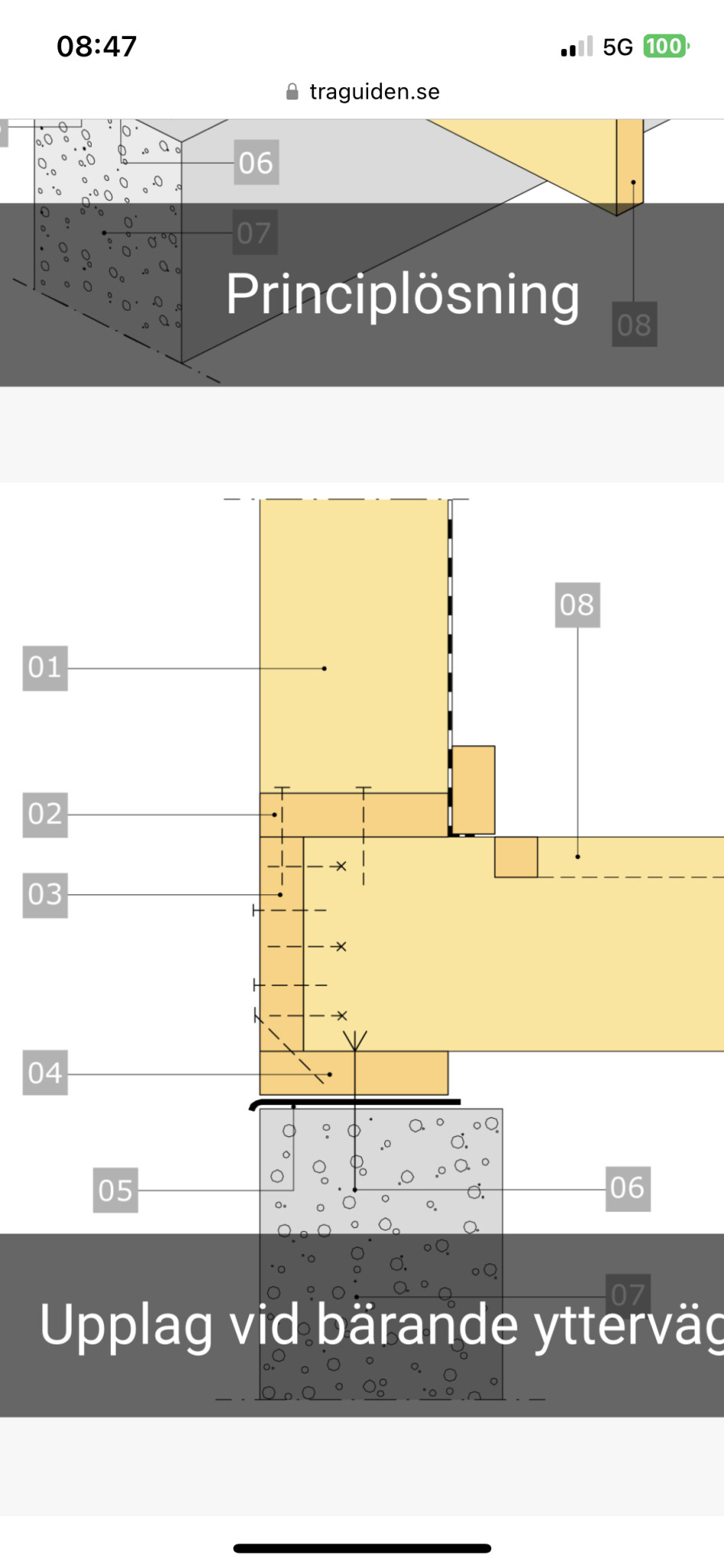
Additionally, the wall is damaged underneath. Why haven't they started by repairing it? Then level with mortar under the sill paper, so minimal shimming underneath is needed.
That notching effectively halves the strength. It looks completely wrong.
Wedges made of chipboard probably won't hold over time and will be subjected to very high point loads. I would guess that this results in sway in the construction, creaking floors, and more.
Try to see what happens to a chipboard that gets a little damp. It turns into rubbish in no time. I would avoid chipboard material in the crawl space where possible.
That notching effectively halves the strength. It looks completely wrong.
Wedges made of chipboard probably won't hold over time and will be subjected to very high point loads. I would guess that this results in sway in the construction, creaking floors, and more.
Try to see what happens to a chipboard that gets a little damp. It turns into rubbish in no time. I would avoid chipboard material in the crawl space where possible.
I didn't quite understand what you mean by oriented horizontally. They were supposed to adjust the wall vertically to get the right heights. Now they have used wedges instead. The sill is almost never in contact with the sill paper and the wall. Nor with the joist that the wall studs stand on above the sill. So, the sill is floating both below and above.