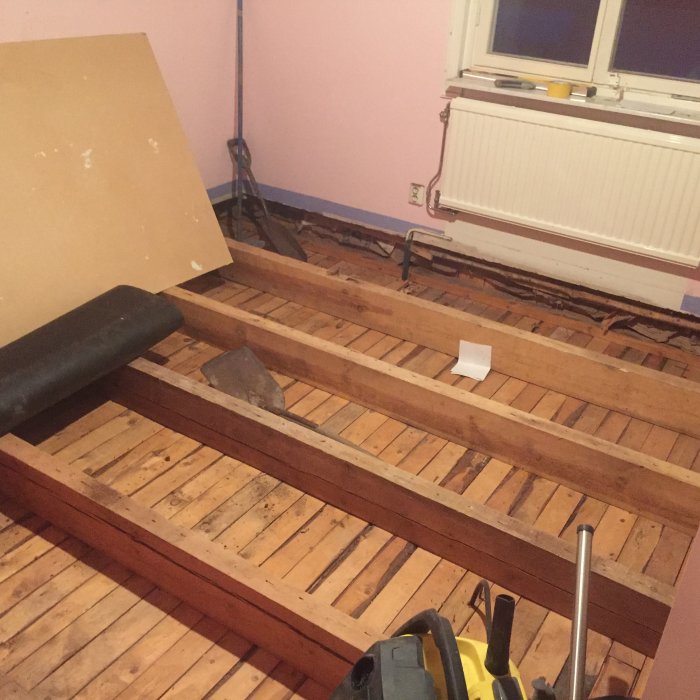
I will take the opportunity to level the floor and am considering if it's useful to use 195 beams to also reinforce the joists. I will only be able to screw into the existing beams but not along their entire length as the walls are in the way, so the question is if it will be of significant benefit.
The existing joists are 75x195 mm and the span is approximately 5700 mm.
I can fit beams up to 3700 mm long, which is the room's measurement.
A bit skeptical about shortlings but sure, you can have those too, but regardless I will need to have a board on each floor joist to level it, so the question is if there’s any point in using a 195 board or if I might as well screw on something more manageable, like a 120 board.
Keep in mind that when you pull on noggings and have already leveled the floor, you make it crooked again!
Why not plane it straight, but noggings before, if you want them. Keep in mind that the studs you have as noggings should be dried to below 12%, so you don't get the floor crooked again when they dry! That wood moves with the seasons is not new for most, but it is the different humidity levels in the air that affect the wood, not the seasons themselves!
The kortlingar should be positioned around 2850, meaning the span of the existing joists, not the part of the room, so not at 1850...
Best regards, P-A
In the middle of the room will likely be exactly at the midpoint as the attic spaces are about the same size on both sides.
I screwed and glued when I set up the kitchen, but a big problem is that these beams are quite twisted, so if you screw a new brace closely against it, it will also be crooked. I thought about placing shims in between, but then you can't glue.
The floor will be a 25 mm solid screwed pine floor.
See #5, that's why I wrote that blocking should be put in place before doing anything else with the joists. Also, note that if the studs you are fastening aren't dry, they may shift once they reach the same moisture content as the indoor environment. The best way is to add blocking and plane it straight; the existing joists won't warp more than they already have. Another thing to consider when tearing up the old floor is that you almost always unsettle or alter the existing studs; they simply move, and they will continue to move more over time without the floor in place. When we performed restoration on "old" log houses and replaced floor planks, we often braced to prevent too much movement in the structure. Good luck!
is there any problem with the old bjälklaget then? It sounds more like the idea is to install a two-ton bathtub or something similar....
Sometimes people do things completely unnecessarily "just because" kind of.........
It sags a little but not so badly, the main problem is that it tilts about 2 cm towards the middle. I will set up the laser this evening to see how much the height differs, maybe it's enough to plane off a couple of cm from the first beam if I'm lucky.
A few level differences are not the end of the world, right? Everything doesn't have to be perfect. Now, I do have a house from 1900, so I'm used to it leaning this way and that. Doesn't bother me at all.
Vi vill skicka notiser för ämnen du bevakar och händelser som berör dig.