
9,589 views ·
4 replies
10k views
4 replies
Lengthen jamb window reveal flush with plasterboard.
I have received help to install window sills/casings.
19mm MDF, attached to the frame with Lemafix.
These casings are cut to a specific size/width with a miter saw.
However, the walls lean slightly, or the windows are not exactly aligned to the measurements.
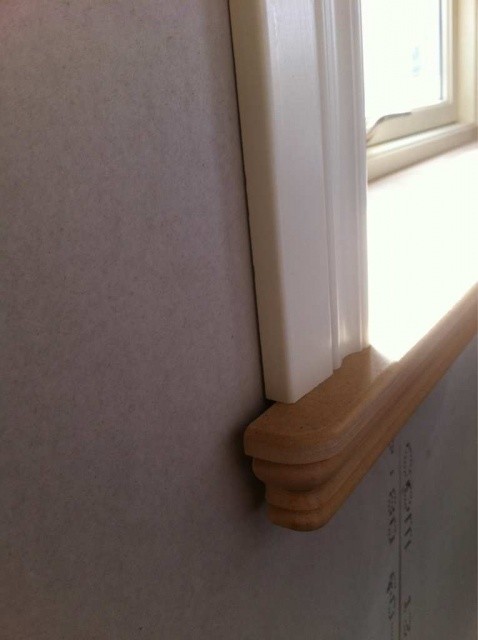
This results in the casing sticking out up to about 6mm from the drywall on the wall.
No casing is too narrow; generally, they stick out.
And I'm not entirely satisfied with this.
At the front edge of the window sill, I plan to glue and screw a profile milled strip, made of two glued strips of 22mm MDF, profile milled and rounded.
The window trim will thereby "stand" on this.
I've done a test fitting, and you can see that it's crooked, large gaps, etc.
I've been thinking back and forth about how to solve this.
The best I can come up with is to invest in a multi-tool, like a Fein/Bosch GOP or similar. Hold the blade against the drywall and longitudinally cut the casing flush with the drywall.
Then go over it with a sander to tidy it up.
What do you think, pros/cons, are there better ways to solve the problem?
I can provide a picture when I get home from work...
PS
I wasn't entirely sure if this is construction technique or window or tool...
Feel free to move it if it's misplaced...
DS
19mm MDF, attached to the frame with Lemafix.
These casings are cut to a specific size/width with a miter saw.
However, the walls lean slightly, or the windows are not exactly aligned to the measurements.
This results in the casing sticking out up to about 6mm from the drywall on the wall.
No casing is too narrow; generally, they stick out.
And I'm not entirely satisfied with this.
At the front edge of the window sill, I plan to glue and screw a profile milled strip, made of two glued strips of 22mm MDF, profile milled and rounded.
The window trim will thereby "stand" on this.
I've done a test fitting, and you can see that it's crooked, large gaps, etc.
I've been thinking back and forth about how to solve this.
The best I can come up with is to invest in a multi-tool, like a Fein/Bosch GOP or similar. Hold the blade against the drywall and longitudinally cut the casing flush with the drywall.
Then go over it with a sander to tidy it up.
What do you think, pros/cons, are there better ways to solve the problem?
I can provide a picture when I get home from work...
PS
I wasn't entirely sure if this is construction technique or window or tool...
Feel free to move it if it's misplaced...
DS
Often you want it to stick out between 5-10 mm so that you can apply a seal against the wall or wallpaper out onto the smyg to avoid seeing the crack that forms between the materials. Should the smyg be flush with the wall? How do you achieve that without cracking?


Is the trim attached to the window? Otherwise, the natural thing to do before fixing the trims is to draw a small line along the wall and then adjust for the wall's tilt, either with a circular saw or in the table saw. I think it’s best to do this against the window frame because there will be a flexible joint there and no requirement for an exactly straight cut. Against your trim, you want a straight cut since attaching the trim to the window trim is complicated enough already.
If the trim is attached to the window/wall, I would probably use an electric planer and shave off a couple of millimeters. A multi-tool will give a very rough cut surface.
If the trim is attached to the window/wall, I would probably use an electric planer and shave off a couple of millimeters. A multi-tool will give a very rough cut surface.
Yeah, I agree...
However, it's already stuck, glued.
A colleague suggested using a router. Let the bearing run against the gypsum.
What's left then are the corners, where you can't reach with the router.
I think that should work, maybe I'll pick up a metal strip from the tinsmith first.
So that the bearing on the steel doesn't go into the gypsum...
However, it's already stuck, glued.
A colleague suggested using a router. Let the bearing run against the gypsum.
What's left then are the corners, where you can't reach with the router.
I think that should work, maybe I'll pick up a metal strip from the tinsmith first.
So that the bearing on the steel doesn't go into the gypsum...
Click here to reply