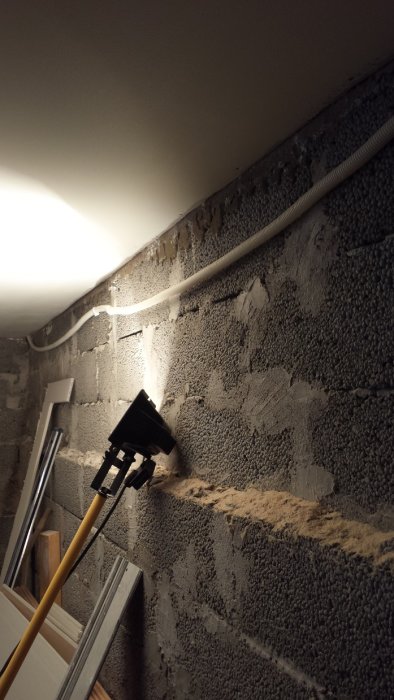
When I was building the garage, I ran out of the right dimension of leca blocks and was in a hurry, so I continued building with a smaller dimension, which I'm paying for now.
I have 3 known options:
1) Pouring concrete - it's a hassle to make a mold and all that... Energy-wise, it might not be the best either, I guess.
2) "Lightweight concrete board," something I haven't worked with, but a guy I know who does plastering thought it could be sensible.
3) Foam plastic, 50mm or a little less. - Better insulation is always appealing.
4) Plaster really thickly - Sounds labor-intensive and unnecessary.
Regardless of the solution, the wall will later be plastered (to a reasonable thickness) and become smooth and clean, so there will be no aesthetic difference. Therefore, the arguments will perhaps involve the amount of work, energy, strength (I will mount wall rails with brackets), etc.
The outside of the wall has 20 cm of insulation, and the space is about 60 cm high and 5 meters long.
felix: Casting is possible, but it's quite fiddly.
corre: It's not just a couple of boards, it's a whole day's cutting or something
Do you have arguments against buying long boards and fitting them in? Both cellplast and lättbetongskiva fill the entire height in standard format, so you just place a few boards on the width. You're probably going to get better strength with your solutions, but it's likely more work as well? I'm not really sure how to secure the boards I'm talking about, but I guess with glue, or by plastering/mortaring them in place.
Lightweight concrete panel works excellently, but it probably costs a bit more? It can be glued with special adhesive or likely regular fine concrete and then plastered with plastering mortar.
I would have avoided polystyrene, mostly to achieve the same type of wall all the way.
Otherwise, there are concrete slabs that are 45 mm thick that are sold as garden slabs in slightly different sizes. A cheap and quick way to fill with concrete without casting.
Interesting idea with concrete slabs too! That should be investigated. Then maybe I can find slabs that are about 55 cm so I can fit a couple of cable conduits as well.
Thanks for the thoughts, I'll get back with a result!
Click here to reply
Vi vill skicka notiser för ämnen du bevakar och händelser som berör dig.