
Hello!
I recently conducted a thermography on an extended room which showed lots of "infiltrations" of cold air. My conclusion is that the vapor barrier was not properly sealed with tape or similar. I wonder if anyone has suggestions on the best way to fix this? The walls have OSB+gypsum and behind that is the foil, probably we need to open them as the first step. All inputs are welcome.
I recently conducted a thermography on an extended room which showed lots of "infiltrations" of cold air. My conclusion is that the vapor barrier was not properly sealed with tape or similar. I wonder if anyone has suggestions on the best way to fix this? The walls have OSB+gypsum and behind that is the foil, probably we need to open them as the first step. All inputs are welcome.


If you have the vapor barrier directly behind the OSB board, you can't avoid holes in it.Jschoenf87 said:
Hello!
I recently conducted a thermographic assessment on an extension room that showed lots of "infiltrations" of cold air. My conclusion is that the vapor barrier wasn't sealed properly with tape or similar materials. I'm wondering if anyone has suggestions on the best way to repair this? The walls have OSB + plasterboard, and behind that, there's the foil. Most likely, we'll need to open them as the first step. All inputs are welcome.
The only way to avoid holes is to have an installation rule as a buffer.
That means the vapor barrier is mounted directly on the frame, and on the outside, you mount a 45x45 or 28x70, then OSB and plasterboard.
I am completely onboard with the smaller screw holes etc. I can consider those negligible but definitely not optimal.
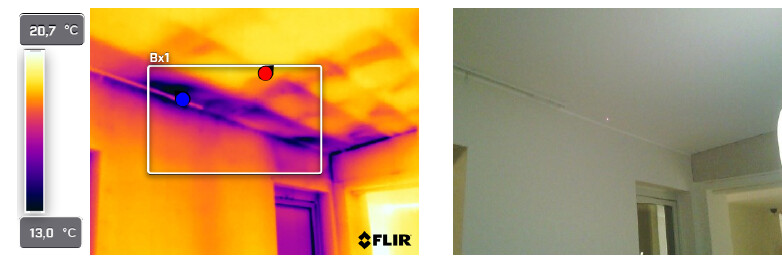
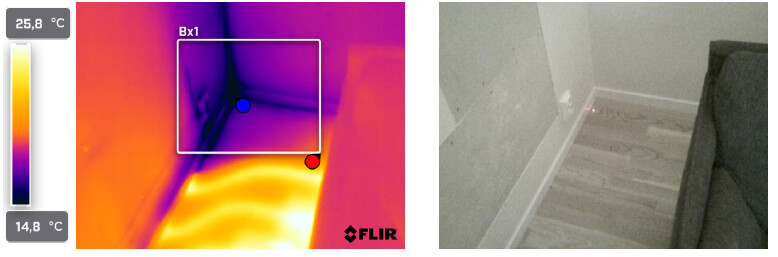


My thought too, but I know too little about thermal cameras.
Looks like thermal bridges/poor insulation.
Is it drafty, or are you checking thermographically out of curiosity?
How does your house look otherwise?
Looks like thermal bridges/poor insulation.
Is it drafty, or are you checking thermographically out of curiosity?
How does your house look otherwise?
The entire test is conducted by creating a vacuum in the house, extracting all the air from it, which causes cold air to be drawn in if there are leaks. Then, all areas are inspected with a thermal camera.
Interesting with the insulation aspect. It would make things easier.
Interesting with the insulation aspect. It would make things easier.
But what kind of supply air is there in the extension?
What does the ventilation look like otherwise?
Finally, the air must come from somewhere.
there is a 10cm air supply installed. The house has a mechanical exhaust system, it works fine.Dr Benz said:
and yes, you can feel some cold drafts + the room doesn't warm up properly even though the heat is on max.
Ok. It looks like underfloor heating. And it also looks like the loop doesn't extend all the way to the interior wall? And also a window in the same area. Could that be enough to create what's shown in the picture?
If it is so poorly sealed, you should be able to max out the ventilation and hold a candle where it looks cold. One should be able to see flickering there if that's the case?
Otherwise, I'm thinking outer wall and thermal bridge insufficient insulation.
Do you have pictures from the actual construction?
Is it drafty in the room or is it just something discovered by chance?
It started when I felt a draft in the pocket frame of the sliding door that sits between the existing house and the extension. It wasn't sealed at all with tape/soft seal and wood, there was just a piece of wood. A lot of cold air was blowing in there. This has been improved now, but there are other places left as you can see.Ok. It looks like underfloor heating. And it also looks like the coil does not go all the way out to the inner wall? And additionally a window in the same area. That may be enough to get it as in the picture?
If it is so poorly sealed you should be able to max out the ventilation and hold a light where it looks cold. I think you should be able to see flickering there if so?
Otherwise, I'm thinking exterior wall and thermal bridge with inadequate insulation.
Do you have pictures from the actual construction?
Is it drafty in the room or is it just something discovered by chance?
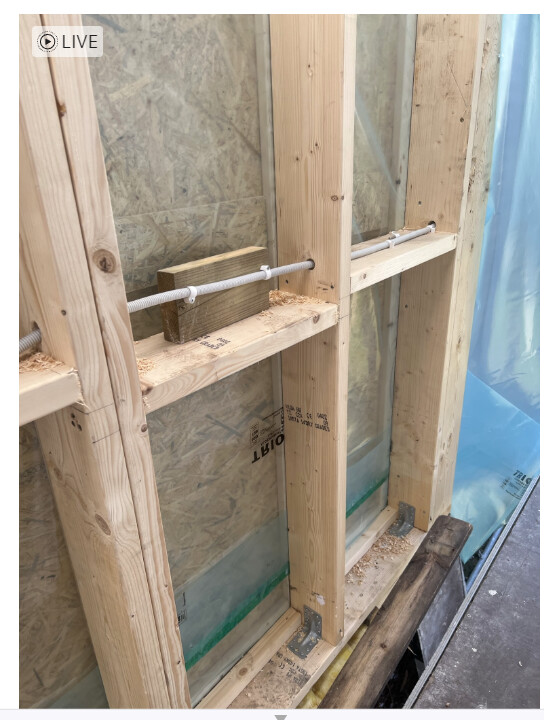
Here's a picture from one corner of the room before insulation in the wall
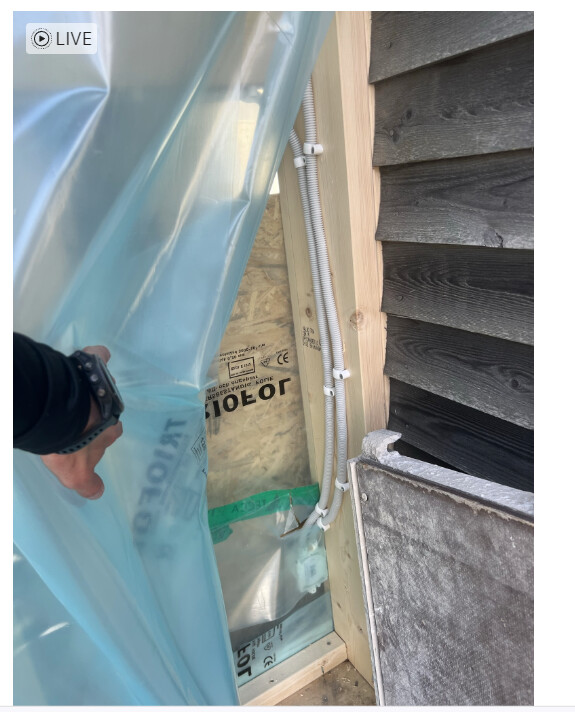
connection to the house (the electric box must be 100% better sealed)
Yes. But then you have a reason that it is not sealed. Unfortunately, I can't give you tips on how to fix it other than the obvious answer...It started with me feeling a draft in the pocket frame of the sliding door that is between the existing house and the extension. It was not sealed at all with tape/sealant and stud connection, there was just a stud. A lot of cold air was blowing in. This has been improved now, but there are other places left as you can see.
Here's a picture from one corner of the room before insulation in the wall
[image]
connection to the house (the electrical box must be sealed 100% better)
[image]
It's just so frustrating that when something is done, it's not done properly...