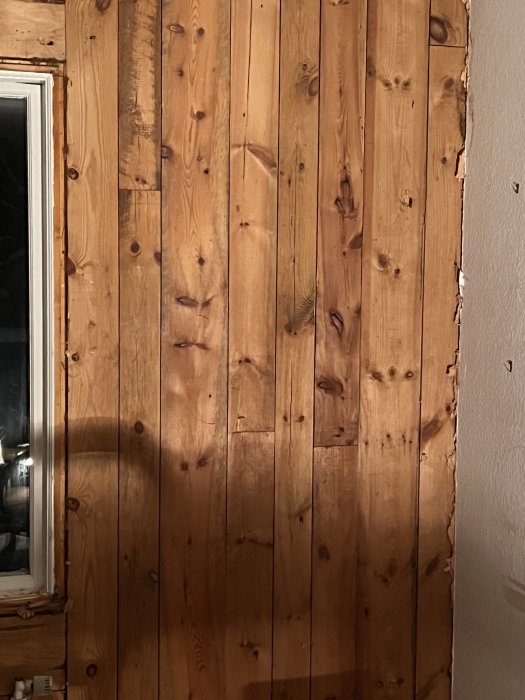
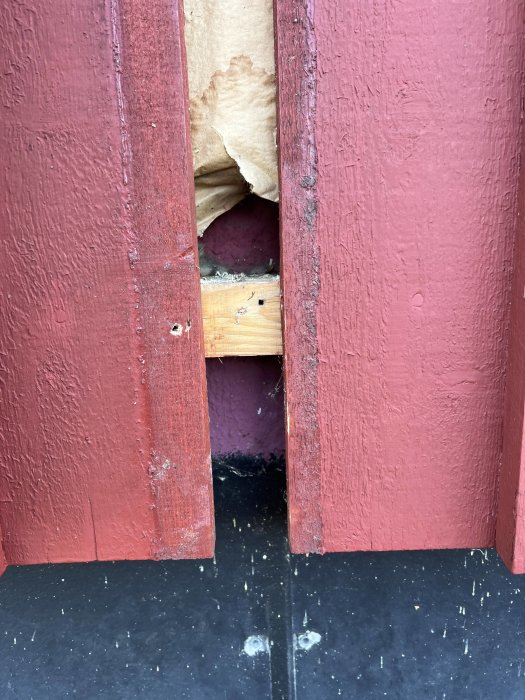
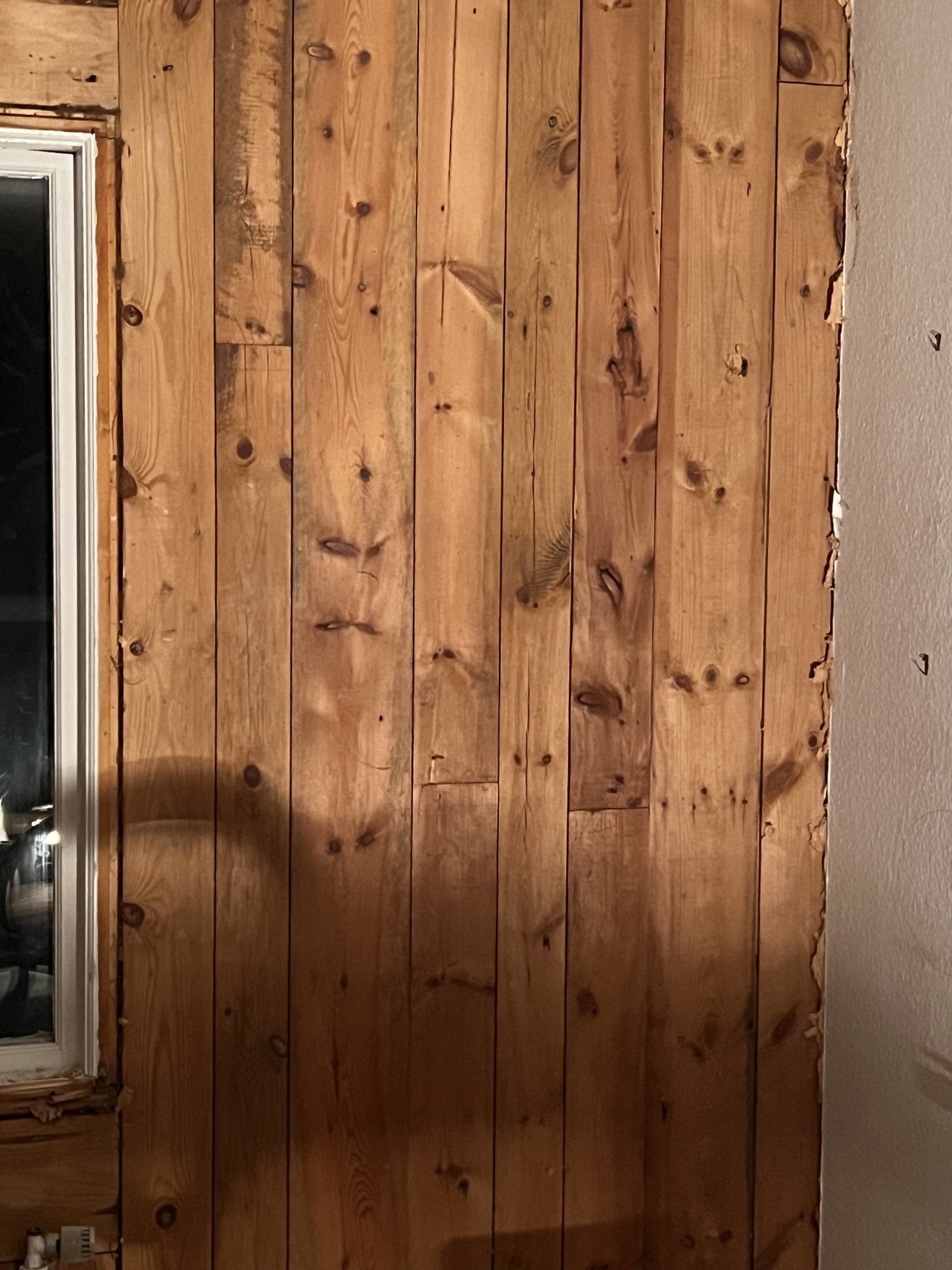
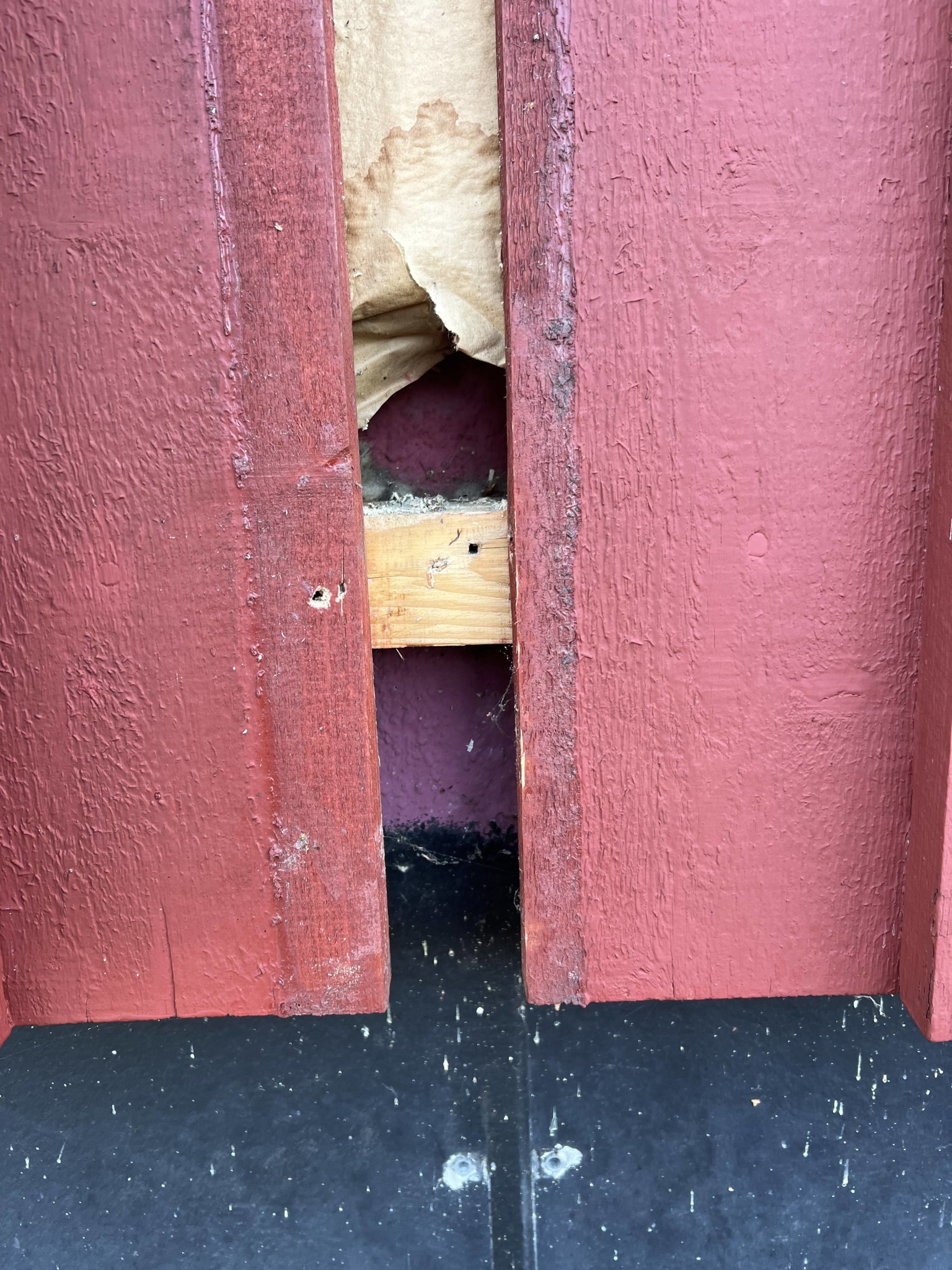
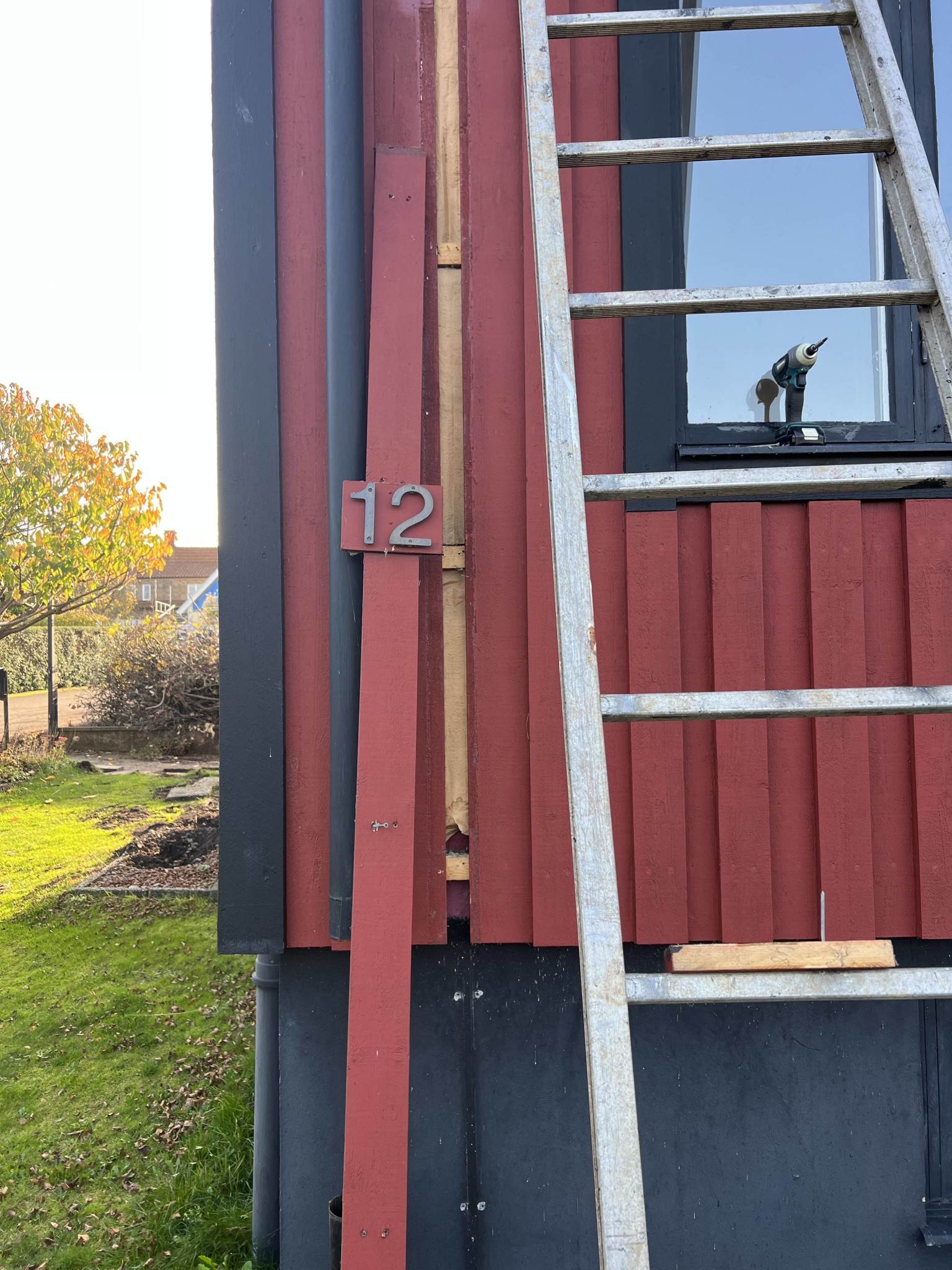
I am renovating a house built in 1940. Today it has vertical paneling with a framework attached to plaster and some insulation between the plaster and the panel. Behind the plaster, there are vertical wooden studs, and on the inside, there's Tretex and wallpaper.
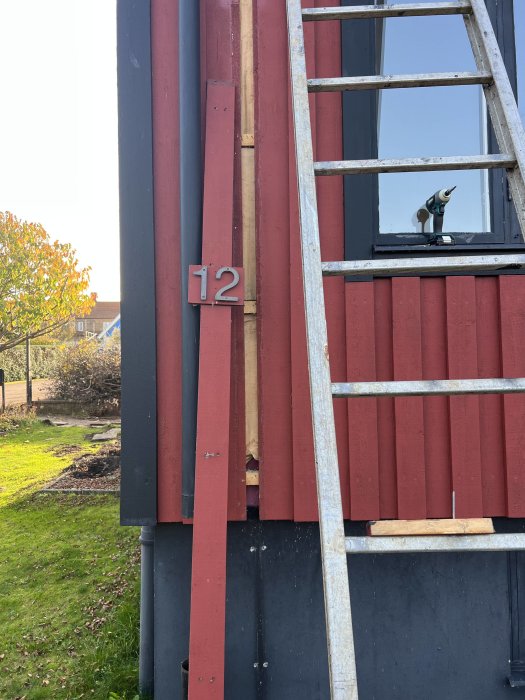
The plan is to switch to horizontal paneling, add facade board insulation (battens outside the insulation as an air gap, of course) and a wind barrier on the plaster. Then on the inside where the vertical studs are, I will install an age-resistant foil, horizontal framework for wiring, and then OSB and gypsum board.
Do you think I am on the right track?
A carpenter said I could install a wind barrier on the inside instead of the age-resistant foil? What do you think about that? Pros and cons?
How thick additional insulation would you put on the exterior wall?
Is a West Coast board better than a facade board? Pros and cons?
I am renovating a house built in 1940. It currently has vertical paneling with studs attached to plaster and some insulation between the plaster and the paneling. Behind the plaster are vertical wooden studs and on the inside, there's tretex and wallpaper.
The plan is to switch to horizontal paneling, add insulation to the facade board (battens outside the insulation as an air gap obviously) and add a wind barrier paper on the plaster. Then on the inside, where the vertical studs are, I will put an age-resistant foil, horizontal studs for electrical wiring, and then OSB and gypsum board.
Do you think I am on the right track?
A carpenter said I could use wind barrier paper on the inside instead of age-resistant foil? What do you think about that? Pros and cons?
How thick additional insulation would you put on the exterior wall?
Is it better to use a west coast board than a facade board? Pros and cons?
Thanks in advance!
Best regards, Thomas
[image] [image] [image]
What type of insulation do you have in the walls? Chips, mineral wool, treetex boards?
Plastic doesn't serve a good function if it doesn't overlap with a possible diffusion barrier in the ceiling, thus creating a completely tight shell; an alternative is a vapor brake. A rule of thumb is that the membrane on the outside should be 5x more permeable than the membrane on the inside.
Something that should also be considered is where the dew point in the new wall will be, where the rule is that the diffusion barrier/vapor brake can be at most 1/3 into the wall construction to ensure that any moisture does not condense on the inside of the plastic but problems can still occur if the existing insulation material in the exterior wall has poor insulation ability in relation to the new one.
Additionally, there are certain systems of facade boards where the boards themselves are dense and correctly mounted create a windproof shell where the outside does not need to be covered with a membrane.
What type of insulation do you have in the walls? Sawdust, mineral wool, treetex boards?
Today it's treetex directly on the wooden wall. But the question is whether you should have a vapor barrier/age-resistant foil or wind paper (the same as on the outside) on the inside of the wooden wall??
Today it's treetex directly on the wooden wall. But the question is whether to use a vapor barrier/age-resistant foil or windproof paper (the same as on the outside) on the inside of the wooden wall??
What do you have in the ceiling towards the attic? If you don't have plastic there, I wouldn't install plastic on the walls.
If you can't ensure it will be completely airtight, plastic should be excluded imo. Especially in a wooden structure, as the plastic, due to its tightness, creates greater moisture pressure where the plastic doesn't exist. A vapor barrier creates a much more forgiving construction if you can't guarantee complete tightness.
Towards the ceiling, there is currently tree -tex and then a wooden roof and loose polystyrene in the attic that should be removed and replaced with loose fill insulation instead.. but the plan is to also add a vapor barrier/age-resistant foil in the ceiling.
We are basically blowing out the whole house, both inside and outside! The only things that will remain are the wooden wall and the rendered plaster on the outside. For the ceiling, I am thinking of the wooden roof, foil, a frame for electrical wiring, and then a gypsum ceiling. Is that a wrong approach??
Against the ceiling today is tree-tex and then wooden ceiling and loose polystyrene insulation in the attic that will be removed and replaced with loose-fill insulation instead. But the idea is to also install a vapor barrier/age-resistant foil in the ceiling.
We are completely renovating the whole house, both inside and outside! The only thing that will remain is the wooden wall and the rendered plaster on the outside. For the ceiling, I'm thinking of the wooden ceiling, foil, framing for electrical installations, and then plaster ceiling. Is that the wrong approach?
Exciting, two years ago I carried out a similar total renovation in our house built in '43, a classic own home house. In my case, I tore everything down and only kept the roof trusses and the roof sheathing and opened the outer wall frame all the way out to the back of the outer wall panel (it should be noted that in my case an additional insulation with west coast board and new outer panel was already done in '76 when an extension was built).
In the ceiling, I would recommend a variable vapor barrier and cellulose insulation as the greatest evaporation happens upwards, and cellulose insulates better and has the ability to absorb moisture to some extent, which better protects houses with wooden construction.
A tip could be to also use cellulose as the insulation choice in the installation zone, as the products on the market today surpass mineral wool by about 4x in insulation value according to some manufacturers. However, keep in mind, like mentioned above, where you might place your dew point.
And no, I do not work for any cellulose insulation manufacturer, but I am completely sold on the concept that one should build like they did around the 1940s and not mix in plastic, mineral wool, polystyrene, etc., in older wooden houses.
Click here to reply
Vi vill skicka notiser för ämnen du bevakar och händelser som berör dig.

T A said:
Hello!