Hello.
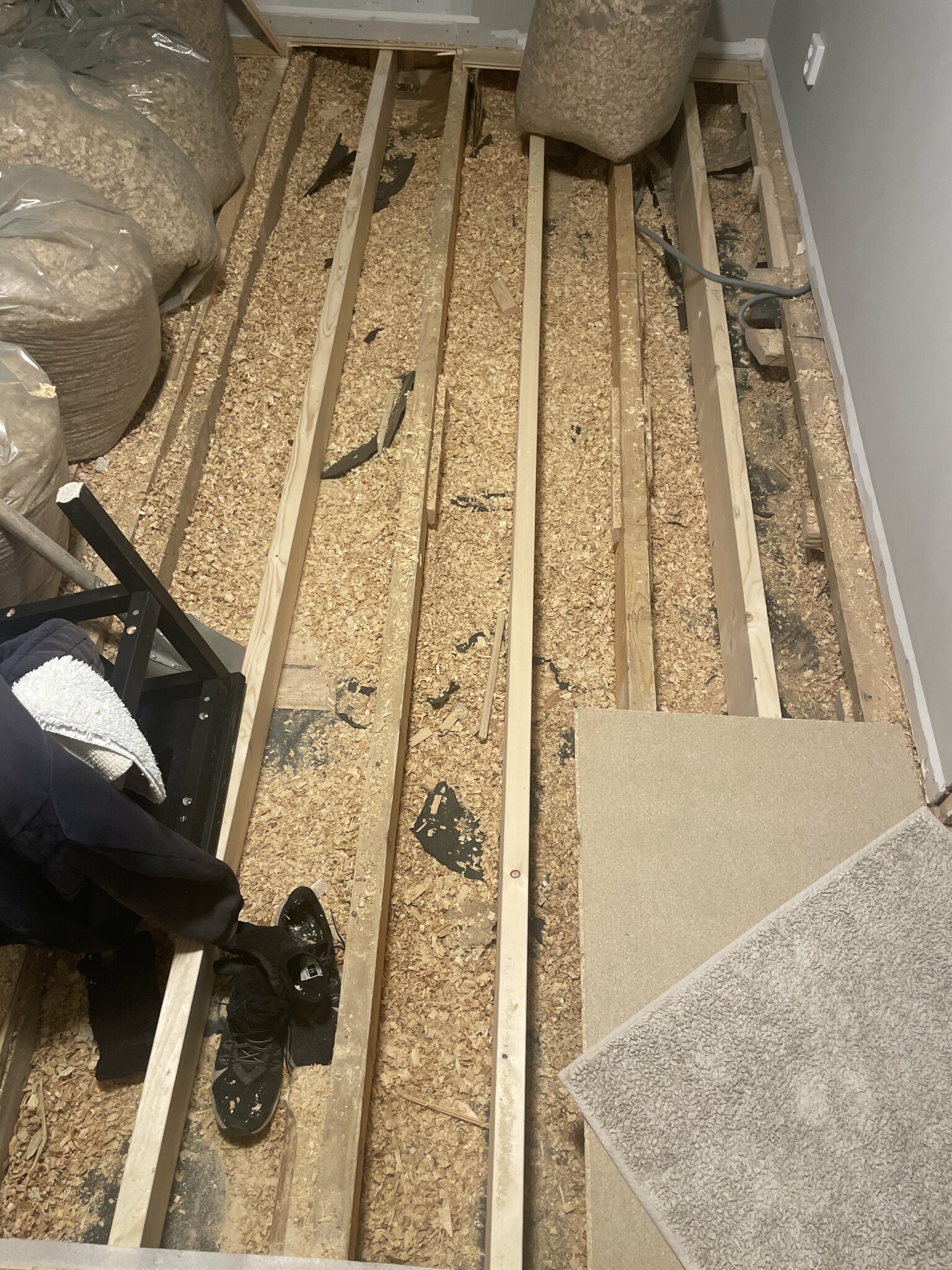
I have had a floor on the upper level that flexes, allowing sound to travel clearly down to the lower level, where you can both see and hear the ceiling light shaking (on the lower level). In my son's room on the upper level, toys can fall over when jumping on the floor.

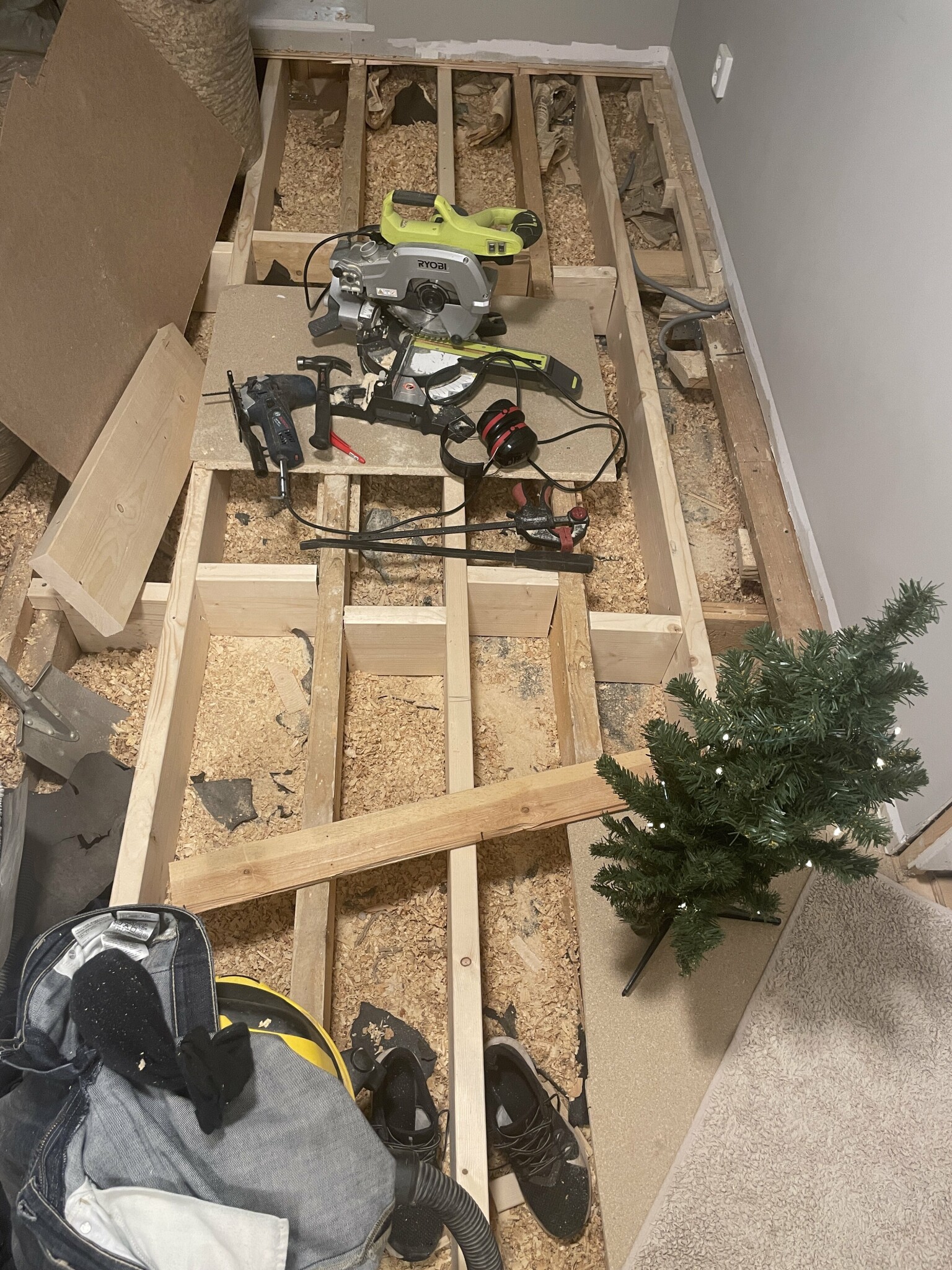
I have now entertained myself by installing cc30 instead of cc60, see image.
The span is about 3600mm, and I have installed C24 -195x45s which are supported on either side by the lower level walls.

It still doesn't feel completely solid.

Do you have any tips on what I can do before I put it all together for maximum 'sturdiness'?

The floor before was 18mm + parquet; I plan to maintain the same height for a floating floor.
I have tongue-and-groove wood from the 1950s that I plan to use. Or should I consider chipboard?

I placed two rows of nogging according to the messy image on the right.

All tips are welcome.
 
  • Wooden floor joists with sawdust filling, visible subfloor structure, carpet piece on the right, bags of material on the left, and scattered tools.
  • Wooden floor construction with sawdust, a circular saw, tools, and a small tree on a partially completed floor.
T
It won't feel solid until you've installed the underfloor and parquet. To make it as solid as possible, I would glue and screw the chipboard onto the joists with staggered joints and then lay parquet on top.

To dampen impact noise to the floor below, some form of insulation is recommended between the joists, preferably something dense like rock wool.

We have a span of about 380 cm and 45x220 at c/c600 mm and short-lathed with the same c/c. It was a bit soft when we just laid boards loosely on, so we glued and screwed a 45x95 onto each beam. It still felt soft... then we glued and screwed chipboard on top, and it got much better.
 
Click here to reply
Vi vill skicka notiser för ämnen du bevakar och händelser som berör dig.