
Long story short (see previous thread from September). The company renovating the bathroom in my mom's house made large cutouts in the floor joists, with questionable reinforcement afterwards.
About a week ago when they leveled the floor, I discovered it was thicker on one side than the other. The floor slope in the bathroom seemed correct, though. I used a 180cm spirit level and measured just outside the bathroom, and it differed maybe 3-4mm over 180cm. When I measured from the other support, I got similar results. It's about 3.6m between the supports, and the kitchen is also over the same joists as the bathroom.
An engineer hired by the project manager did a calculation that said the load-bearing capacity was okay (done before I discovered the leveling). However, he completely ignored the information about the distance between the supports, and that the kitchen is over the same joists. He only calculated based on the bathroom's width and a standard weight. Is that the usual method?
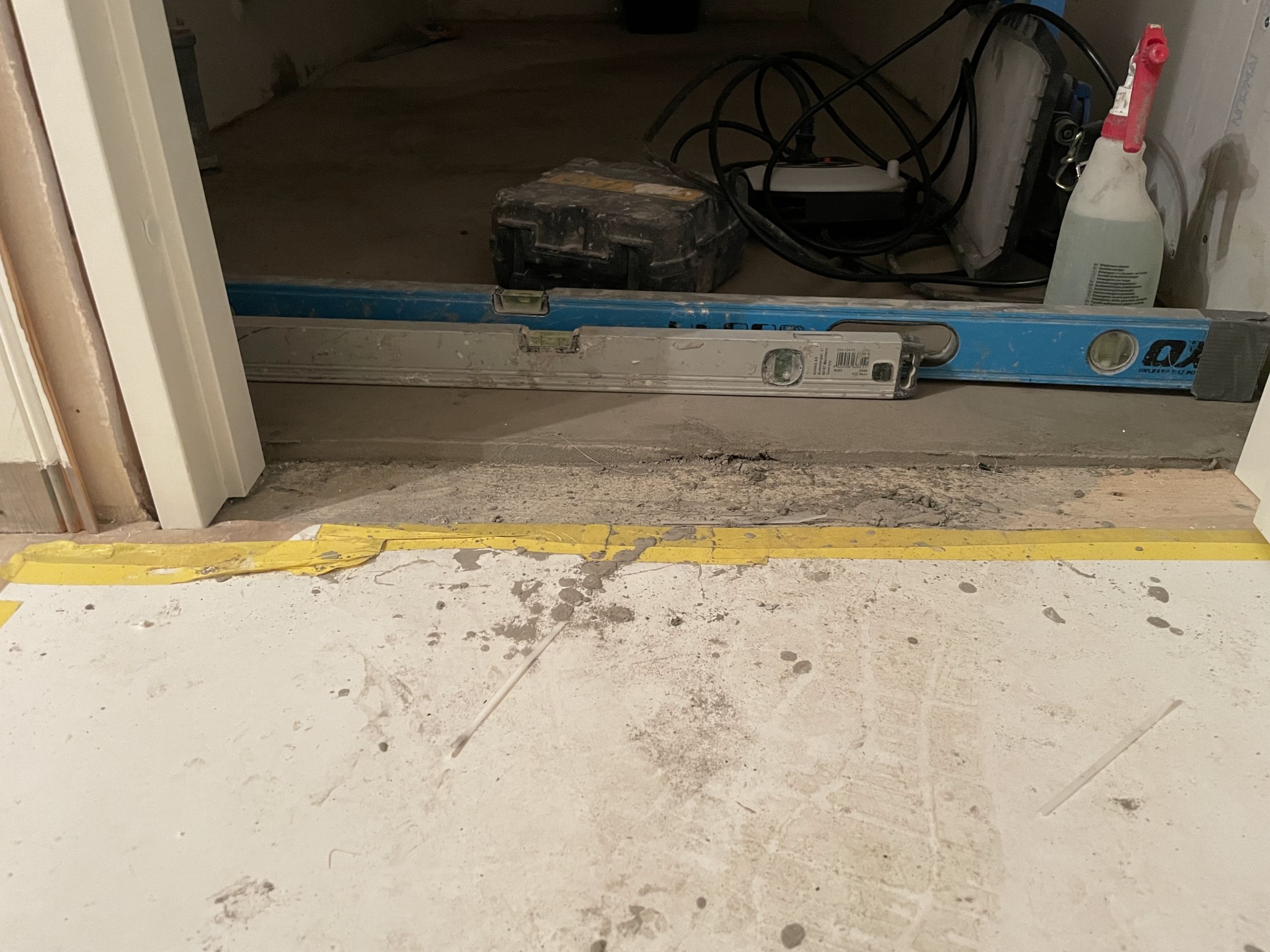
Today, my mom discovered that the threshold to the bathroom differs, just like the leveling. She then checked the ceiling downstairs under the bathroom and found that the ceiling tiles have started to separate at the seams. She got the same result as I did upstairs when she measured the ceiling with the spirit level. It seems like the joists have sagged a bit, but how much difference is allowed before it becomes a problem?
When we measure a bit further into the house away from the bathroom where the joists are untouched, it's completely straight. There wasn't any tilt on the old bathroom either.
About a week ago when they leveled the floor, I discovered it was thicker on one side than the other. The floor slope in the bathroom seemed correct, though. I used a 180cm spirit level and measured just outside the bathroom, and it differed maybe 3-4mm over 180cm. When I measured from the other support, I got similar results. It's about 3.6m between the supports, and the kitchen is also over the same joists as the bathroom.
An engineer hired by the project manager did a calculation that said the load-bearing capacity was okay (done before I discovered the leveling). However, he completely ignored the information about the distance between the supports, and that the kitchen is over the same joists. He only calculated based on the bathroom's width and a standard weight. Is that the usual method?
Today, my mom discovered that the threshold to the bathroom differs, just like the leveling. She then checked the ceiling downstairs under the bathroom and found that the ceiling tiles have started to separate at the seams. She got the same result as I did upstairs when she measured the ceiling with the spirit level. It seems like the joists have sagged a bit, but how much difference is allowed before it becomes a problem?
When we measure a bit further into the house away from the bathroom where the joists are untouched, it's completely straight. There wasn't any tilt on the old bathroom either.
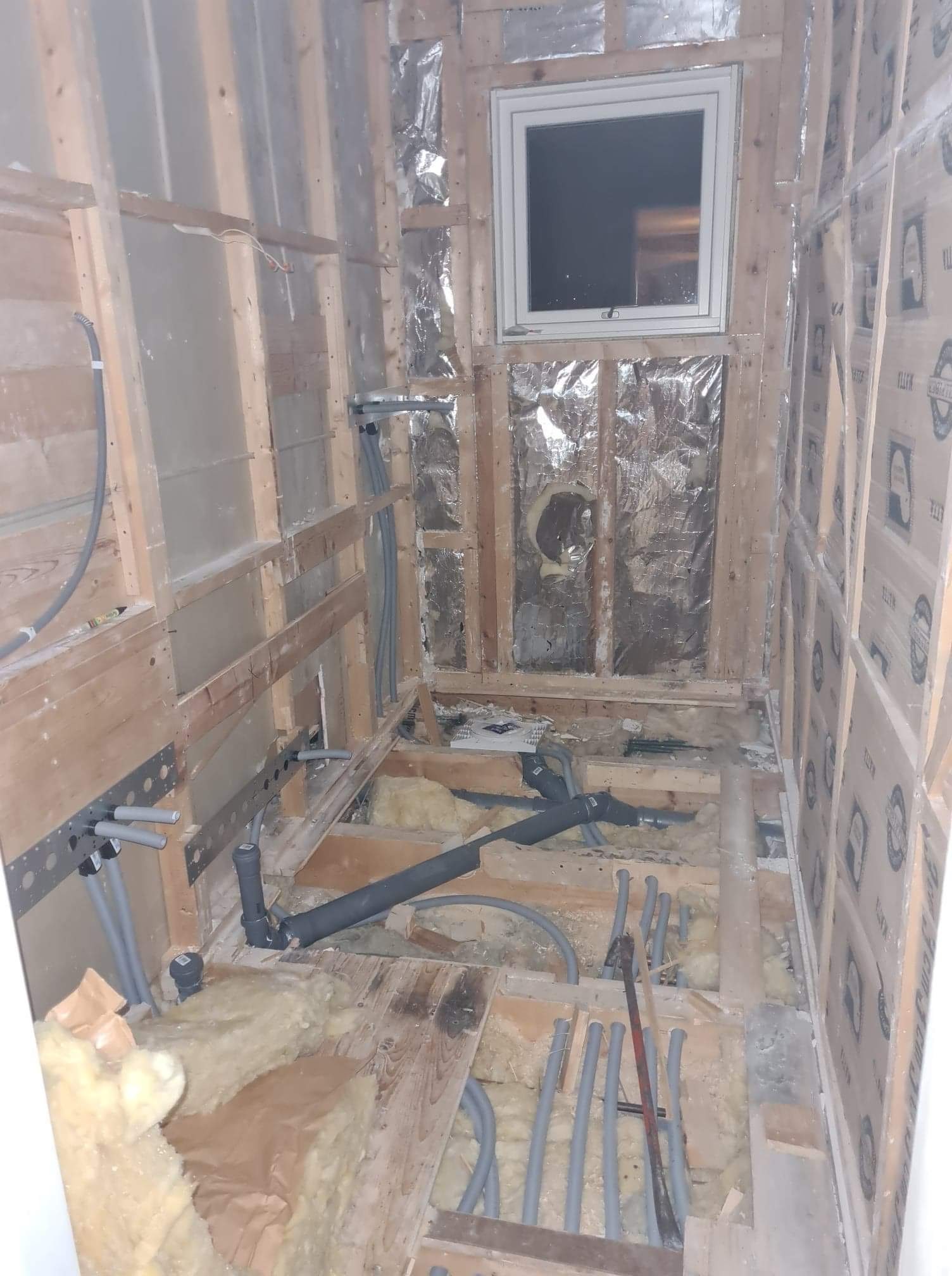
Unfortunately, it often looks like this after new plumbing installations and from a load-bearing/functionality standpoint, it doesn't look good. It also seems to be a bit wider between the studs than "normal." Regarding your question about the designer, it is a mistake if he only calculated based on the bathroom's width unless the beams have this length between the supports. What you can do is request to see the calculation. In the short term, there are probably no issues (maybe a bit more sway in the floor), but in the longer term, the floor structure will deform further due to creep, and this can lead to tiles coming loose or grout cracking.
Yes, that's what we're a bit worried about too...B bossespecial said:Unfortunately, it often looks like this after new piping installations, and from a load-bearing/function perspective, it doesn't look good. It also seems to have a slightly wider spacing between the studs than "normal." Regarding your question about the structural engineer, it's wrong if he only calculated based on the bathroom's width unless the joists have that length between the supports. What you can do is request to see the calculations.
In the short term, it's certainly not a problem (maybe a bit more wobbling in the floor), but in the longer term, the flooring will deform further due to creep, and then, for instance, tiles could come loose, or grout could crack.
Here are the structural calculations. I can't see that he took the cutouts into account or whether the reinforcement they did was okay, but I have no idea how to read a structural calculation.
He hasn't been on site in the house, just received numbers from the project manager. When I questioned which numbers he received, I only got some snobby reply that didn't answer the question...

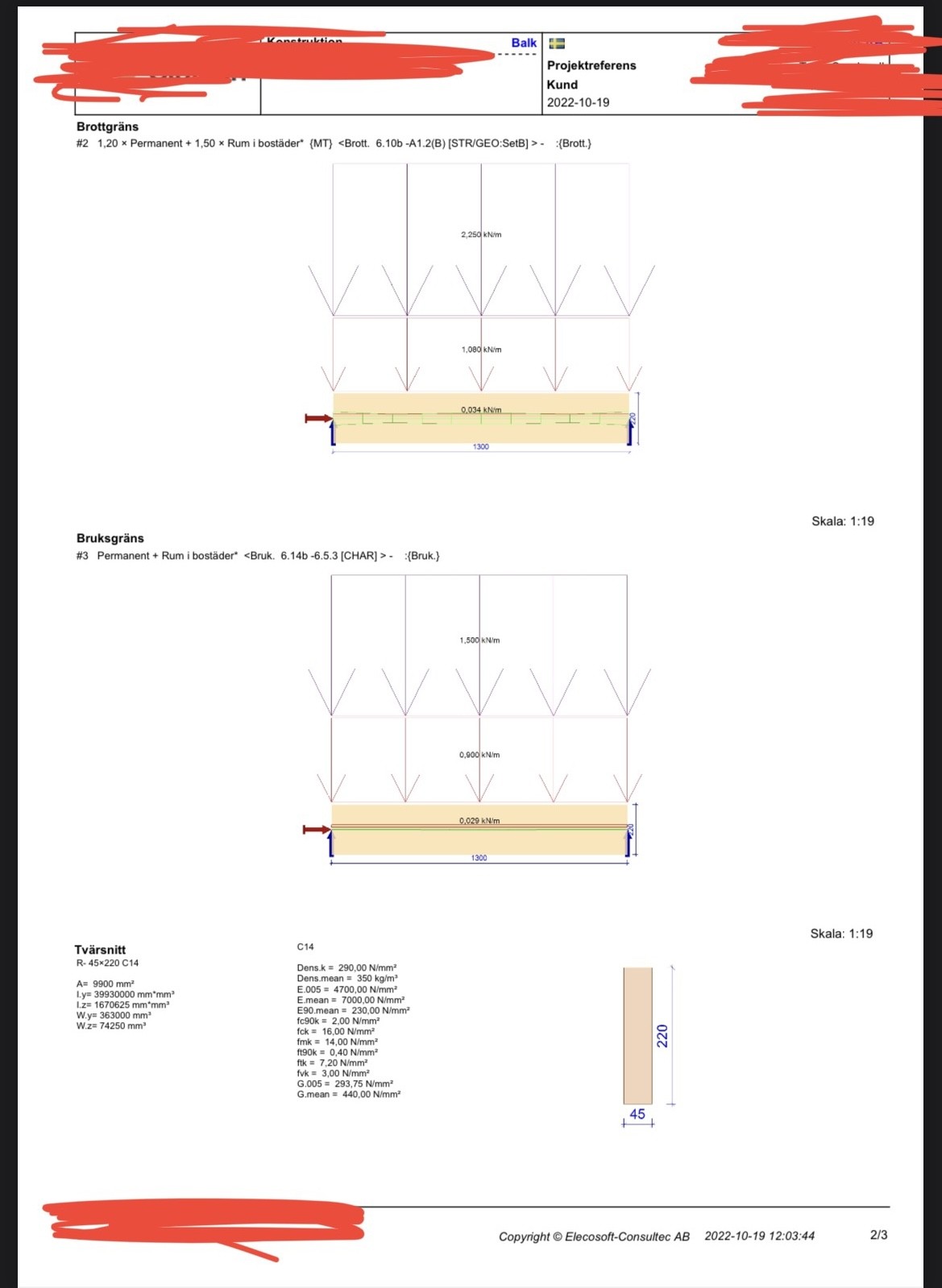

Based on this calculation, it's completely wrong and doesn't seem to apply to this bathroom. Wrong span (assuming there are no supports under the bathroom walls), from the pictures it looks like the spacing and dimension are incorrect, and no notches or holes are included in the calculation.Lity said:
Yes, that's what we're a bit worried about as well...
Here is the construction calculation. I can't see that he's included the notches or whether the reinforcement they did was okay, but I have no idea how to read a construction calculation.
He hasn't been on-site at the house, just got numbers from the project manager. When I questioned which numbers he received, I only got some snooty reply back that didn't answer the question...
Isn't that right? No, there is a rec room underneath, which is at least 1m longer than the bathroom. Supports are along the right long side of the bathroom (a concrete/brick wall underneath), and the next support along the left long side is by the outer wall which is about 2.3 m from the left long side of the bathroom. To the left of the bathroom is the kitchen. The kitchen is U-shaped and loads the exact same beams as the bathroom.B bossespecial said:
They used EPS concrete to "reinforce" the cut-outs, instead of 22mm particle board. It was applied incorrectly and was laid pretty much directly on the basement ceiling, and he didn't encapsulate it beforehand, so it has leaked cement fluid (water, cement, and glue-like) along the ceiling and dripped down into the rec room. It's probably not mixed correctly either, because it just crumbled when you scraped it. According to the EPS companies, it is not okay as an alternative to reinforcing cut-outs. It is actually a replacement for the particle board. It can contribute insulation and lateral stability, however, but that was not the problem either...
The most serious cut-outs were on the two innermost beams. The innermost one was 14cm high and about 20cm wide. The other was 8cm high and 16cm wide, plus incorrect cut-outs for water pipes on the same beam. The beams are 220mm high, so at least that matches the calculation...
It is cc60 (cm) between the beams, and they are a bit sturdier than today's at 70x220. But still... They probably didn't put in sturdy beams just for fun.B bossespecial said:
Click here to reply