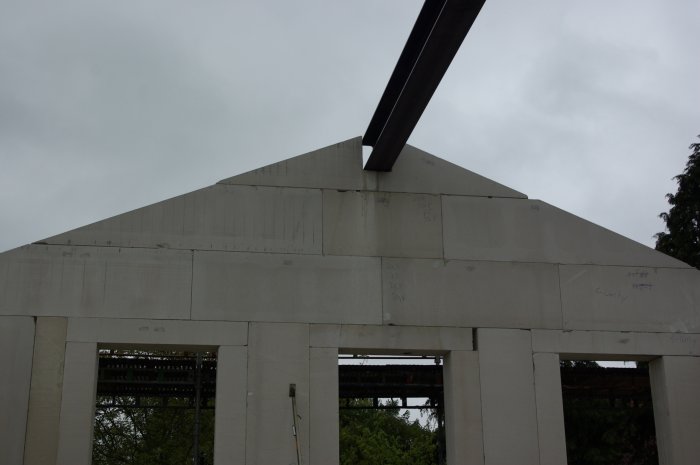
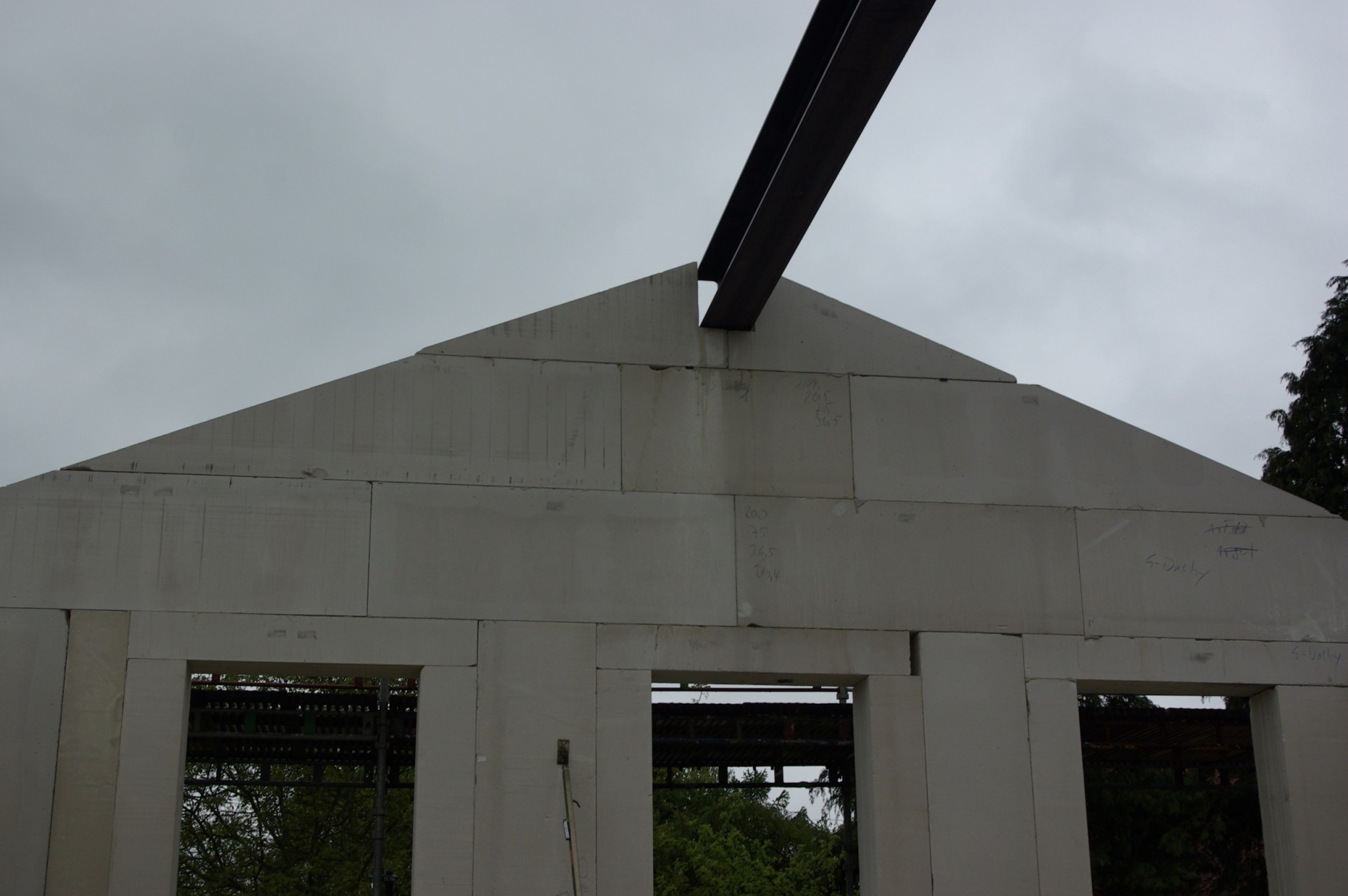
I am building a light concrete house and have just discovered that the construction company has installed a steel I-beam at the ridge to support the roof, instead of a glulam beam as specified in the delivery description.
This is a modification made without my consent.
Is a steel I-beam equivalent to a glulam beam? I can imagine there are pros and cons to both. As a layman, it sounds to me like it would be easier - and therefore cheaper - to handle the insulation of the sloped ceiling (to be done with glass wool panels) and the gypsum of the inner ceiling if you have a glulam beam. It should be easier to attach (drill & nail) into wood than metal, although there are certainly solutions for an I-beam as well.
But since it is not part of the construction company's task - but my own - to insulate the sloped ceiling and do the gypsum work, it sounds like they have made a change that could affect the construction I am to do.
The roof trusses can, of course, be used to attach the insulation and gypsum.
Additionally, it must be fireproofed as glulam has higher resistance to fire compared to metal, which softens and bends. Talk with the engineer about what is required with that change, as well as with the construction company if they have calculated the whole thing and how they will solve the fire safety and also the fastening/insulation for your part.
Still, you should contact the designer or the municipality (which is supposed to approve the whole thing?) so there won't be any issues with the paperwork
I would argue that a steel beam creates a substantial thermal bridge, with the consequent risk of condensation and mold.
How the drywall will be installed depends on how far the trusses will extend down, but it will likely be tricky around the beam, which probably needs to be covered with something that can be screwed into.
I would not accept the change without further discussion, and in any case absolutely consult the designer.
That the steel beam has different (=worse) thermal properties I suspected already earlier, but not that it could be so serious. The person responsible for control is also very surprised by the change.
There is a reason why the designer did not choose a steel beam. The building permit has also been granted with a glued laminated timber beam, so new construction drawings need to be submitted for approval. Attaching something to the steel beam is not a problem, but as mentioned, it is a deviation from the design made by the designer. Now it is the construction company acting as designers and thus responsible for ensuring that the beam is sufficiently sturdy.
The construction company or the person who made the change automatically becomes responsible for the construction if an already approved construction is altered. That responsibility does not remain with the original designer.
As far as I interpret the thread, the difference is against the delivery description. There is no mention that this is a construction change in relation to the building permit. It could be that it was discovered that glulam would need to have unreasonable dimensions when the construction was calculated. And that the delivery description may be an earlier standard description.
What are the dimensions of the house, how long is the span of the beam, and how wide is the roof that loads the beam?
Yes, it is the construction company that is responsible for the constructor, and we had a meeting this morning at the construction site. The construction is halted until we have sorted this out.
Glue-laminated beam is included in the delivery description but also in the construction documents approved by the municipality's building permit department.
The constructor says they switched to a steel beam because there are no glue-laminated beams that are sufficient. The house is 11 meters long, and as mentioned, there are lightweight concrete walls - 365 mm thick. Glue-laminated wood would also, he says, be too bulky and protrude (go too far down through the roof and insulation, if you understand what I mean. Is it true that it wouldn't have worked with a glue-laminated beam?
The constructor is to arrange a new drawing today and also show how they think the issue with the thermal bridge can be solved - they talked about possibly insulating on top of the steel beam. And perhaps even raising the walls a bit to make room for the insulation of the beam. You can understand that they are reluctant to remove the steel beam - it would entail significant costs for them, not just material - glue-laminated beam, and new roof trusses - but also labor costs, carpenters who cannot continue working.
In summary, is it possible to solve the problem with the thermal bridge if the steel beam remains?
It seems there might not be significant issues insulating and plastering with the roof trusses as a base - but they will demonstrate this with drawings as well.