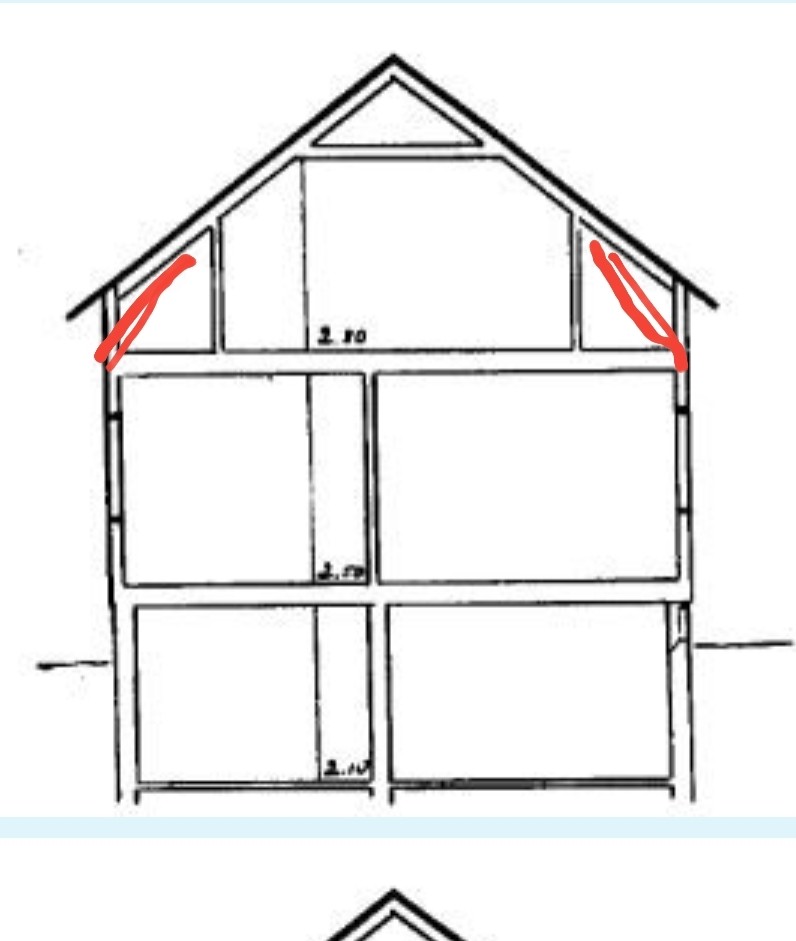
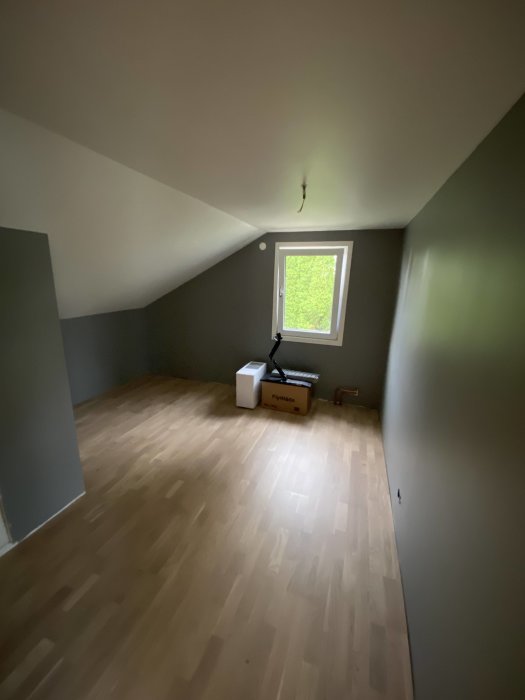
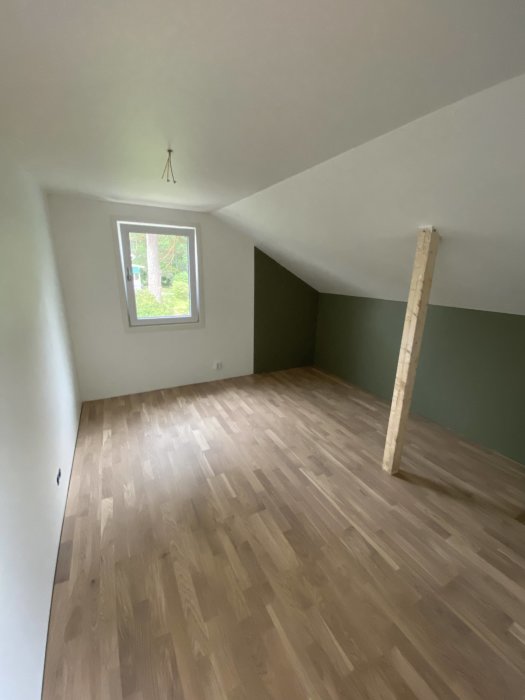
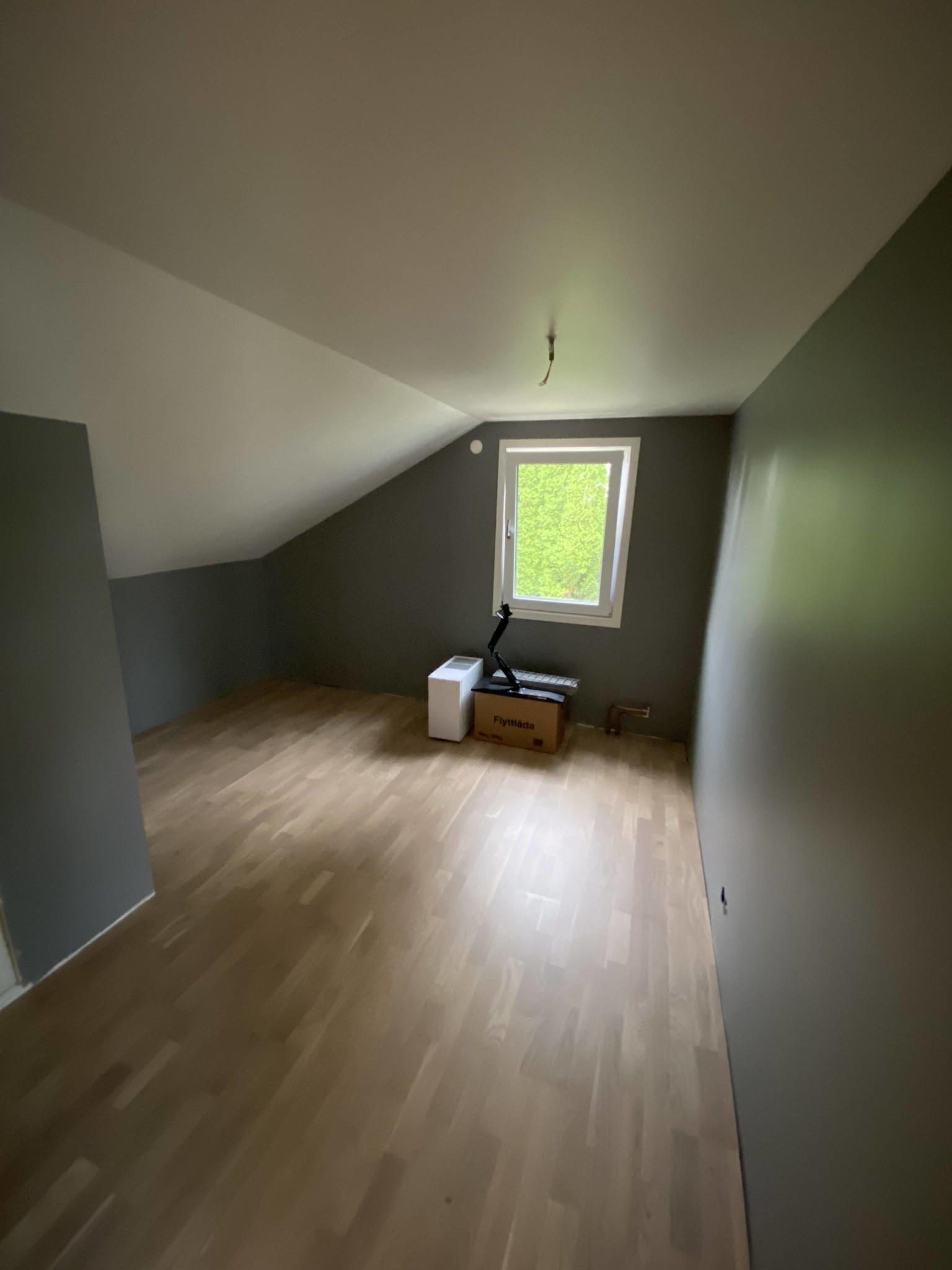
Hi, here is the house plan, so it feels like there is something to it.
The plan you are showing looks exactly the same as for our house and the support beams are not drawn but are placed like this. Do you have the same in reality?
Assuming that the "posts" and other things you removed, pressed downward against the ceiling beam, etc., in the floor below.
The ceiling beam has probably, so to speak, become a bit more tense now, as the roof truss's leg presses outward.
A gap has formed under the ceiling beam and wall posts or other things in floor number 2.
So when someone walks on the floor at the top... Something bangs together.
The drawing you show looks exactly the same as our house, and the support legs are not drawn but are placed like this. Do you have the same in reality?
Two completely different types of roof trusses, you have a Swedish roof truss while TS has a Frame truss.
Regarding over-dimensioned constructions, you have to go back to the 1910s (in some places the 1920s) and earlier, like the whole 1800s. Back then, they used to be quite generous with the material thicknesses.
We have bought a 50s-built wooden house that we have renovated.
One thing we have done is remove the kattvindar to get "bigger rooms."
BUT
When you walk upstairs, it "thuds" very much. (did not do that before)
The closer you get to the demolished kattvindsväggen, the more it thuds.
(it thuds when my 4-year-old walks up there and we sit downstairs, so very sensitive)
The beams running are very substantial, I tried to add even more joists in between, but it didn't work.
Now I'm starting to believe that the walls of the kattvindar had a function that pressed down the beam that goes along the house's long side and thus made it "solid."
In the areas where we still have the kattvindar, the floor is excellent.
Has anyone experienced the same?
My thought is to put up a couple of heavy joists to "press down" this beam at the wall sides.
Or does anyone have a tip?
Would be very grateful for that.
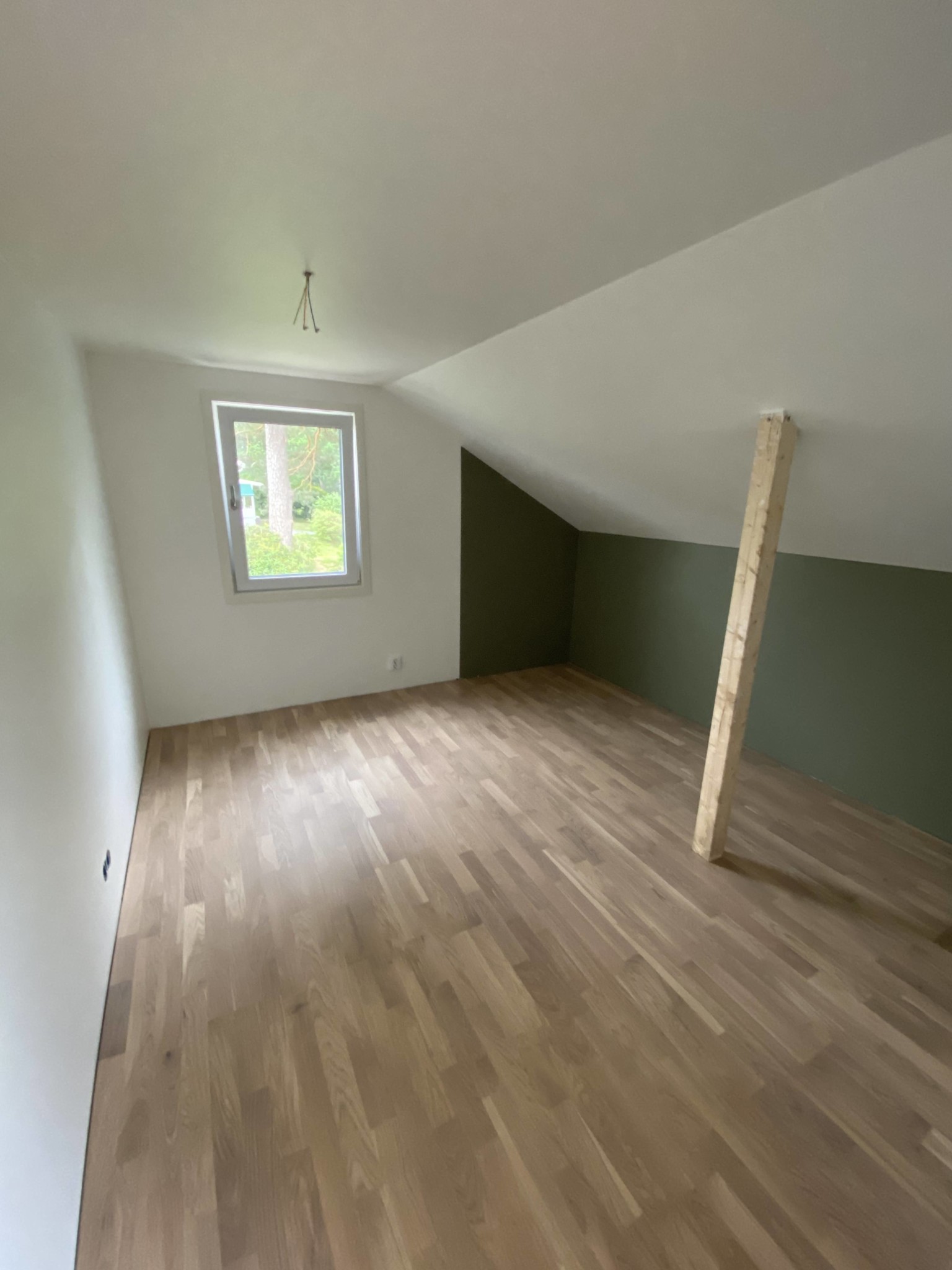
Here is a picture when the floor is open, and the green line is where the kattvind was previously.
Congratulations. You have, without understanding what you're doing, removed a load-bearing part of your rafters. You have thereby broken the law and risk the entire roof collapsing under heavy snow and wind loads. You are thus putting your entire family and everyone in the house in danger.
Bring in a structural engineer who can describe how to replace the parts you removed, or restore them.
Ps: the wall you removed also contributes to strength via diaphragm action.
With diagonal support legs, it is even worse than I initially wrote. The roof's load, now lacking something to counteract it, will want to push the exterior walls outward, and there is a risk that the whole house might collapse. Bring in an inspector NOW. If you live somewhere where there can be strong winds and/or snow, I would consider not staying in the house until this is addressed. I don't want to be mean, but what you have done is nothing less than life-threatening.
With diagonal braces, it's even worse than I first wrote. The roof's load now, lacking something to resist, wants to push the outer walls outward and there's a risk the whole house could collapse. Get an inspector NOW. If you live where there can be strong winds and/or snow, I would consider not staying in the house until this is addressed. I don't mean to be harsh, but what you've done is nothing less than life-threatening.
Where do you get that it would be diagonal braces?
Otherwise, I agree with everyone else; restore it or bring in an engineer/designer as soon as possible.
Place a glulam beam all the way up at the roof ridge, ensuring that it supports the outer walls of the gables. Reinforce if necessary. Roof trusses that run from the roof ridge to the eaves. You can increase the size by gluing graded timber on the underside. Use PU glue and construction screws. I think this will solve the problem. In your sketch, I don't think the span looks large for the floor joists since they are supported in the middle on the floor below.
It is not only snow that burdens roofs but also storm winds. It can result in many "tons" of pressure.
Address it immediately, as many have already pointed out.
It should also be noted that alterations in the load-bearing structure usually require a building permit, and I would be surprised if the insurance company would potentially compensate for damages that can be traced back to the alteration.
Even though the discussion has centered around the serious side of the problem, i.e., weakening of the structure, it would be interesting if someone could provide an analysis of the original question, i.e., the thudding and the acoustic part.
Regarding stability, the basic construction already has features that make me wonder. With exterior walls protruding above the joists, there is a risk that the trussed rafters (the diagonal beams) push the walls outward. With the joists integrated into the truss as a lower chord, you would get a much stronger construction and the truss would primarily transfer only vertical forces to the wall. The downside, of course, is that the upper floor won't be as high. The tie beam, of course, helps to hold the structure together, but it is positioned quite high up, so if the rafters aren't stiff enough, they can tend to bow out in a splaying manner. The collar ties should also help to stabilize this somewhat but at the cost of high moments in their fittings and/or load on the part of the exterior wall that is above the joists. I unfortunately have a similar construction (which never had collar ties) in an older auxiliary building. Although there is a diagonal bar running from the floor joist up to the wall plate, there are still problems because the bar tends to lift and twist the joist (it is positioned on one side of the joist and therefore twists) while the top of the wall stud has been pushed outward.
Addition: saw that post 37 addressed approximately the same issue.
The acoustic problem is indeed the least in this case, but nevertheless interesting as an acoustician. The increased span gives higher and more low-frequency (bass/thudding) footstep sound in itself. But if it is also the case that the exterior wall has to take more load now, it will also conduct more footstep sound. Load-bearing walls are something you should always consider when calculating footstep sound in wooden houses, and not just think about the joist construction.
Hello, here's the house plan, so it feels like there's something to it.
I've worked as a designer of roof trusses, and as others have already said, address it immediately. The support beams are necessary for the upper arms of the trusses to hold up; too much weight on the roof, and it can collapse, and it will likely not be covered by any insurance when you've compromised the integrity. You'll need to replace with new support beams or alternatively a load-bearing beam along the entire area where you've removed them. But then it must rest on proper supports that you don't have and would be forced to arrange. If you want to make such a change with the room, make sure to hire a designer to calculate it. As it is now, I personally would refuse to be on that floor.
I have an almost identical construction on my house.
I removed the knee wall almost 2 years ago. However, I started by dividing the room lengthwise so that I had a load-bearing wall in the middle across the roof trusses. Additionally, I only removed the knee wall under 2 roof trusses (1.2m between them) on one side and under 3 on the other side. On the side where 3 roof trusses were exposed, I installed a load-bearing post to support under that roof truss.
Everything turned out well and I haven't noticed anything since I built this. If anything, the floor joist structure feels more rigid now.
We have bought a 50s wooden house that we have renovated.
One thing we have done is remove the knee walls to get "bigger rooms"
BUT
When you walk on the upper floor, it "thumps" a lot. (didn't do that before)
The closer you get to the removed knee wall, the more it thumps.
(it thumps when my 4-year-old walks up there and we sit downstairs, so it’s very sensitive)
The beams are very solid, I tried adding even more joists in between, but it didn't work.
I'm starting to think that the walls of the knee walls had a function that pressed down the beam running along the house's long side and thereby made it "rigid."
In the places where we still have knee walls, the floor is excellent.
Has anyone experienced the same?
My thought is in that case to put up a couple of thick joists that "press down" this beam at the wall sides.
Or does anyone have a suggestion?
I would be very grateful for it.
Here is a picture when the floor is open, and the green line is where the knee wall was before.
Hi!
I work as a structural engineer and can only confirm what many have written, that the joists in the wall were part of the roof structure. Often in houses, the roof and the first floor framework are one and the same construction. By designing it as a truss, where the knee wall is included, you can reduce the dimension of both the floor beam and the roof beam. When you removed the knee wall, you also removed the intended collaboration, so the roof beam and the floor beam have too long spans. This means that the construction has a lower stiffness, and a consequence is problems with footstep noise. Contact a structural engineer to calculate it to ensure the roof can handle the intended snow load. The floor can be reinforced if the roof is okay. Good luck!
Vi vill skicka notiser för ämnen du bevakar och händelser som berör dig.