
11,942 views ·
27 replies
12k views
27 replies
It's raining inside - I don't understand where from!

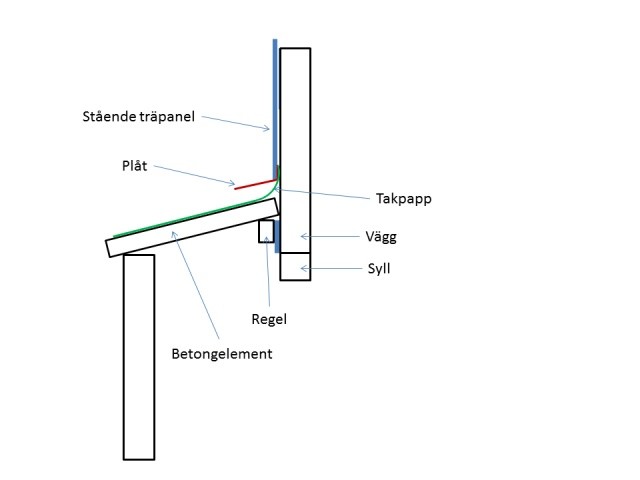
In a house we have, there is a small extension in the basement with its own little roof that connects a bit up the wall. Unfortunately, the extension was done by those who didn't quite have all their marbles, as there are some strange constructions, but the biggest problem is that it leaks - and I can't figure out where it's coming from!  Now I'm hoping you guys can help in a last desperate attempt.
The water is coming from/around the sill, but that's all that can be seen.
Originally, the sheet metal was just cut into the panel, and I suspected that it was leaking in between the panel boards. This summer, I spent some time removing the panel and inserting the sheet metal under/behind the panel and laying new roofing felt that went behind the metal. But no - it's still leaking! It should be said that the roof slope is inadequate, and it seems like the problem only occurs with heavier rain. There are roofing tiles on the roofing felt, and the sheet metal lies tight against the tiles. I don't think rain can get under the metal, but even if it did, the roofing felt should stop it...
One alternative I'm considering is that the extension is not the culprit, but that water is entering higher up, but I can't figure out where that would be. The house is from 1947, and it's been leaking for as long as we've had the house, but now I've been annoyed by this long enough.
Any tips and ideas on where the water could be getting in are more than welcome - because I’m about to lose it over this...
Now I'm hoping you guys can help in a last desperate attempt.The water is coming from/around the sill, but that's all that can be seen.
Originally, the sheet metal was just cut into the panel, and I suspected that it was leaking in between the panel boards. This summer, I spent some time removing the panel and inserting the sheet metal under/behind the panel and laying new roofing felt that went behind the metal. But no - it's still leaking! It should be said that the roof slope is inadequate, and it seems like the problem only occurs with heavier rain. There are roofing tiles on the roofing felt, and the sheet metal lies tight against the tiles. I don't think rain can get under the metal, but even if it did, the roofing felt should stop it...
One alternative I'm considering is that the extension is not the culprit, but that water is entering higher up, but I can't figure out where that would be. The house is from 1947, and it's been leaking for as long as we've had the house, but now I've been annoyed by this long enough.
Any tips and ideas on where the water could be getting in are more than welcome - because I’m about to lose it over this...

Is wind required for water to get in, or does it come in even if it's calm? Sometimes wind can push water backwards up along the roof.
Then it's probably the case that it doesn't just leak when it rains a lot, but that with small amounts of rain, the water stays in the wall.
As you already mentioned, it could very well be that the water comes into the wall from the roof above.
We had a leak at a skylight that no one could fix, and when we tore it down inside to renovate, it turned out that the water came from a chimney hatch five meters further up along the roof. The water ran down along a rafter to the skylight.
Then it's probably the case that it doesn't just leak when it rains a lot, but that with small amounts of rain, the water stays in the wall.
As you already mentioned, it could very well be that the water comes into the wall from the roof above.
We had a leak at a skylight that no one could fix, and when we tore it down inside to renovate, it turned out that the water came from a chimney hatch five meters further up along the roof. The water ran down along a rafter to the skylight.
It's a bit difficult to say how the weather affects the leakage. Previously, before I changed the metal sheet, it was only when there was really bad weather (rain and wind) that it would leak. After I changed the metal sheet, the whole fall went by with a couple of serious autumn storms without leakage, and I thought the problem was fixed. Now, I should mention that we don't live in the house ourselves, so it's a bit difficult to rely on others' observations, unfortunately.
I'm aware that the wind can push water backward, but shouldn't the roofing felt that lies under the panel prevent that if that's the case?
There are two windows on the same gable as the extension, and I replaced both of them this summer, and I couldn't understand how it could have come in there.
It's very strange. I thought I would put a tarp over the metal sheet and over the entire roof of the extension to rule out that the wind is pushing water under the roofing, at least.
I'm aware that the wind can push water backward, but shouldn't the roofing felt that lies under the panel prevent that if that's the case?
There are two windows on the same gable as the extension, and I replaced both of them this summer, and I couldn't understand how it could have come in there.
It's very strange. I thought I would put a tarp over the metal sheet and over the entire roof of the extension to rule out that the wind is pushing water under the roofing, at least.

What is the ceiling above that part? In other words, at the very top above the panel?
Leakage is sneaky! I discovered a small trickle of water on the floor of the house I'm building. After some troubleshooting, it turned out that water was coming in under the threshold of the balcony door on the floor above and then running down along the inside of the exterior gypsum. It looked tight and good from the outside, but upon closer inspection, I found that the threshold plate wasn't mounted clamped into the milled groove. The flange on the plate was just against the threshold a few mm lower. It was still inexplicable how water could come in that way, but with storm rain from the "right" direction, the flaw was revealed. Sealed with appropriate goop, and the problem was solved.
Conclusion: If it's not more or less airtight, water can find its way in the most peculiar ways. Sometimes it might take a storm that only hits every five years for it to show itself.
//LocTite
Conclusion: If it's not more or less airtight, water can find its way in the most peculiar ways. Sometimes it might take a storm that only hits every five years for it to show itself.
//LocTite
@Loctite: Yes, I'm beginning to suspect this. I was down and had a look at the mess yesterday and realized that the roofing felt probably doesn't go as high up as in the sketch. Hm! I'll have to take responsibility for that
I was thinking of putting a tarpaulin or construction plastic over the entire roof of the extension and tape it to the metal flashing, and let it be that way for a number of rainstorms ahead. If there's a difference, at least I'll know it doesn't leak further up.....
Thanks for all the thoughts and ideas!
I was thinking of putting a tarpaulin or construction plastic over the entire roof of the extension and tape it to the metal flashing, and let it be that way for a number of rainstorms ahead. If there's a difference, at least I'll know it doesn't leak further up.....
Thanks for all the thoughts and ideas!

I have had the same problem. In that case, it was the metal sheet that directed some of the water inside the standing panel. It's important to create a small gap between the metal sheet and the panel. Alternatively, let the tar paper go above the metal sheet, about 5 mm.
@grävaren: That was interesting! How do you mean the sheet "led" the water? Did the water go on the outside of the sheet between the sheet and panel and then over the edge of the sheet under the panel, do you mean?
I don't quite understand how you mean
I don't quite understand how you mean
It seems that water droplets run down the inside of the panel. When they reach the metal sheet, some end up inside the sheet. If there is a gap between the sheet and the panel, the water is forced to the outside of the sheet.
OK, I had no idea it could be like that . Now I have at least put a strip of construction plastic along the entire roof of the extension and taped it to the metal with duct tape. Let's see if it makes any difference initially. If it doesn't seal, the next step will probably be to lift the panel as the excavator suggests.
. Now I have at least put a strip of construction plastic along the entire roof of the extension and taped it to the metal with duct tape. Let's see if it makes any difference initially. If it doesn't seal, the next step will probably be to lift the panel as the excavator suggests.Gahhhggg! It's leaking, despite the construction plastic sealing the sheet metal. In other words, it's very likely coming in higher up. I was hoping to avoid tearing down the panel this summer....
Try plastic wrapping the next place, see the result. Test again. That way, you might avoid tearing down half the house for a small hole somewhere.