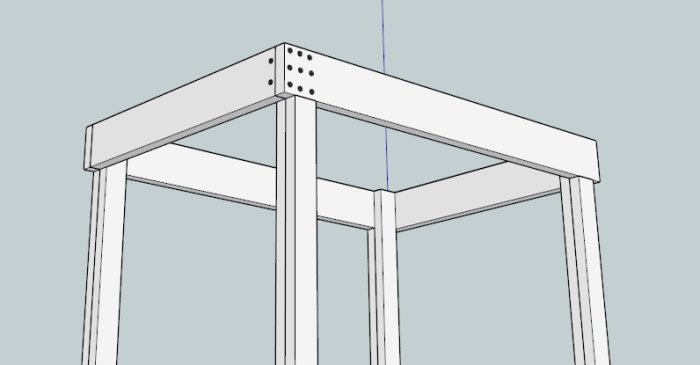
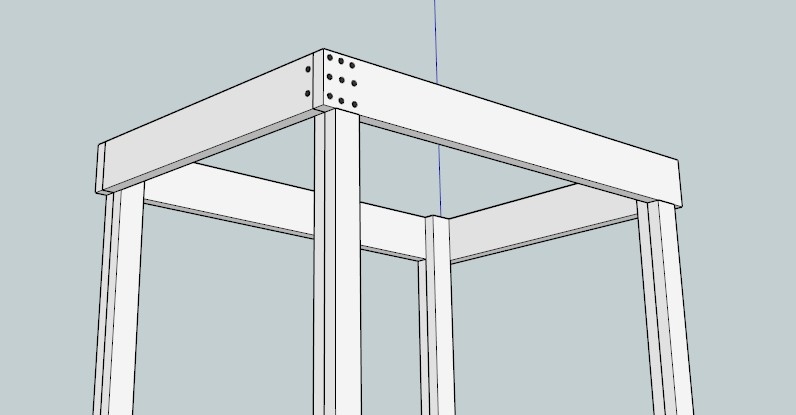
I'm considering building a loft bed, or rather a loft with a bed and some storage. It's for a child, but maybe one would want to lie there sometimes too and read a story or so, so it should support some weight. Anyway, I'm thinking of a construction like this:
...which is built from beams 45x90 and 45x170. The long frame beams rest on the legs, while the cross beams only "hang" screwed into the longer beams. I was thinking of screwing and gluing the two beams together to form the legs. Does it work as I've planned? I'm also considering having a couple more cross beams between, and an MDF board as the floor on top. Is it reasonable with screws as I've placed them? Too many? Misplaced? Any tips are appreciated. The loft is about 165x120 cm large and about 140 cm high.
170mm feels a bit excessive with the dimensions you mention, but of course, it depends on the load What I'm wondering is whether the construction should be attached to the wall or freestanding? If it's wall-mounted, the outer post is sufficient, but if you plan to have it freestanding, you need to brace it with some form of cross, preferably on 2 of the sides to achieve stability in the construction.
Just have to ask, 160 long and 120 wide? Doesn't that make a very strange format?
Regarding the construction otherwise, I'm a bit concerned about how it handles any skewing? 3 legs can be attached to the wall, but the 4th leg is a bit exposed, I feel?!
Are you thinking of a stabilizing frame at the bottom?
Are you planning to attach it to the wall? Could you then utilize the wall construction more? Hang the bed more on the wall, so to speak?
Aside from the above questions and reflections, I would probably consider angle brackets in the corners (short sides) for additional support even if the long sides likely bear well enough...
But as I said, skewing/twisting seems to be the biggest problem that needs to be addressed somehow... Maybe a couple of "kortlingar" can solve the problem in one direction, but in the other? Diagonal braces?
It will not be attached to the wall. In any case, the wall should not bear anything.
I have also thought about the skewing. How do you think I should best solve it? Would a frame at the bottom solve the problem? Please explain braces and diagonal braces further. What would it look like? Feel free to draw a sketch if it's not too complicated, or explain so that I understand what I should attach where. I have never built anything even similar to this before.
And the measurement is a child's bed plus more width to also have storage in the loft.
The ideal would be to avoid having a "threshold" (frame at the bottom) at least on one long side, so that the children do not risk bumping their toes on it when they want to use the space under the loft.
I think that 45*145 or even 45*120 is enough.
Fasten one or two screws in the wall so it doesn't go anywhere.
If you can screw the studs that are against the walls securely, then just one post on the outer edge should be enough.
I think that 45*145 or even 45*120 is sufficient. Fasten one or two screws into the wall, and it won't go anywhere. If you can screw the beams that are against the walls firmly, then one post on the outer edge is enough.
As I mentioned earlier, I don't want the wall to have to support the construction, but rather it should rest entirely on the posts. What do you think about braces or something similar, as I asked about in posts 5 and 6?
We live in a rental property, and I don't want to affect the walls too much, hence the freestanding construction. If a few screws in the wall help to keep the construction stable laterally, then maybe it's doable, but building a wall-mounted construction might cause too much damage.
By kortlingar I mean a rule between the söngben on the short side, perhaps at a half-meter height. This is to brace/hold the legs together in a joint.
By snedstag I mean a possible diagonal brace that is about 0.5m down on the legs and goes diagonally up (45º) towards the beams that the bed then rests on. If you use the same concept in the actual "bed frame" then the warping in this should not be a problem
In addition to this, I would have at least screwed the bed to the wall with 2 sturdy screws in the longitudinal bed beam and 2 in the headboard (ok fastening and moderate intervention).
I would also attach the bottom part on 3 of the legs to minimize the risk of these coming out of place, leaving only the risk with one leg, which you can at least reinforce fairly well with kortling and snedstag
The fourth leg can be attached with carpet tape to the floor to prevent it from sliding away at the bottom. If you then use 45x170 as you suggest, the attachment of the leg will be sturdier than if you listen to advice suggesting that weaker timber is sufficient. (which it certainly is in terms of load) Depending on the mattress and sheets, you might want an even higher side on the bed. You’ll also need some form of railing that should be attached firmly, which is facilitated by a solid frame.
Depending on where I've asked, I've received quite different answers, ranging from it holding up very well, and that I hardly need to brace at all (but most suggest some kind of support), to that I need to make a much more solid construction. Just out of curiosity, what do you think of this construction? http://www.thehandmadehome.net/2011/08/how-to-build-a-loft/ Admittedly, it's against three walls (mine will be against two), and it's lower than my construction, but it's significantly wider and has only four legs at the corners supporting it, is not screwed into the wall, and the loft frame is hanging on the legs instead of resting on them.
Another question now that the actual construction is approaching. I suspect that the floor is (not insignificantly) lower a bit into the room than right by the wall. How do I level the loft in the best way if that's the case?
Can't you solve it by first deciding that one of the legs is the height you want. Then let the other three be deliberately too high. Take a long spirit level and mark where the height should be. Take down and cut.
Click here to reply
Vi vill skicka notiser för ämnen du bevakar och händelser som berör dig.

 What I'm wondering is whether the construction should be attached to the wall or freestanding? If it's wall-mounted, the outer post is sufficient, but if you plan to have it freestanding, you need to brace it with some form of cross, preferably on 2 of the sides to achieve stability in the construction.

