
Want to turn the two bedrooms on the upper floor into a single larger one by tearing down the wall between them. But is the wall load-bearing? I consulted a carpenter. He "didn't think" it is. That's not enough for me. Does anyone here on the forum know? What information do I need to answer the question? I have all the building permits but load-bearing walls are not drawn in.
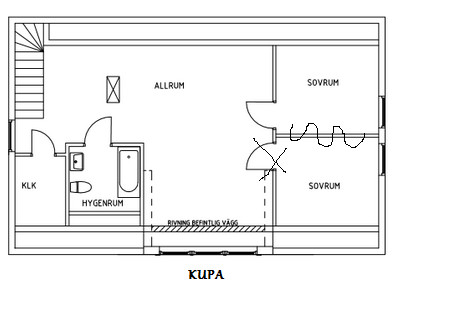

The easiest way to check this is to go up to the attic. If all the roof trusses have the same dimensions and design, the marked wall is not load-bearing. The only thing a wall on the upper floor in a house with a sloped roof should bear is the roof trusses. Some caution is advised with houses built before around 1950 (often built with plank frame construction).
If you want to tear down the wall in any case, you can first remove the drywall. If there are only a few measly 75-reglar left, then the wall is not load-bearing.
Hello and thank you for the reply. The house was built in 2000. Relatively low ceiling height on the upper floor compared to more upscale villas. The attic consists of just a little sliver, so it's not possible to get up there. There's not even a hatch. There's only an inspection hatch in the knee wall. If I were to open a hatch, I probably wouldn't see anything more than insulation.
As mentioned, I can't access the wind. However, I can open up the wall and check the size of the studs. Does it seem like a safe method, as someone mentioned, to assume that the wall is not load-bearing if the studs are 75 or smaller?
If the house was built as recently as the year 2000, you can assume that all the trusses have the same design, and then the wall in question cannot be load-bearing. Additionally, it seems like the upper floor has a large sloping roof, and then the horizontal part of the inner ceiling on the so-called hanbjälke is short and without the need for support. The easiest way to assess this is by looking at a section of the house. The idea of looking at the thickness of the wall you want to remove is the wrong method.
Click here to reply