Hello all knowledgeable people! After using this forum as a knowledge bank since we bought our house, it's now time for me to ask my first question.
We live in a small house built in the early 1900s with a crawl space. In the 50s, the house was expanded with about 35 square meters of basement and 35 square meters on the ground floor with two rooms approximately of equal size on each floor and a room on the upper floor.
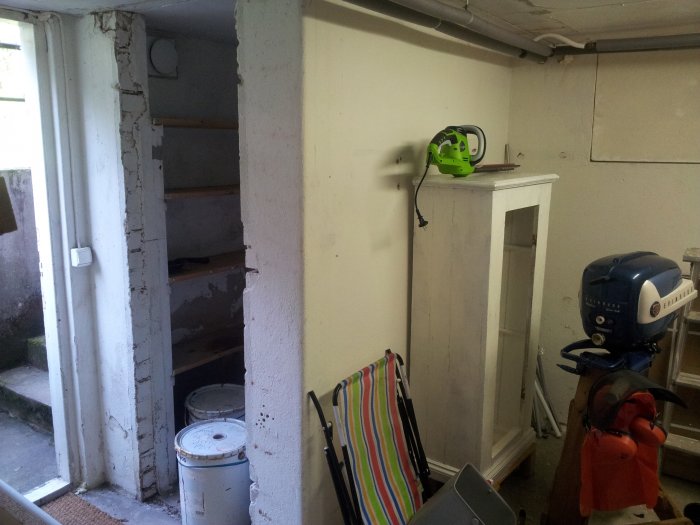
My question concerns the basement (which can only be accessed from the back of the house). Here, there is what I assume has been a pantry, barely a meter wide and 1.5 meters deep in one corner of one of the rooms. We want to tear down the wall so that we get a larger room and get rid of what currently only houses spiders...
The wall is a brick wall (which is why I'm wondering if it might have a load-bearing function). On the floor above, there is only flooring and closets over the wall.
Can we knock down the wall without worrying that something might happen?
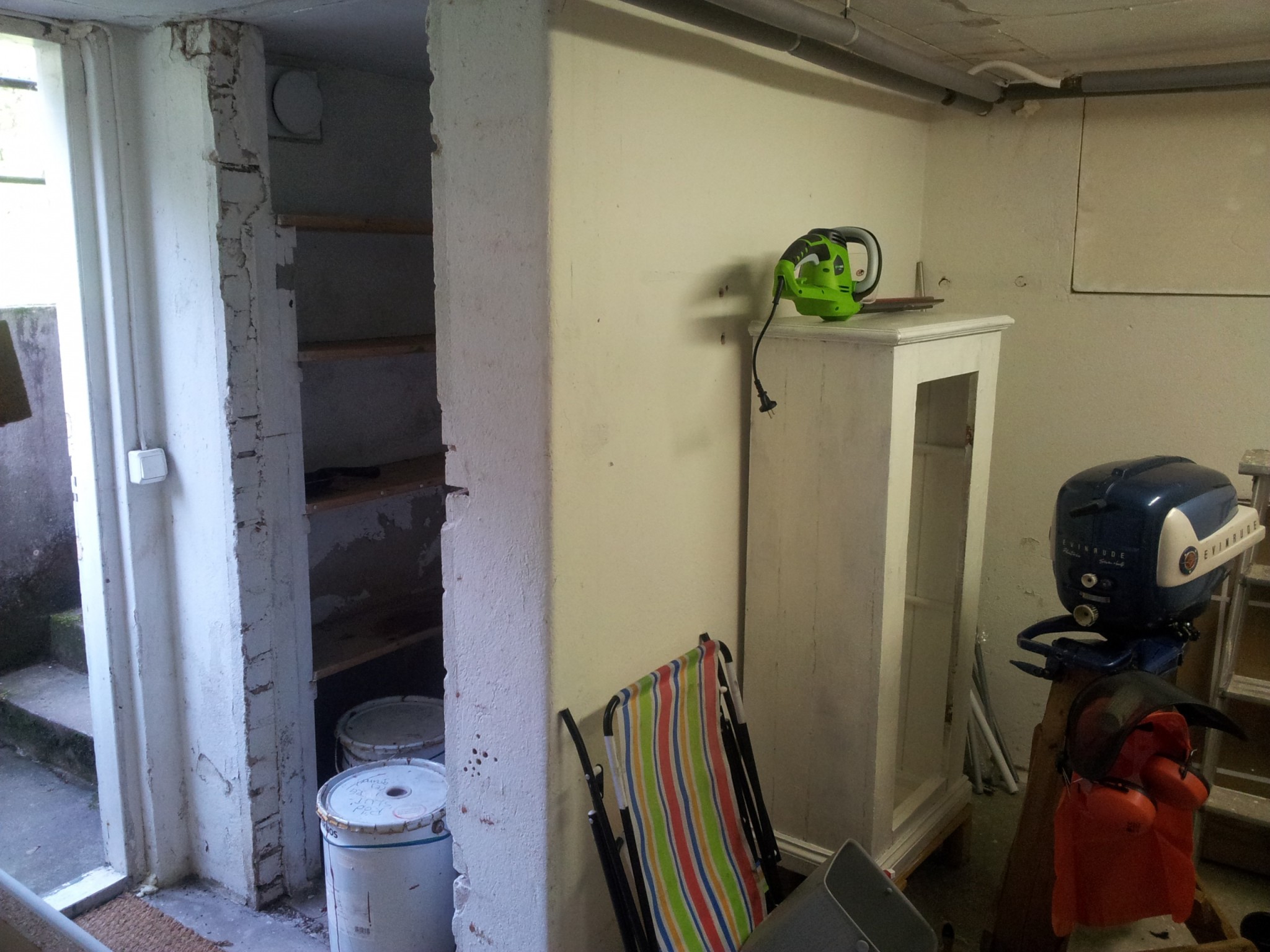
Attached is a picture (it's the wall behind the small cabinet that I mean).
I actually don't know what it is in this part of the house since this is the first thing we're tackling in the newer part of the house. I'll check when I get home and get back to you!
Now we have tried to check but realized that the ceiling tiles in the basement are asbestos and we don't dare to tear into that. However, what I saw was that the tiles are "above" the wall, meaning the tile that starts about 20 cm to the right of the wall ends 30-40 cm to the left of the wall. This should mean that the wall was installed after the ceiling. But maybe that's not a clue?
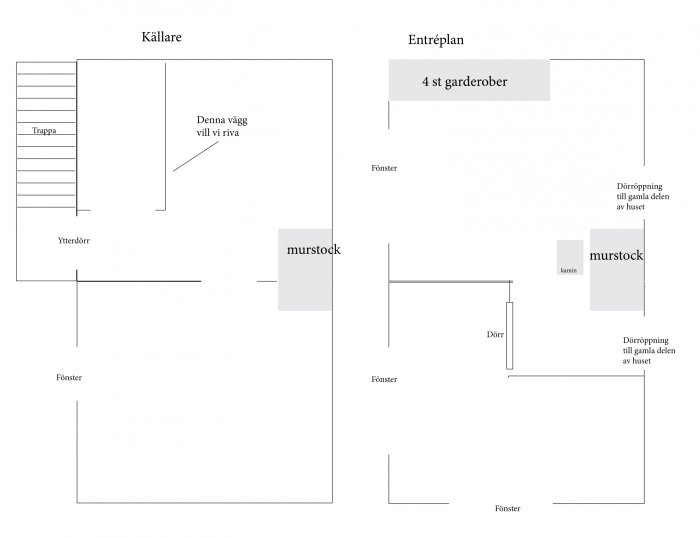
Hmm, a bit difficult to see the whole picture in the images and your description in text. Do you have floor plans of the basement level? The wall could very well function as stabilizing if it is merged with another wall... However, it is difficult to determine this, make a floor sketch of all basement walls and also mark in walls on the upper floor, so it becomes easier to give advice.
Now we have tried to check but realized that the ceiling tiles in the basement are asbestos and we don't dare to tear them down. However, what I saw was that the tiles are "above" the wall, i.e., the tile that starts about 2 dm to the right of the wall ends 3-4 dm to the left of the wall. This should mean that the wall was put up after the ceiling. But maybe that's not a clue?
Now I have drawn up a floor plan of the basement and the rooms above, though not completely to scale...
Hope this can help! According to my partner, who grew up in an eternit house, it's asbestos...
It shouldn't be load-bearing. In the floor plan, the other room down in the basement doesn't have a supporting wall, so it would be strange if one was needed here.
It's safest to make an opening so you can see the beams that rest on the wall you want to demolish. If they’re not joined above that wall, there shouldn't be any problem removing the wall.
Click here to reply
Vi vill skicka notiser för ämnen du bevakar och händelser som berör dig.