8,024 views ·
15 replies
8k views
15 replies
Is it possible to plane this?

Hello!
I've cut up some oak with a chainsaw and chainsaw mill.
Before I got the hang of handling it, it became a bit choppy, to say the least. Now I have some "scrap pieces" that I wonder if they can be salvaged, as oak is quite expensive after all.
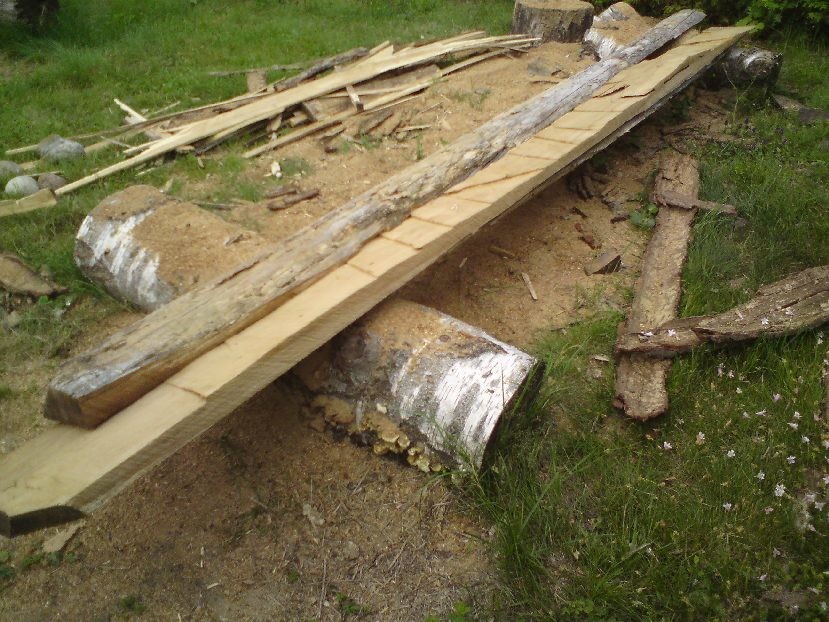
My hope is to be able to plane this piece into a long board. But as you can see in the picture, it is not completely smooth, unfortunately, on either side.
My question now is whether a planer can smooth the surfaces so they become straight? Or does a planer require one side to be completely smooth from the start? (I have no experience with planing)
Or is there another machine that would be more suitable? Regards, Fredrik
I've cut up some oak with a chainsaw and chainsaw mill.
Before I got the hang of handling it, it became a bit choppy, to say the least. Now I have some "scrap pieces" that I wonder if they can be salvaged, as oak is quite expensive after all.
My hope is to be able to plane this piece into a long board. But as you can see in the picture, it is not completely smooth, unfortunately, on either side.
My question now is whether a planer can smooth the surfaces so they become straight? Or does a planer require one side to be completely smooth from the start? (I have no experience with planing)
Or is there another machine that would be more suitable? Regards, Fredrik
With a jointer and planer, you'll solve it, as long as it's big enough.
But maybe you could smooth it a bit in the jig first, now that you've gotten some practice.
I myself have a bunch of oak logs that I plan to saw up with a chainsaw and jig, I haven't done it before either. Do you have any tips to give me?
But maybe you could smooth it a bit in the jig first, now that you've gotten some practice.
I myself have a bunch of oak logs that I plan to saw up with a chainsaw and jig, I haven't done it before either. Do you have any tips to give me?
Hi!
Great to hear that you're thinking along the same lines.
I bought Logosol's jig, but since my chainsaw only has a 14-inch bar, the cutting length was a bit too short with this combination. However, I must say that this combo is probably preferable.
To get through the entire log, I bought the jig from Jula. It works very well but feels significantly more dangerous. I continuously checked the tightening screws, at intervals of about 10-20 seconds with the chainsaw turned off. However, it never felt as if they vibrated loose.
I also bought a sharpenable chain for my chainsaw and a sharpening file kit, which worked very well. Sharpening every five minutes or so did the trick since the oak is quite hard on the chain.
At first, I rented a more powerful chainsaw with about 3.5 hp, but now I'm using my own Partner 382, which if I remember correctly, is only about 1.4 hp. So my experience has taught me that everything relies on a sharp chain.
Note, of course, that safety is a no-brainer!
I wanted to ask you about the planer; so you mean that planers don't require one side to be smooth against the fence that the board slides against, which I assume the planer blade on the other side of the board is directed toward?
Best regards,
Fredrik
Great to hear that you're thinking along the same lines.
I bought Logosol's jig, but since my chainsaw only has a 14-inch bar, the cutting length was a bit too short with this combination. However, I must say that this combo is probably preferable.
To get through the entire log, I bought the jig from Jula. It works very well but feels significantly more dangerous. I continuously checked the tightening screws, at intervals of about 10-20 seconds with the chainsaw turned off. However, it never felt as if they vibrated loose.
I also bought a sharpenable chain for my chainsaw and a sharpening file kit, which worked very well. Sharpening every five minutes or so did the trick since the oak is quite hard on the chain.
At first, I rented a more powerful chainsaw with about 3.5 hp, but now I'm using my own Partner 382, which if I remember correctly, is only about 1.4 hp. So my experience has taught me that everything relies on a sharp chain.
Note, of course, that safety is a no-brainer!
I wanted to ask you about the planer; so you mean that planers don't require one side to be smooth against the fence that the board slides against, which I assume the planer blade on the other side of the board is directed toward?
Best regards,
Fredrik
Yes, it must be.fredand44 said:
That's why you must first joint the plank, and jointing such a plank can require some skill. Basically, you "manually" plane on the machine so that one side becomes smooth, then you can plane the other side. Then I would saw the edges so they become a bit straighter, and then plane them if needed.
Here is a thread on the subject that might give you some tips.
http://www.byggahus.se/forum/verktyg-maskiner-fordon/175744-rikthyvla-langa-amnen-hur-gor-ni.html
Didn't know that Jula had a jig, but I now have a Logosol jig, and on that a Jonsered 6.5hp, so that should be enough I hope. Haven't decided yet, but I'm thinking of starting by testing "quarter sawing" with the jig, otherwise I need to have a bar at least 1.2m long to get through my largest log.

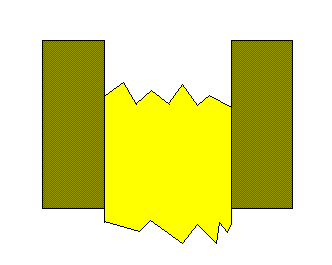
It is possible to plane such a subject but you need to attach it to a straight edge and then let the edge slide against the planing table.
Make sure no screws go against the steel.
Then the chains should be sharpened at 10-15 degrees for effective ripping, 45 degrees is for crosscutting.
Furthermore, the chainsaw should have a slightly richer mix to prevent seizing.
/Kent
Make sure no screws go against the steel.
Then the chains should be sharpened at 10-15 degrees for effective ripping, 45 degrees is for crosscutting.
Furthermore, the chainsaw should have a slightly richer mix to prevent seizing.
/Kent
Last edited:
I thought it was as low as 5 degrees that is recommended for ripping!?snickarboden said:It is possible to plane such a piece, but you must fasten it to a straight rule and then let the rule slide against the planing table. Make sure that no screws go against the blades. Then the chains should be sharpened at 10-15 degrees for ripping effectively, 45 degrees is for cross-cutting. Furthermore, the chainsaw should have a slightly richer mixture to avoid cutting.
/Kent
I would like to argue that the biggest reason for the result being what it is, is the combination of an too small chainsaw + feeding too fast, which puts a lot of pressure on the bar that simply bends and cuts at an angle.
Another cause could be if you haven't used a ripping chain and are trying to use a crosscut chain.
Another cause could be if you haven't used a ripping chain and are trying to use a crosscut chain.
Hello!
Thanks for the tips regarding chainsawing!
I would gladly accept more tips regarding planing.
I read that the first thing to do is joint planing.
The sides of the stock/oak/plank are quite straight, is it those sides that are referred to with joint planing?
If you look at the picture, the thickness is quite varied, for example at the end of the plank to the right in the picture.
I estimate that the plank at its thinnest point is about 2.5 cm.
Do you think it's possible to plane down the whole plank to this thickness or is it impossible?
Best regards,
Fredrik
Thanks for the tips regarding chainsawing!
I would gladly accept more tips regarding planing.
I read that the first thing to do is joint planing.
The sides of the stock/oak/plank are quite straight, is it those sides that are referred to with joint planing?
If you look at the picture, the thickness is quite varied, for example at the end of the plank to the right in the picture.
I estimate that the plank at its thinnest point is about 2.5 cm.
Do you think it's possible to plane down the whole plank to this thickness or is it impossible?
Best regards,
Fredrik
Exactly my thought too, but TS writes that it happened before he got the right handle, so I think he's already realized itcem77 said:

Yep! This was one of the first pieces, but it feels like a waste to discard so much oak.
Just as you suspect, I've used a cutting chain.
But yep, I’ve pretty much gotten the hang of chainsawing, but of course, there’s always room for improvement.
But I’m hoping to get some tips on planing if it's possible to salvage this piece.
Just as you suspect, I've used a cutting chain.
But yep, I’ve pretty much gotten the hang of chainsawing, but of course, there’s always room for improvement.
But I’m hoping to get some tips on planing if it's possible to salvage this piece.
If you do as the carpenter's shop says with a couple of studs on each side of the piece, it will work out, and indeed you can plane until almost nothing remains. But you need a plane large enough to take the entire piece + studs in width.
It's also possible to hand plane, it just takes a bit more time
It's also possible to hand plane, it just takes a bit more time