
10,860 views ·
18 replies
11k views
18 replies
Is it possible to assess from a floor plan if the wall is load-bearing? (Apartment)
Hello,
I wonder if it's possible to assess whether a wall is load-bearing via the attached drawing in this thread? I have bought an apartment (but haven't gained access yet, it's three months away...) and wish to remove the wall between the kitchen and the living room for a more open floor plan.
I have knocked on this wall but the sound is the same for all the walls in the apartment, i.e., it is concrete. The building was constructed in 1962-1964.
Thankful for a response.
Sincerely,
Abraham E
I wonder if it's possible to assess whether a wall is load-bearing via the attached drawing in this thread? I have bought an apartment (but haven't gained access yet, it's three months away...) and wish to remove the wall between the kitchen and the living room for a more open floor plan.
I have knocked on this wall but the sound is the same for all the walls in the apartment, i.e., it is concrete. The building was constructed in 1962-1964.
Thankful for a response.
Sincerely,
Abraham E
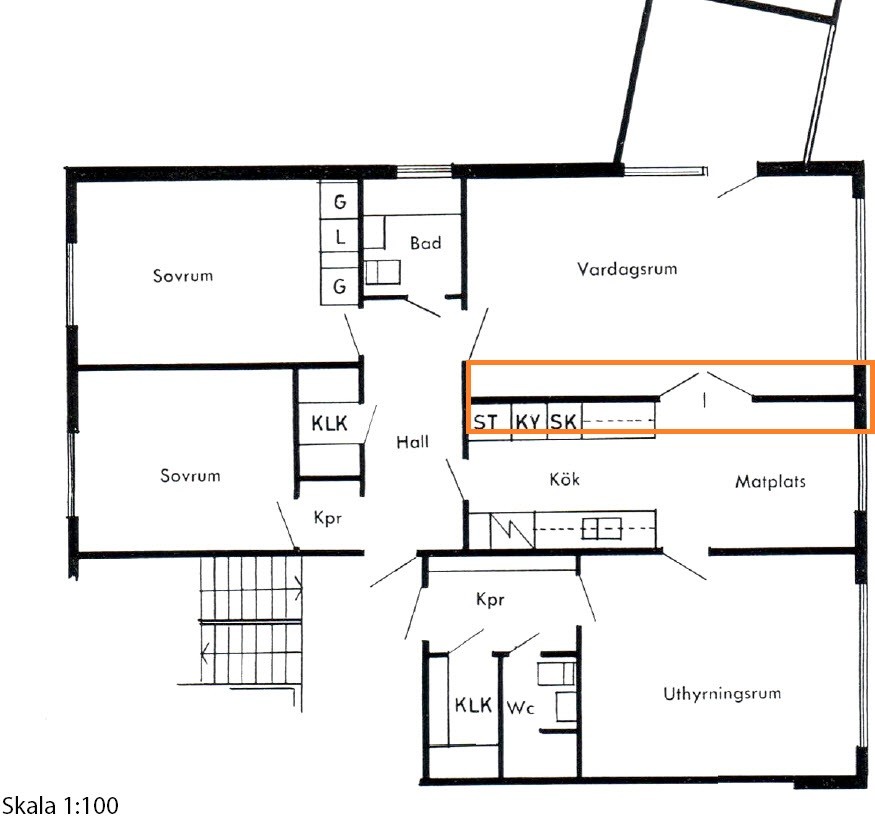
My knowledge would probably suggest that it's usually difficult to assess only through a floor plan. However, I might very well be wrong.
But nevertheless, it was unusual to build non-load-bearing partition walls in concrete, and nowadays it does not occur at all. Are you sure all of them are concrete? Even if you had the opportunity to remove it, you have approximately 10 tons of material to clear away and transport out of the apartment. (Without knowing the exact dimensions of the wall).
But nevertheless, it was unusual to build non-load-bearing partition walls in concrete, and nowadays it does not occur at all. Are you sure all of them are concrete? Even if you had the opportunity to remove it, you have approximately 10 tons of material to clear away and transport out of the apartment. (Without knowing the exact dimensions of the wall).

Know-It-All
· Västra Götaland
· 11 966 posts
It doesn't look like it should be load-bearing. But! This is something you need to check with your housing cooperative since they own the apartment. They also have knowledge of whether it is load-bearing or not.

I would think that there is quite a high risk that it is load-bearing.
As mentioned, have a chat with the association, perhaps it has already been investigated for some apartment, what is load-bearing. Otherwise, you should have a structural engineer examine it, it doesn't have to be particularly expensive (to investigate). As a bonus, you can probably find out what material the wall is made of, e.g., lättbetong. This significantly affects which demolition technique can be used.
If the house is from 1962, I believe that some houses were still being built with brick. But also with concrete hollow blocks. If it is a non-load-bearing wall, it could be blåbetong. If it is blåbetong, it can be demolished with simple hand tools; you can basically saw the wall with a regular handsaw, although it won't be suitable for sawing wood afterwards...
As mentioned, have a chat with the association, perhaps it has already been investigated for some apartment, what is load-bearing. Otherwise, you should have a structural engineer examine it, it doesn't have to be particularly expensive (to investigate). As a bonus, you can probably find out what material the wall is made of, e.g., lättbetong. This significantly affects which demolition technique can be used.
If the house is from 1962, I believe that some houses were still being built with brick. But also with concrete hollow blocks. If it is a non-load-bearing wall, it could be blåbetong. If it is blåbetong, it can be demolished with simple hand tools; you can basically saw the wall with a regular handsaw, although it won't be suitable for sawing wood afterwards...

It suggests a multi-story building and then it is load-bearing.
In the 1950s-60s, buildings were rarely constructed with a span of more than 4m, and then there was a load-bearing concrete wall of 25-30 cm.
Non-load-bearing interior walls are usually only 10-12 cm thick.
In the 1950s-60s, buildings were rarely constructed with a span of more than 4m, and then there was a load-bearing concrete wall of 25-30 cm.
Non-load-bearing interior walls are usually only 10-12 cm thick.

I live in a house from '62 and in many places in the apartment, it is 6 meters between two apartment partition walls (e.g., across two large bedrooms) without a load-bearing wall in between. It is an apartment of 112 sqm and there is only a 1-meter-long concrete wall that is load-bearing apart from those that delimit the apartment.L Leif i Skåne said:
But is it 6 m in the other direction as well?BirgitS said:
I live in a house from -62 and in many places in the apartment, there's a 6-meter distance between two apartment-separating walls (e.g., across two large bedrooms) without a load-bearing wall in between. It's an apartment of 112 sqm and there's only a 1-meter long concrete wall that is load-bearing besides those that delimit the apartment.
Do you mean from the outer wall to the nearest load-bearing wall?L Leif i Skåne said:
Due to the layout, it's not entirely easy to answer that. But if you measure along the interior wall between the bedrooms and until you reach that 1 m load-bearing wall, it's probably closer to 9 m. But then there's support from the apartment-separating wall that goes sideways barely 5 m from the outer wall.
From the 1 m long load-bearing wall, it's just under 4 m in one direction until you reach the wall to the neighbor, but in the other direction, it's about 4.5 m to the wall toward the stairwell. From that, and in the direction that is not towards the bedrooms, it is perhaps 3 m to the nearest outer wall.
But it has, in any case, allowed us to have an open layout along about 10 m of one outer wall.
If you compare with TS's apartment, it would correspond to only a section behind the tall cabinets in the kitchen being load-bearing on that side of the apartment and not the entire wall.
So, it is not possible to know where and how there are load-bearing walls or wall sections in TS's apartment.
Hello everyone,
Thank you for the time you took to respond to this thread. It might be best to check with the association if the wall is load-bearing.
I hope it is not load-bearing. If I tear it down, I'll get an open floor plan with a very large area.
Thank you for the time you took to respond to this thread. It might be best to check with the association if the wall is load-bearing.
I hope it is not load-bearing. If I tear it down, I'll get an open floor plan with a very large area.
Without a proper blueprint (this is a real estate blueprint), it would just be speculation. To resolve the issue, a reinforcement plan is required (belongs to the K-drawings). The most common construction method for apartment buildings in the 1960s was load-bearing, cast-in-place interior walls and lightweight so-called infill walls in the facade. There were also interior walls that were not load-bearing, in the form of framed walls or lightweight concrete walls. All concrete walls should be considered load-bearing regardless of thickness. Apartment-separating walls were a little thicker, around 20 cm, otherwise they were thinner. I have never seen a concrete wall in an apartment building from the 1960s that was not load-bearing. I did my first construction internship in 1965.
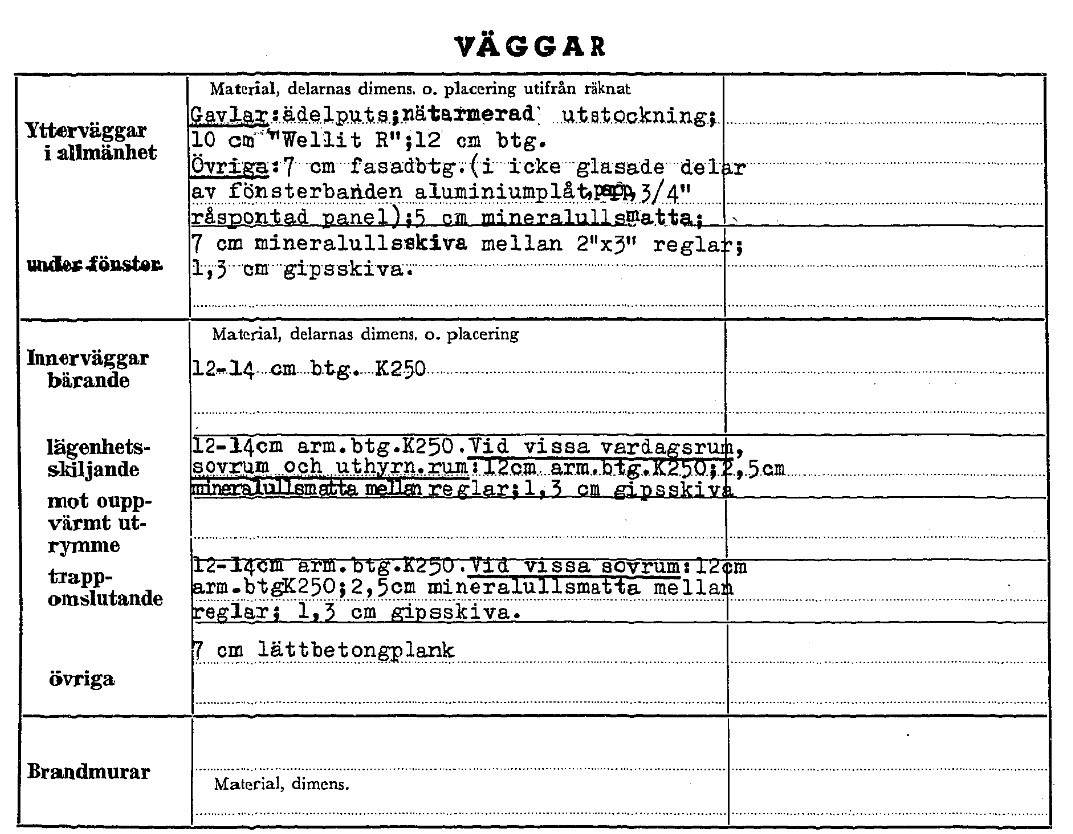
Your condominium association should request that you have an assessment from a person who is competent in the field, to ensure that there will be no problems in the future. Even if the association does not require it, it is advisable for you to do it yourself, as the consequences of mistakes can be significant. You can certainly get wise advice from people who do paper assessments, but an on-site assessment is probably needed to be sure.