
6,749 views ·
15 replies
7k views
15 replies
Is it okay to lower joist hanger?
Hi,
I need a quick confirmation that I'm thinking correctly.
I'm going to build joists for the bathroom floor and want to lower it to reduce the level difference between the floor in the adjoining room.
It's a bit special, but I think it should work. My question is whether it's okay to hang a joist hanger below the beam as in my sketch? The beam consists of two screwed together (maybe glued) 45x170. This is so the joists can be free from the wall.
Comments?
// Kobolt
I need a quick confirmation that I'm thinking correctly.
I'm going to build joists for the bathroom floor and want to lower it to reduce the level difference between the floor in the adjoining room.
It's a bit special, but I think it should work. My question is whether it's okay to hang a joist hanger below the beam as in my sketch? The beam consists of two screwed together (maybe glued) 45x170. This is so the joists can be free from the wall.
Comments?
// Kobolt
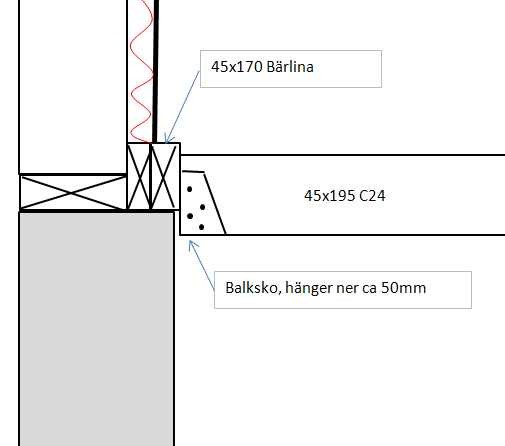


Very marginally. There are only shear forces at the ends. The bending moment, which is what dimensionally determines the beam, is usually maximal in the middle of the beam. Neither the load-bearing capacity nor the deflection is significantly affected by notching the beam at the bottom at the corner.Matti_75 said:
It is not a worse alternative to notch at the beam end, the bending moment is zero at the end and the shear capacity is not significantly reduced.Kobolt said:
However, it is questionable to notch at a mid-support if the joist is continuous over the partition wall. There, both the bending moment and shear force are at their maximum!!
If I notch out just as much at the midpoint support, which is also a load-bearing wall, and fasten it properly to the wall, there should be no difference compared to having two separate beams with beam brackets that are notched at each end, right?
A continuous beam on three supports is much stiffer than two separate beams.Kobolt said:
I think you misunderstand me, I have a span of about 4 meters. I can divide it into 2+2 meters with joist hangers at each end (i.e., 4 joist hangers) or alternatively notch the underside of the 4-meter beam in the middle about 50mm and attach it there. There should not be any direct difference. The deflection must be less than having a 4-meter beam on only two supports.
Let me clarify a bit:
A 4 m long continuous beam on three supports is MUCH stiffer than two separate 2 m long beams!
If you use a 4 m long beam, you have the opportunity to achieve a stiffer floor if you don’t notch out (too much) at the center support. Can you notch out the wall instead? This wasn't really your question, but I couldn’t resist commenting on the big difference between the two options, (will come back with some numerical examples if I get time). If you notch out in the middle, you get something between a continuous beam and two separate beams.
Regarding your original question about notching at the beam ends, it's a good solution.
A 4 m long continuous beam on three supports is MUCH stiffer than two separate 2 m long beams!
If you use a 4 m long beam, you have the opportunity to achieve a stiffer floor if you don’t notch out (too much) at the center support. Can you notch out the wall instead? This wasn't really your question, but I couldn’t resist commenting on the big difference between the two options, (will come back with some numerical examples if I get time). If you notch out in the middle, you get something between a continuous beam and two separate beams.
Regarding your original question about notching at the beam ends, it's a good solution.
Last edited: