
26,576 views ·
43 replies
27k views
43 replies
IPE beams - strength
A steel beam also has the advantage of being able to mount a hoist trolley with an associated hoist and be able to lift slightly heavier items as well as move them sideways (e.g., engine lift if you have such an interest). However, it might then require a slightly larger beam than IPE 120, but it depends on how much you have stored on the roof and what you want to lift with the hoist....
Judging by your picture of the garage, it should be of utmost interest to get the lowest construction height possible on the beams to be used. Then you should stick to steel, and furthermore, you should look at HEA or even better HEB, not IPE.
injonil has a good point there.
However, there is no reason to look at HEB (which is also usually harder to obtain) in this case since even the smallest HEA beam (HEA100) meets the requirement by far. It is also only 96mm high compared to an HEB100 which is 100mm.
I would choose IPE100 or HEA100 depending on what I could get most easily/cheaply.
Or why not VKR/KKR 100x100 or similar.
However, there is no reason to look at HEB (which is also usually harder to obtain) in this case since even the smallest HEA beam (HEA100) meets the requirement by far. It is also only 96mm high compared to an HEB100 which is 100mm.
I would choose IPE100 or HEA100 depending on what I could get most easily/cheaply.
Or why not VKR/KKR 100x100 or similar.
I wasn't planning to embed the beams but to live with them protruding slightly. The current height is 2.40m (while the garage door opens at about 2.10m), and if 3 beams build down to 2.20m, I could probably live with it. My hope was that IPE100 could be "matched" by Glulam 42x180, as it would be cheaper. Moreover, working with glulam is more manageable due to the weight.injonil said:
Anyway, I'll take what you mention into consideration and think it through further. Better to think 10 times and get it right from the start
 What size should one go up to in HEB to match IPE100 or IPE120?
How is VKR/KKR in terms of strength and bending stiffness compared to IPE100? Does it meet the standards for floor bending?Gabbe1 said:injonil makes a good point there.
However, there is no reason to look at HEB (which is usually harder to find) in this case since even the smallest HEA beam (HEA100) meets the need amply. It is also only 96mm high compared to an HEB100 which is 100mm.
I would choose IPE100 or HEA100 depending on what I could get hold of most easily/cheapest.
Or why not VKR/KKR 100x100 or similar.
Edit: Forget the above question since both VKR and KKR are much more expensive than IPE. It still feels like IPE 100 has more advantages in terms of price and weight.
Last edited:
Hmmm...another thing occurred to me then... If HEB 100 is now 1.4 times stronger than IPE 120, wouldn't it be enough with 2 HEB 100 beams instead of 3 IPE 120 beams? IPE 120 was already slightly above the standard according to the previous calculation...roli said:
Isn't it easier to place 45x220 on top of the truss's bottom chord and hang the trusses' bottom chord in this?
Let the 45x220 beams rest on the outer wall.
And there's no need for a special glue-laminated post in the outer wall; a regular stud in the wall's dimension is sufficient (provided that it is locked laterally, which is easy to do).
I suggest placing 2 pieces of 45x220 at each truss (to be as little in the way as possible).
I don't understand why an extra beam has been built between the trusses. The trusses seem to be spaced at cc120, with an extra beam in between.
Let the 45x220 beams rest on the outer wall.
And there's no need for a special glue-laminated post in the outer wall; a regular stud in the wall's dimension is sufficient (provided that it is locked laterally, which is easy to do).
I suggest placing 2 pieces of 45x220 at each truss (to be as little in the way as possible).
I don't understand why an extra beam has been built between the trusses. The trusses seem to be spaced at cc120, with an extra beam in between.
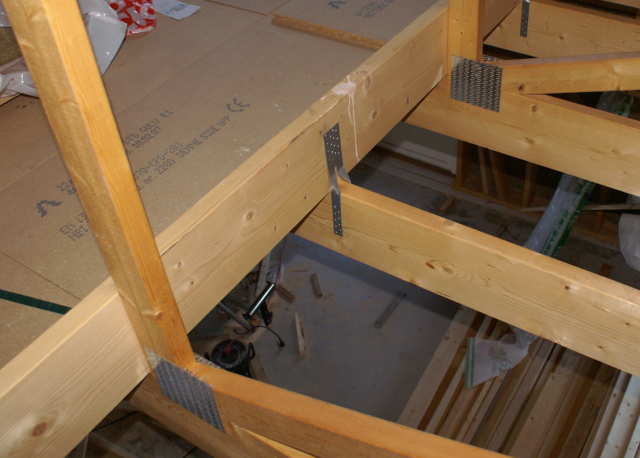
Doesn't that solution involve transferring some of the weight to the underside of the trusses? That's what I was trying to avoid. I don't know how much the trusses can handle and I don't want to load them more than they are intended for.JOW said:Isn't it easier to place 45x220 on top of the lower frame of the truss and suspend the truss's lower frame on this.
Let the 45x220 beams rest on the outer wall.
And there is no need for a special glulam post in the outer wall, as a regular stud in the wall's dimension is sufficient (provided it is braced sideways, which is easy to do.)
I suggest placing 2 pieces of 45x220 one at each truss (to interfere as little as possible).
I don't understand why they built with an extra beam between the trusses. The trusses seem to be set at cc120, and with an extra beam in between.
And to clarify even more. Initially, there were only 2 trusses at 120cc and nothing else. The rest I have built myself to achieve an upper floor and also to further stiffen the construction.
After some more research, I believe a length of 2.33 should be fine for 120x45 joists. That's according to this table as I've used C24 joists. So then maybe you can use 2 HEB100 beams instead of 3 IPE100. Many good ideas nowroli said:
http://www.svenskttra.se/MediaBinar...e_FileID=0fbb3079-0d41-4e9e-8800-0728dbeb723c
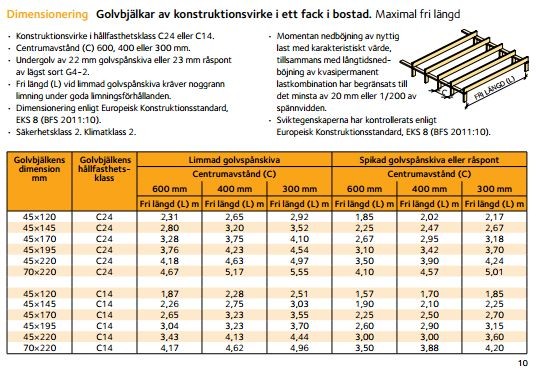
Getting through without breaking is one thing, they will manage that. But the question is how much deflection you want.
Previously, it was written about 10 mm or L/400, the table you show uses 20 mm or L/200, and those are different values. So how "wobbly" do you want the floor in your storage area?
Previously, it was written about 10 mm or L/400, the table you show uses 20 mm or L/200, and those are different values. So how "wobbly" do you want the floor in your storage area?
No, with that analogy, it's silly to hang steel beams from the roof you're trying to support.d0nnie said:
So, it doesn't matter which side of the beams/truss bottom frame the beam is placed on, construction-wise.
Provided that the beam is joined with the bottom frame/beams (e.g., with fork anchors as shown in the picture). The beam should still rest on posts in the walls.
The disadvantage, of course, is that they build upwards (which might not matter in the attic), which can also be an advantage if you don't want to build downwards in the room (the garage in this case).