I'm renovating our old laundry room into an office. Over the years, washing machines and other factors have caused the wooden floorboards to settle significantly, with a difference of 20-30 mm between the high and low points, so I want to replace it to lay a new surface floor. The wooden floorboards run across the floor joists and consist of tongue-and-groove boards, approximately 16x80 mm. I expect I'll also need to adjust some floor joists, how bad it is exactly will be seen when I’ve lifted a bit more. I also have access to the joist system from underneath via the crawl space.
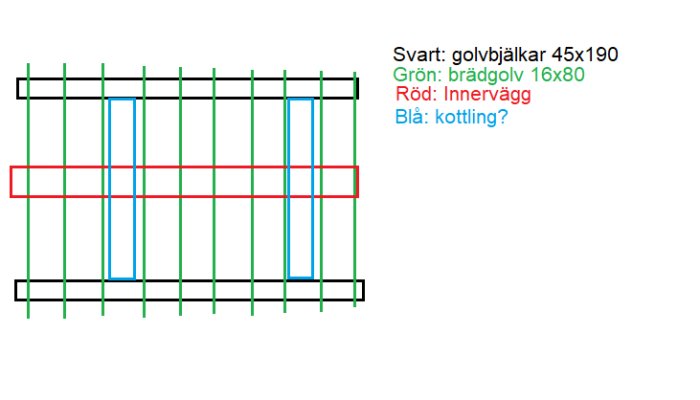
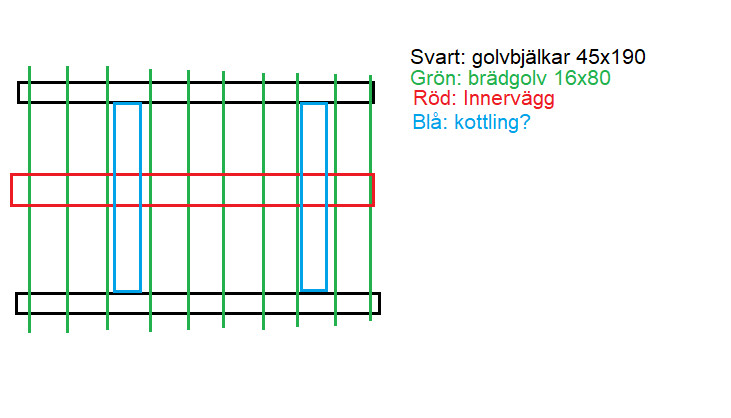
But, how do I handle floorboards that run under an interior wall that doesn't sit directly on a floor joist? Should I insert noggings at regular intervals to support the bottom plate of the wall? If so, how close together and how large should the noggings be?
I am renovating our old laundry room into an office. Over the years, washing machines and other things have caused the wooden floor to settle quite significantly, with a difference of 20-30 mm between high and low points, so I want to replace it to be able to lay a new surface floor. The wooden floor lies across the floor joists and consists of tongue-and-groove boards, about 16x80 mm. I expect to need to level some floor joists as well, exactly how bad it is I will see when I have broken up a bit more. I also have access to the joist system from below through the crawl space.
But, how do I handle floorboards that go under an interior wall that doesn't stand directly on a floor joist? Should I insert noggins at regular intervals to support the bottom plate of the wall? If so, how close and how large should the noggins be?
[image]
You might be able to place a floor joist under the entire interior wall since you have access to the space underneath and raise the interior wall to its correct position or at least prevent it from sinking even more. How long is the distance between the floor joists?
It is actually only 2m between the supports, there is a central wall in the middle of the house and a substantial stud on each side of it, halfway between the outer wall and the central wall.
Unfortunately, all the water pipes run right where it has settled the most, both drinking water and heating.
It's actually only 2m between the supports, there's a central wall in the middle of the house and a substantial beam on each side of it, right between the outer wall and the central wall.
Unfortunately, all the water pipes run exactly where it's settled the most, both drinking water and heating.
Strange that it settled so much then. Have the beams or the central wall sunk anywhere?
Or has the wooden floor only sunk between the beams?
I haven't had time to tear up the whole floor yet, but I will try to find some time this weekend or at the beginning of next week. It may be that only the board floor has sunk; the joists looked pretty straight from underneath, from what little I could see.
Click here to reply
Vi vill skicka notiser för ämnen du bevakar och händelser som berör dig.

zarkov said:
I am renovating our old laundry room into an office. Over the years, washing machines and other things have caused the wooden floor to settle quite significantly, with a difference of 20-30 mm between high and low points, so I want to replace it to be able to lay a new surface floor. The wooden floor lies across the floor joists and consists of tongue-and-groove boards, about 16x80 mm. I expect to need to level some floor joists as well, exactly how bad it is I will see when I have broken up a bit more. I also have access to the joist system from below through the crawl space.