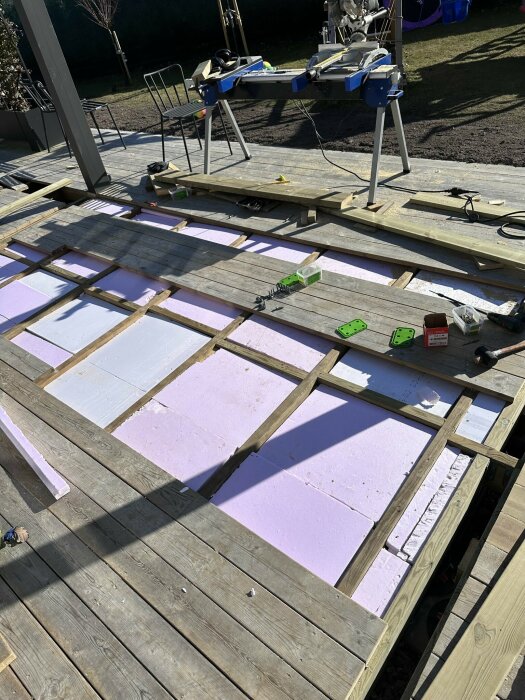
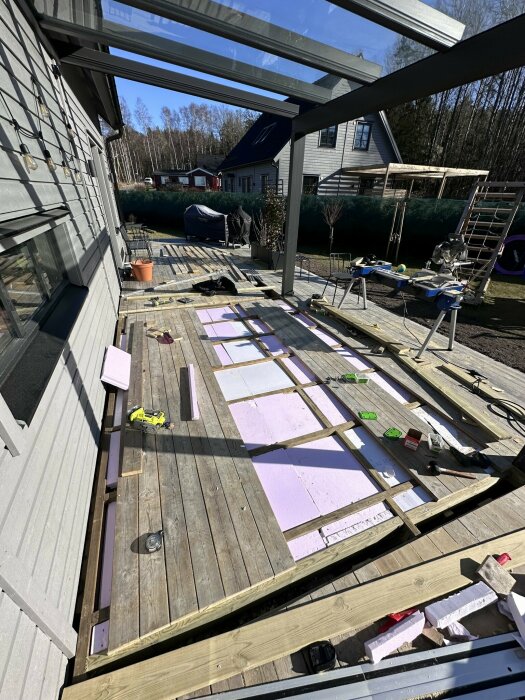
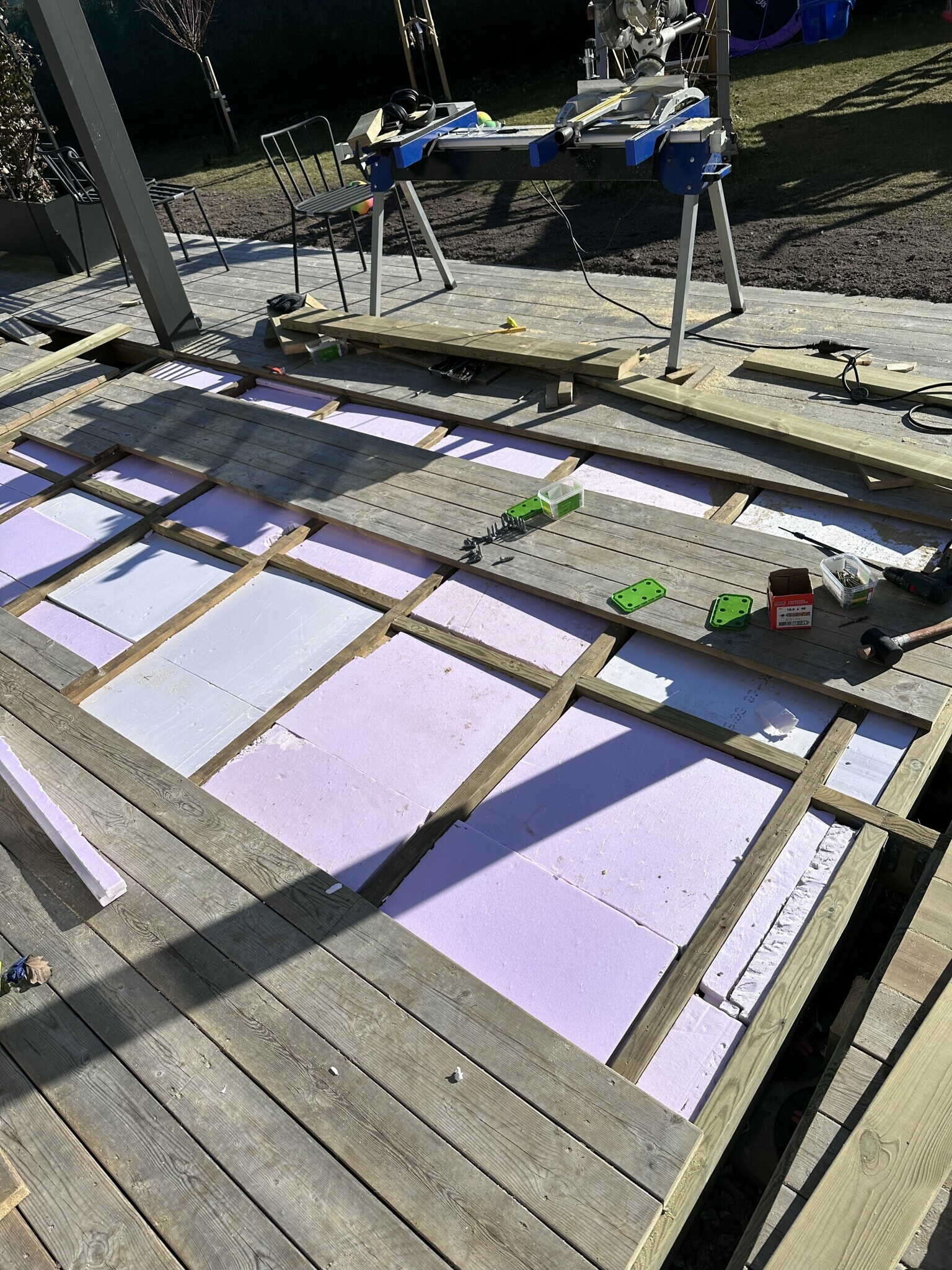
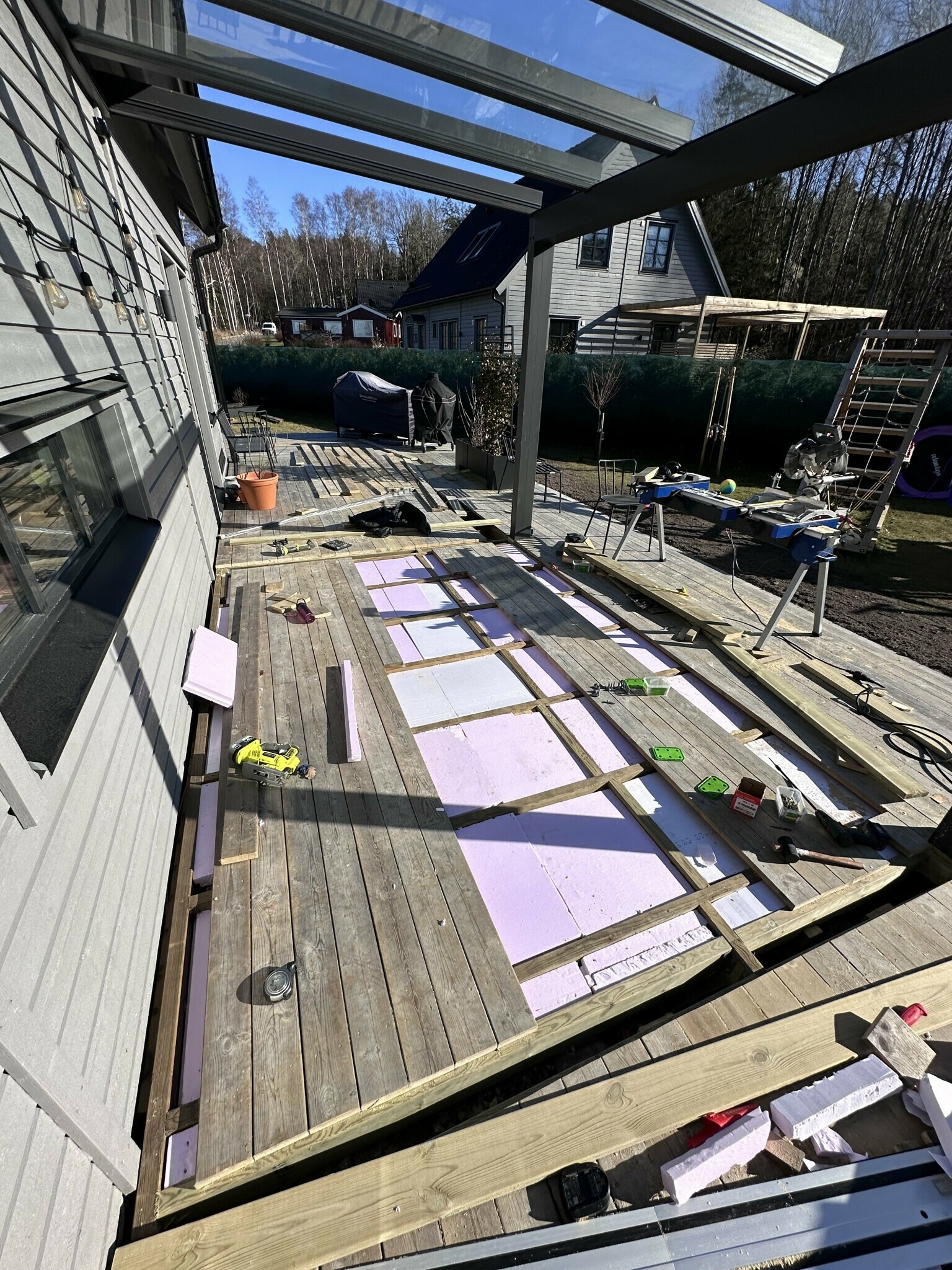
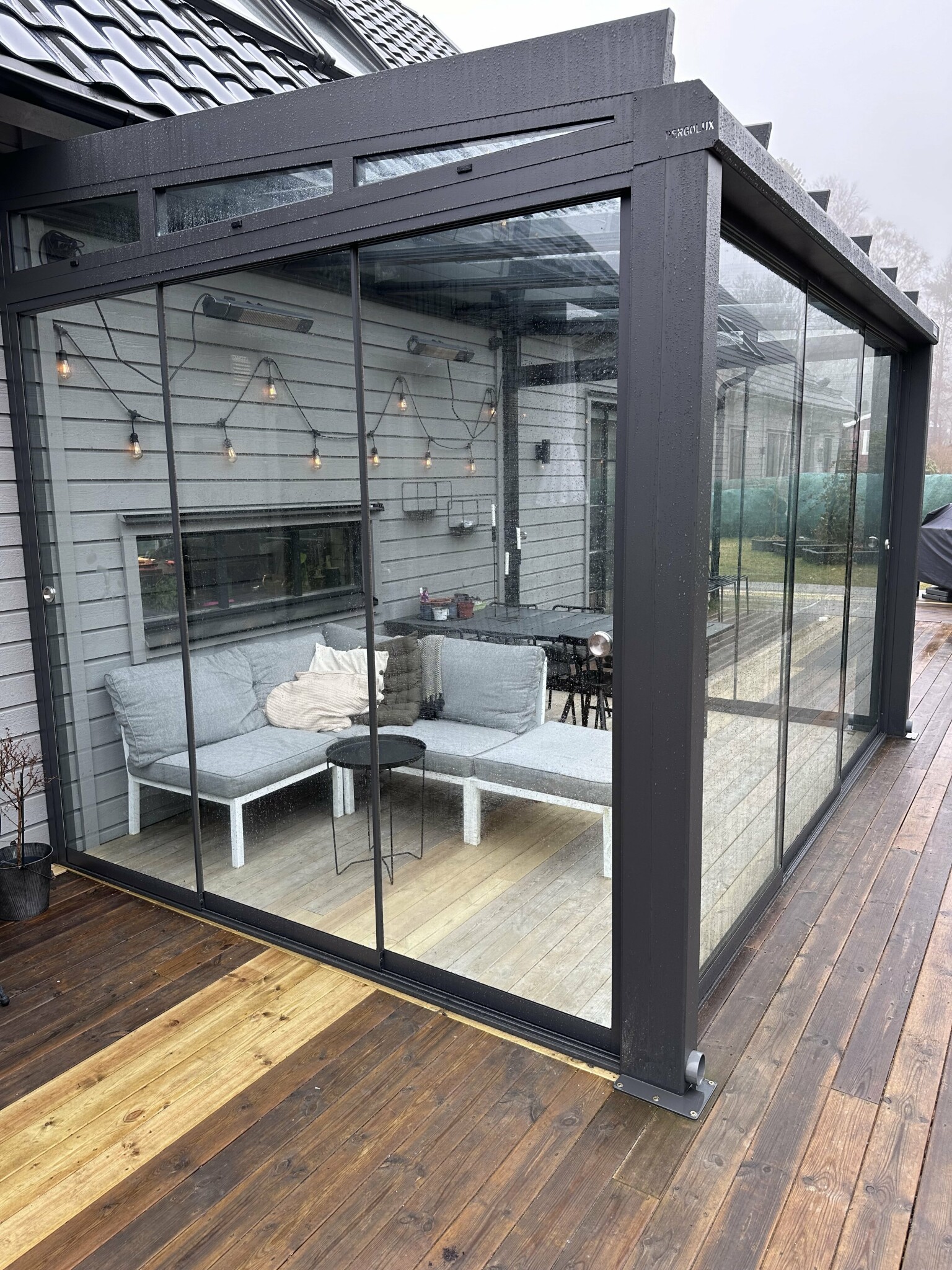
I have placed XPS (from byggmax) under the decking where I've built an enclosed porch. After much advice and recommendations from the forum and other sources.
But now that I'm finished, I came across some information that XPS is a very flammable/fire-prone material.
I'm really just wondering if I should have done something differently or if this looks okay. I placed the XPS boards between existing joists with a slight slope so that any liquid can drain off, and 0.5-1cm from the decking board.
This is what a Fire Engineer at the Greater Gothenburg Rescue Service says:
"Fire class F means that the product does not meet any fire requirements, or has not been tested. In today's applicable BBR, class E is generally the lowest level that applies where material properties are required. However, other materials can be used in some cases if they are built in or protected in another way. With such a solution, however, the material that protects the unclassified material must meet the specified requirements in BBR and not contribute to the risk of ignition of the underlying material.
What requirement applies depends again on the building class and the space in which the material is placed.
Unfortunately, we do not have the opportunity to answer more precisely to specific questions and must refer you to a fire consultant if you have further concerns about your specific case."
Should I make any additions in some way?
Here are some pictures! Thanks
(I originally asked in Trädgård & Utomhus › Altan & Uteplats but realized that it was probably the wrong part of the forum)
I'm afraid that's probably not the optimal solution. One could imagine that a spark from a grill outside an open sliding door could ignite the foam plastic if bad luck struck. A stone wool-based ground board and windproof paper might have been better. With that, you can also lay the insulation next to the wooden studs with a clear conscience and make the whole thing airtight and significantly warmer than with XPS and a gap. Naturally, there must be ventilation on the underside and in the conservatory, but as usual, the ventilation must be either regulated or properly dimensioned, not uncontrolled free-blow.
I'm afraid it's not the optimal solution. You could imagine a spark from a grill outside an open sliding section potentially igniting the foam plastic if you're unlucky. A stone wool-based ground panel and windproof paper might have been better. With that, you can also place the insulation next to the wooden studs with a clear conscience, making it airtight and significantly warmer than with XPS and a gap. Of course, there must be ventilation on the underside and in the conservatory, but as usual, the ventilation should be either regulated or properly dimensioned, not an uncontrolled free flow.
Thank you so much for your response, I almost suspected that such a one would come! Unfortunately, I've seen several suggestions for the solution I've chosen (here on the forum).
Is there any other alternative you suggest besides breaking everything up and redoing it?
Just don't grill nearby or do other fire-hazardous activities there. Xps is not easily flammable but is obviously not good in a burning structure where it can feed the fire, though it doesn't burn well on its own.
I don't know exactly what this is, of course, but it's probably similar.
Just don't grill nearby or engage in other hazardous activities there. XPS is not easily flammable, but of course, it's not good in a burning structure where it can feed the fire, but it doesn't burn well on its own.
[media]
I don't know exactly what this is, but it's probably similar.
Interesting video, and even more interesting comments!
The XPS is only under the patio and nothing is exposed outside. Framework around the entire structure.
A few considerations:
- Should one have placed a ground cloth/wind barrier between the decking and XPS?
- Are there patio rugs made for all weather that are flame-retardant, should one perhaps have one of those?
Or should one just bite the bullet and tear up the XPS and replace it. I'm hardly daring to light a tealight nearby
I think you are exaggerating the fear a little, many materials are more or less flammable. It looks like you have a couple of nice flammable cushions and pillows on the outdoor furniture, for example. Take a scrap piece of the board you used and do your own test, different brands can behave differently. I assume you won't go wild with a propane torch in the sunroom.
Thank you so much for your response, I almost suspected such an answer would come! Unfortunately, I've seen several suggestions for the solution I chose (here on the forum).
Is there any other option you would consider, other than breaking up and redoing everything?
[image]
The risks are small, but one must also understand that it is not possible to compare a video with a gas torch to a fire that has taken hold and fire gases are produced from all materials due to the heat. If you had the XPS (?) from the video in an oven at 300 degrees beforehand, you would see a real blaze! That's the environment that arises locally at the beginning of a fire. You've surely noticed that a single log barely catches fire, but if you have 3-4 heating each other, it becomes a lovely blaze.
I really have no idea what fire protection regulations say, but I wonder if such a solution is not directly prohibited. At the very least, you should have interconnected smoke alarms in the sunroom and indoors so you can get an early warning if something happens. Now, I don't think the greatest risk of fire is from the outside in, but if the worst were to happen and you get a fire in electrical cables in a wall that burns through, the sunroom could contribute to the damage becoming unnecessarily large.
Edit: found this: "Many believe that foam plastic is safe to build with because it is allowed, but as the material is used today, it poses a great fire risk. The safety relies on everything being perfect, that it is built exactly as it is tested, that it is maintained and undamaged, and that no ignition source gets past the protective surfaces." https://www.brandskyddsforeningen.se/brandsakerhet/byggsektorn/cellplast/
The risks are small, but one must also understand that it cannot be compared to a video with a propane torch with a fire that has taken hold and fire gases are formed from all materials due to the heat. Had you had the XPS (?) from the video in an oven at 300 degrees first, you would have seen a real blaze! That's the environment that occurs locally at the start of a fire. You've probably noticed that a single log is barely able to catch fire, but if you have 3-4 warming each other, it becomes a nice blaze.
I really have no idea what fire safety regulations say, but I wonder if such a solution is not directly prohibited. At a minimum, you should have connected smoke detectors in the sunroom and indoors so you can receive an early warning if something happens. Now, I don't think the greatest risk for fire is from outside in, but if the worst were to happen and you get a fire in electrical cables in a wall that burns through, the sunroom can contribute to making the damage unnecessarily large.
Edit: found this: "Many believe that foam plastic is safe to build with because it is allowed, but as the material is used today, it poses a significant fire hazard. Safety relies on everything being perfect, that it is built exactly as tested, that it is maintained and undamaged, and that no ignition source gets past the protective surfaces."
[link]
You are absolutely right.
I've also read that, they probably mean you should have plasterboard or something similar as a protective layer.
Not entirely easy to find exactly what applies, or how one should proceed.
I spoke with a fire consultant who, like some other builders, pointed out that cellular plastic/XPS is unsuitable to use unless it is built into fire-protective materials (fiber cement, gypsum, or similar).
It should ideally be protected from below with a subfloor, as well as a board on top.
The fire consultant said that if an accident occurs and it starts to burn near the cellular plastic, it is virtually impossible to extinguish and contributes to the spread of the fire. In that case, he also pointed out that the insurance company might have opinions if you built it this way.
That being said, one might consider switching to rockwool (stone wool) or similar.
I think the biggest risk with your construction is mice/black ants, they have plenty of room, a sheltered location, and warm and cozy material to build with/in.
In my care, cellular plastic should be covered with at least 7cm of concrete on the top side and remain well below ground on the other sides, so it's an unnecessarily complicated material to use if you don't have a cast slab.
I think the biggest risk with your construction is mice/black ants, they have plenty of space, a protected location, and warm and cozy material to build with/in.
In my care, cellular plastic should be covered with at least 7cm of concrete on the top side and be well below ground on the other sides, so it's an unnecessarily complicated material to use if you don't have a cast slab.
That's also a good point! Had I known what I know today, I would never have chosen cellular plastic.
I'm leaning towards putting a couple of scraps at the bottom and just laying mineral wool on it.
Click here to reply
Vi vill skicka notiser för ämnen du bevakar och händelser som berör dig.



Rickard. said: