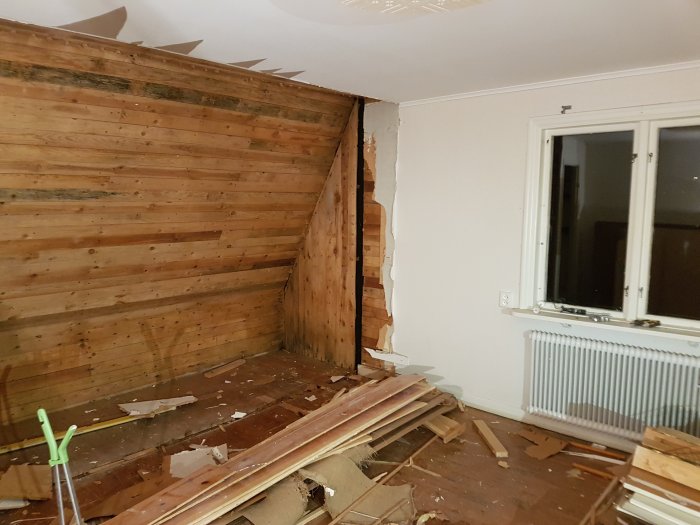
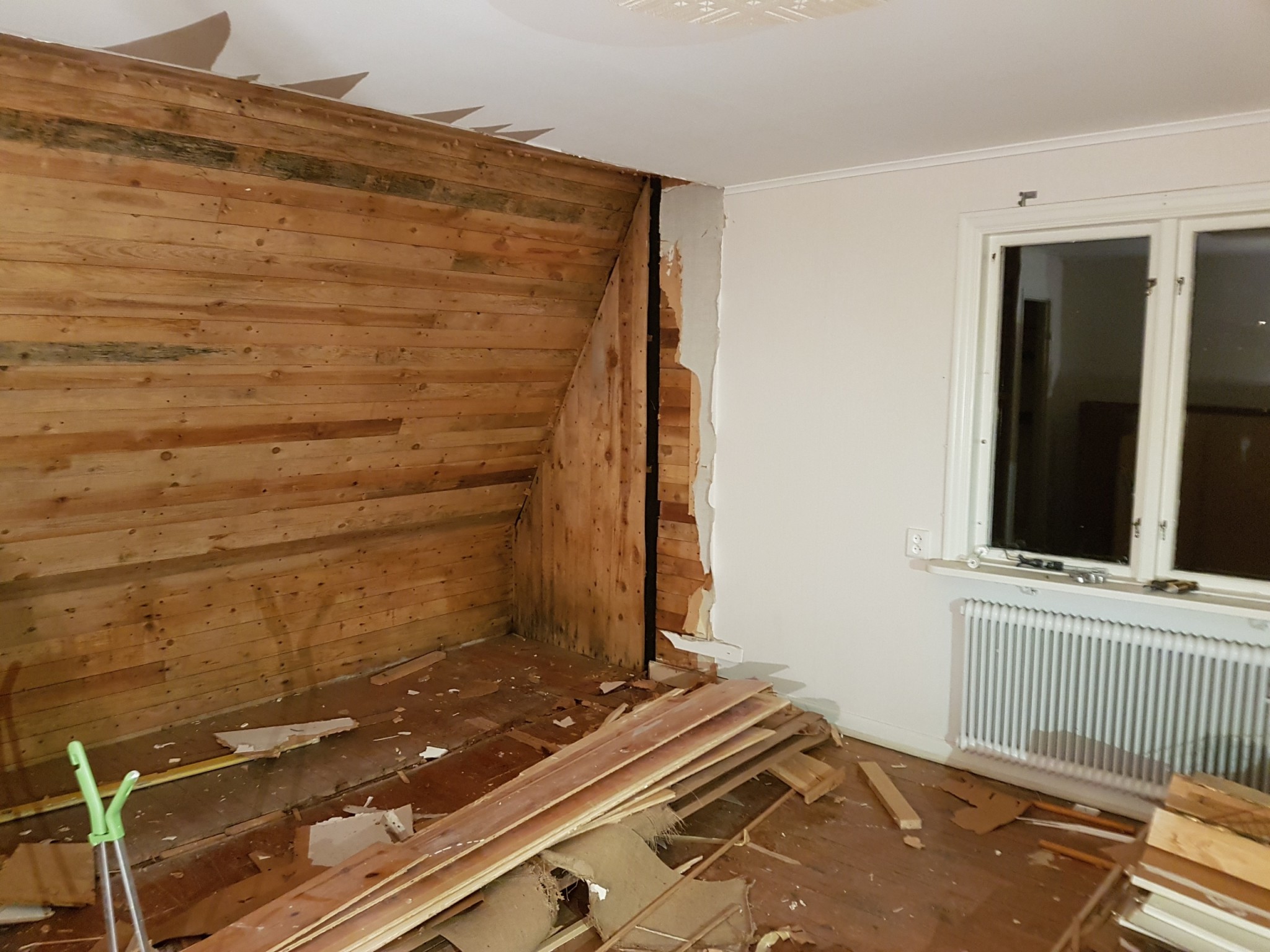
I have demolished a couple of dormers in my 1930s house with a mansard roof to get a bit more space in the bedroom. I have looked at the original drawings, and according to them, the remaining slanted roof should have a frame of boards and cross planks as shown in the picture. Behind the planks, there is a black felt that holds the insulation of wood chips/peat in place.
What I'm considering now is insulating the slanted roof to reduce energy consumption. My main question now is whether I should install a plastic layer first to avoid moisture problems? The felt that is currently there is probably not tight enough to create double moisture barriers? In that case, I should be able to put plastic against the boards and then install 70mm studs, insulate, and drywall? Or is the idea with plastic wrong?
It should be positioned a maximum of 1/3 into the wall on the warm side, which it will be since I'm adding insulation. The question was whether the existing paper is considered airtight?
I have used isolinas linisolering and their papp to insulate the inside of a wall. I am somewhat skeptical of plastic and mineral wool in old constructions. It is said that you should only use a maximum of 45mm. The cost is a bit higher, but the risk of moisture damage with thicker insulation, mineral wool, and plastic is reduced.
I have used Isolina's wood fiber insulation and their paper to insulate the inside of a wall. I am a bit skeptical about plastic and mineral wool in old constructions. It is said that you should lay a maximum of 45mm. The cost is a bit higher, but the risk of moisture damage with thicker insulation, mineral wool, and plastic is reduced.
That sounds interesting, I will read up on it a bit. The idea is to not insulate more than 45 or at most 70mm which seems reasonable. However, I am a bit concerned about how it will affect the load-bearing structure that will become colder. I am a bit worried that it could become a problem.
That's exactly why you shouldn't insulate more than 45. Some say it's not economically justifiable to insulate so little, but in your case, you're redoing the surface layer anyway. Plus, I think for comfort, 45 isn't wrong. Doubling 45 doesn't make the insulation twice as effective. The first few centimeters have the most impact, and then it quickly diminishes. But the risk of moisture in the wall should probably be taken seriously.
The need for a vapor barrier (=plastic) entirely depends on the type of insulation present in the wall. If you intend to keep the sawdust or use cellulose fibers, you should not use any plastic. The existing paper is a wind barrier. If it contains asphalt, it is vapor-resistant but definitely not vapor-tight. It is also never good to combine hygroscopic insulation materials like sawdust and cellulose fibers with non-hygroscopic ones like mineral wool.
Assuming that the wood shavings are directly against the outer roof/boarding with roofing felt on top?
Then it's an extremely sensitive construction against moisture already, as the "moisture barrier" is on the cold side of the insulation.
Click here to reply
Vi vill skicka notiser för ämnen du bevakar och händelser som berör dig.