Due to the lack of storage space in the house and the absence of suitable outdoor storage, we now have about 15 moving boxes with various items in a guest room, and half of us are getting tired of this situation. The easiest would be to throw away all the boxes, but that suggestion was not accepted, so now I am about to insulate a small outbuilding with the thought of moving the boxes there if I manage to make it dry and frost-free. And above all, if I manage to carry out the project, which is going so-so - and that's why I'm here.
The outbuilding is a small space measuring 4.5 * 2.8 m, built of plastered masonry blocks, dirt floor, previously asbestos roof (which I have now removed). It's quite low in the ceiling (something I didn't understand the consequences of until later; more on that) about 1.4 - 1.8 m (sloped roof). On one gable, there are two old barn doors.
My idea was to...
- tear down the roof
- frame the roof with 45x95, install rough boards and then metal roofing
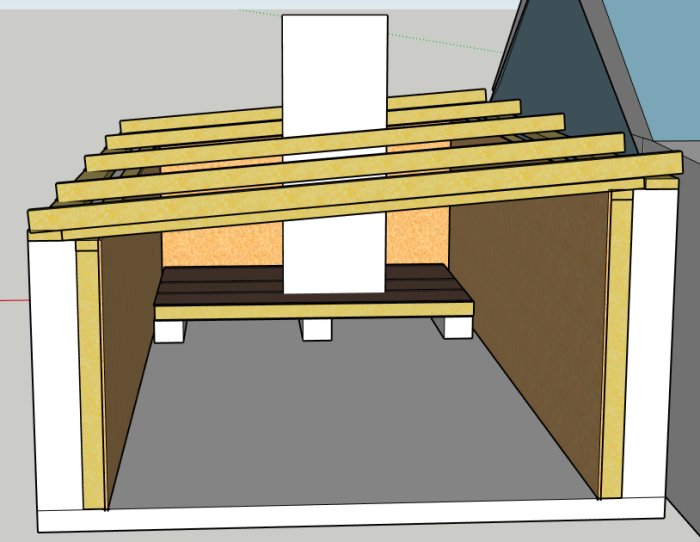
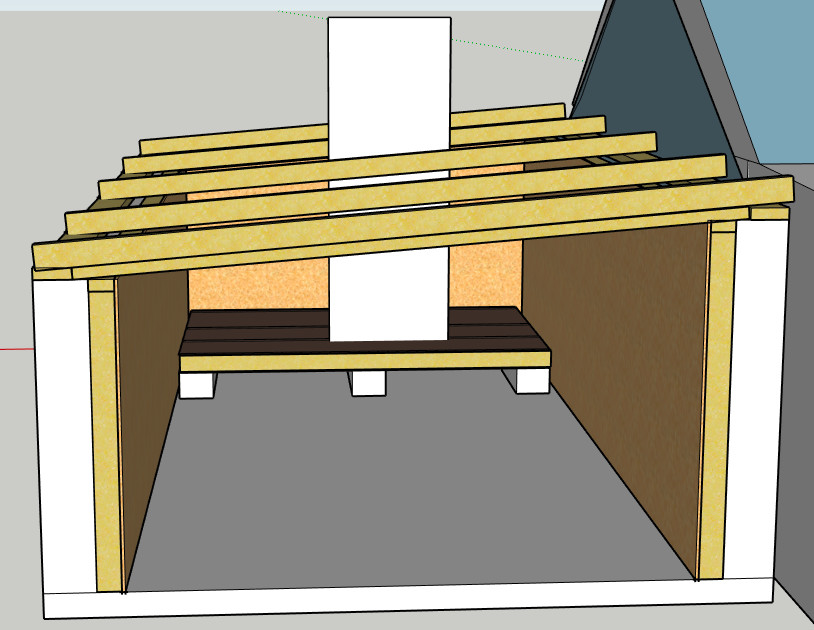
- divide the inner half of the space: lay masonite and floor beams on paving stones, frame 45x95 on walls, insulate the floor, walls, and roof, build a wall and install an interior door, then possibly set up a portable dehumidifier and heater to keep it frost and moisture-free.
But it was the door that didn't work...
There's only a meter clearance! So now I'm a bit back at square one. Raising the roof is possible, but considering the neighboring building, it wouldn’t look so nice...
So now I would like to ask for ideas...
I have an old cellar under part of the house, which is accessed from outside. It looks like this: https://imgur.com/a/GGgbqyv. Is it smarter to close it off and store the boxes there?
In due time, we will build a garage, which will have a storage section where boxes and such can be stored and forgotten. So, really, a temporary solution for a couple of years will suffice.
I have a considerable amount of boxes and other rat up in our attic in our house from the 1900s, and it's probably not a particularly pleasant climate, but nothing there is affected by anything anyway. Both cold and damp in the winter and hot as heck in the summer.
I have a considerable amount of boxes and other rat up in our attic in our 1900s house and there's probably no particularly pleasant climate up there, yet nothing is affected by anything anyway. Both cold and damp in the winter and hot as heck in the summer.
That sounds reassuring. Yes, when I think about it, that's always how I've had it before, but the attics must have had good ventilation since it worked. Feels like that's a prerequisite? But of course, then maybe I don't need to worry about making it frost-free. What do you think is best in my case, the basement or the outbuilding? And the outbuilding, is it enough to just fix the roof so it doesn't leak and skip insulation, etc.?
The damage to what is stored depends a bit on what you have in the boxes - if there are paper, fabric, or electronics in the boxes, they will suffer in one way or another if they are in unheated spaces. The basement has a gravel floor and the wall is likely quite damp as well, making it unsuitable for storage. The outhouse has gravel underneath and there is also a risk that the walls will draw moisture from the ground, but if you lay a construction plastic on the gravel and then build a suitably insulated floor on beams placed on the stones that seem to exist today, it might work well enough. Then use metal studs (not wood) against the walls, construction plastic, and moisture-resistant boards on top - unclear how/if you should insulate. You can probably make the roof with 145-170 mm beams and tongue and groove/roofing felt outward and construction plastic + plywood inward with fiberglass insulation and an air gap towards the outer roof. If you then install radiators to keep it at 10 degrees year-round, books and clothes will probably be okay for a few years. The space will be so small that it won't cost a lot to keep it heated. Then there's the matter of the door... If you put it in a built-up partition wall, a cheap storage door that isn’t fully insulated might suffice, but some insulation would be preferable. If necessary, it might even be adjusted to the ceiling height
The damage that occurs to stored items depends a bit on what you have in the boxes - if there's paper, fabric, or electronics in the boxes, they will suffer in some way if left in unheated spaces.
In the boxes, there is both paper and textiles. However, it's not about archiving old Shakespeare manuscripts, so we can tolerate some degradation in condition, but not to the point of them being destroyed, of course.
The basement has a gravel floor, and presumably, the wall is quite damp too, making it unsuitable for storage. The outhouse has gravel underneath, and there is also a risk that the walls draw up moisture from the ground, but if you lay a construction plastic on the gravel and then build a suitably insulated floor on joists laid on the stones that seem to exist today, it might work well enough.
I don't think the outhouse has gravel underneath; it’s just soil. I've tried excavating part of the inner half to lower the stones a bit, but it’s very rocky. Does this change anything? Or is your recommendation still to lay construction plastic on the gravel, stones on top, and joists directly on the stones? I was thinking of laying Masonite under the joists to be able to place insulation between: is it a good idea?
Then metal studs (not wood) against the walls, construction plastic, and moisture-resistant boards on that - unclear how/if you should insulate though.
Let me see if I understand. The construction plastic, it can be taped to the boards on the inside before they are attached to the metal studs to simplify the assembly, I assume? Moisture-resistant boards, are you thinking of Masonite (oil-hardened board), asfaboard, or something else? I probably won't attach anything to the walls that I know of, so that could work; it is, after all, a (hopefully) temporary thing. What are the arguments against insulating?
The roof you could probably do with 145-170 mm studs and rough boarding/roofing felt outward and construction plastic + plywood inward with fiberglass insulation and an air gap against the outer roof.
Sorry for the stupid questions. What is roofing felt? Underlay roofing paper? How do I create the air gap against the outer roof? Do you mean between the rough boarding and the roof sheet? My thought was to place battens on the rough boarding (underlay paper) and screw the roofing sheet onto these, to create a certain air gap. Is this what you mean by the air gap against the outer roof?
If you then install a heater to keep it at 10 degrees year-round, books and clothes will probably survive for a few years. The space will be so small that it won’t cost much to keep it heated. Then there's the matter of the door... If you place it in a built interior wall, a cheap storage door that’s not fully insulated might suffice, but some insulation would be nice. If necessary, it can probably be adapted to the ceiling height
Sorry for yet another stupid question, but why would you want insulation in the door but not necessarily in the walls? And as for adapting to the ceiling height, is it just a matter of chopping off the door? It would be about half that goes away. An alternative could be to build a "plug" of plywood and styrofoam, as we won’t need frequent access to the items inside directly, and it’s more about "hide and forget" for a while.
There is nothing listed that is damaged by cold. It is the moisture you need to keep an eye on. You can keep it away with the help of heat, but dehumidifiers also work.
There is nothing in the listed items that is damaged by cold. It's the moisture you need to be aware of. You can keep it away with the help of heat, but a dehumidifier works too.
To make it very simple, do you think it would work to place the boxes in the basement (on a SJ pallet for example), set up a dehumidifier, and seal it up?
My garage, about 30m2, has asphalt on gravel (previously a carport) and is now insulated. A small cheap dehumidifier (Jula) is enough to both heat it and keep it dry. I think I had 9 degrees as the coldest last winter, but then again, I don't live in Västmanland.
It is insulated with 145mm in the ceiling and 95mm in the walls. And if I do a 30-minute workout in the garage in the winter, the temperature quickly rises a couple of degrees, so not much heat is needed. Furthermore, I have a poorly insulated overhead door (Skånska byggvarors cheapest).
To make it very simple, do you think it would work to place the boxes in the basement (on a pallet for example), set up a dehumidifier, and seal it off?
Yes, but if a lot of moisture comes in, the dehumidifier will need to run a lot.
if there is paper, fabric, or electronics in the boxes, it will be damaged in one way or another if it is stored in unheated spaces.
Why do you think that? I have had "paper, fabric, and electronics" and everything else found in a normal small "farm" including about ten electric machines and about the same number of gasoline-powered ones, stored in "unheated spaces" during the winter for nearly fifty years. No problems at all with the cold, provided that you, for example, ensure things like the washing machine and pressure washer are drained of water.
When it comes to books and other papers, they are more sensitive to moisture than you might think - they can easily get mildew/black mold, the same applies to cotton fabrics.
Gravel or soil doesn't matter much - it's the ground moisture that rises regardless. As for plastic at the bottom, it was partly to stop some of the moisture. I had a crawl space dehumidifier installed in a townhouse I lived in, and they put plastic under the whole house on the gravel and then installed the dehumidifier. Their argument was that it was only moisture coming up through the concrete that needed dehumidifying, plus condensation of course.
If you place plastic all the way up to the walls, the moisture will have a smaller area/path to rise, I think.
Insulation underneath is good if you want to keep warm and not use too much electricity. It requires less downward than upward - most heat escapes upwards and through windows, etc.
By moisture-resistant, I meant probably not to use drywall for the inner wall... if you have plastic in the wall and also heating, then OSB or oiled board (thicker than 3mm) should work.
When it came to insulation, I thought you have stone walls, and if there’s little draught, the air between the stone wall and the inner wall board might be enough insulation. Otherwise, a stone wool/glass fiber insulation board would probably be fine for a few years.
A roof membrane is a heavy fabric that in certain roof constructions replaces the roof decking. Then battens and metal on top of that. The air gap should be between the outer roof and the insulation to ventilate away moisture that has risen. It also requires open eaves and ridge, with insect mesh.
Of course, a "plug" of plywood and foam can work instead of a door - simple and convenient if you don't want to go in too often.
Since this is supposed to be a temporary solution, you may not want to spend too much money, and if you accept that the material becomes discarded, you can always simplify. It's also a question of the value of what you want to protect/save.
Then I have experienced that what was meant to be a temporary solution tends to become permanent - or at least semi-permanent and suddenly used for something else :-D
As someone wrote before, a dehumidifier can have a good effect, also providing a little warmth, just remember to have a dehumidifier that can be connected to a hose to remove the water that condenses. This can be difficult in the winter if you don't have a drain....
Why do you think that? I have had "paper, fabric, and electronics" and everything else that is found on a typical small "farm" including about ten electric machines and as many gasoline-powered ones, stored in "unheated spaces" during winter for nearly fifty years. No problems at all with the cold as long as you, for example, make sure to empty things like washing machines and pressure washers of water.
It is not the cold but the moisture in unheated spaces that damages paper, fabric, and electronics.
Vi vill skicka notiser för ämnen du bevakar och händelser som berör dig.






Alfredo said:
Why do you think that? I have had "paper, fabric, and electronics" and everything else that is found on a typical small "farm" including about ten electric machines and as many gasoline-powered ones, stored in "unheated spaces" during winter for nearly fifty years. No problems at all with the cold as long as you, for example, make sure to empty things like washing machines and pressure washers of water.