
4,832 views ·
25 replies
5k views
25 replies
Identify wood species exterior door
If you want sustainability, I believe most in LeTonkinois or similar. Then you have fairly frequent maintenance that takes about an hour when you do it. Alkyd oils age in a different way that makes maintenance more difficult in the long run. Varnish is durable until it no longer holds, and then it becomes a tremendous amount of work, as wooden boat owners know.
But le toninois Bio Impression is a mixture of linseed oil and tung oil, and Herdins has a corresponding product. However, they lack UV protection and rot protection. If I understand correctly, the door manufacturers want that in the first layer.H heimlaga said:If you want durability, I believe most in LeTonkinois or something similar. Then you have a fairly regular maintenance that takes about an hour when you do it. Alkyd oils age in a way that makes maintenance more difficult in the long run. Varnish is durable until it no longer is, and then it becomes an enormous amount of work, as wooden boat owners know.
If I understand it correctly, there is a big difference. Linseed oil struggles to penetrate dense woods like hardwood and oak. However, there are people who are better suited than I am to explain this.Z z_bumbi said:
From Wisbo
Eleostearic acid is what governs the properties of tung oil because it has a conjugated double bond that allows it to dry much faster than other oils and form a very elastic and water-repellent film that is also alkali-resistant, which means it can be used on surfaces like plastered walls or concrete. Tung oil has very good wetting properties and penetrates much better into wood than raw linseed oil.
The oil is used by many furniture craftsmen who polish the oil into the wood with cotton cloth in several thin layers with drying intervals to create a water-repellent and protective film. It is also often included as a "secret" ingredient in treatments to protect stone and slate countertops in kitchens, etc., from water. When it dries, unlike linseed oil, it doesn't become glossy but gives a matte finish.
If you intend to use it as a penetrating primer oil, it should be mixed with about 15-20% boiled linseed oil (depending on the quality) and diluted so that the solid content is between 30 and 50% to prevent the drying from being too rapid, which could cause the oil to skin-dry on the surface.
What I find if I look around online seems to be that linseed oil becomes harder and tung oil more flexible, tung oil more easily builds up a film on the surface. Tung oil is thicker, so the mechanism for it to penetrate better than raw linseed oil is a bit unclear. Raw linseed oil penetrates at least 10 cm in most types of wood, but applied in larger quantities, it takes ages to cure. Luckily, boiled linseed oil penetrates almost as well (the difference is small) and cures faster. I'll see if I can find some paint enthusiast over the weekend so I don't have to try to find research reports.
As it stands now, my plan is to treat withZ z_bumbi said:What I find when I look around the internet seems to be that linseed oil becomes harder and tung oil more flexible, tung oil is easier to build up a film on the surface. Tung oil is thicker, so the mechanism for it to penetrate better than raw linseed oil is a bit unclear. Raw linseed oil goes in at least 10 cm in most types of wood, but applied in any larger quantity takes ages to cure. Luckily, boiled linseed oil penetrates almost as well (the difference is small) and it cures faster.
I'll see if I can find a paint nerd over the weekend so I can avoid trying to find research reports.
- Jotun Benar adeltraolja to get a golden-brown hue and some extra UV protection
- Then a few treatments with le tonkinois bio impression, which is a quality tung oil
This is based on not being able to get other products without ordering, and the contact I got with bovalls, etc was a bit poor. They answered from a script. Osmo was the best because they got the best results, but they couldn't explain why, why they recommend other products in the video, why they recently changed, etc.


S
sinuslinus
Träskalle
· Östergötlands län
· 6 098 posts
sinuslinus
Träskalle
- Östergötlands län
- 6,098 posts
If you apply the Benar oil first, it will create a dense layer.Viktor.J said:
As it stands now, my plan is to treat with
- Jotun Benar adelträolja to get a golden-brown hue and a bit of extra UV protection
- Then a few treatments of le tonkinois bio impression, which is a quality tung oil
This is based on the fact that I can't get hold of others without ordering, and the contact I had with Bovalls etc. was a bit poor. They responded according to a script. Osmo was the best because they got the best results, but they couldn't explain why, why they recommend other products in the video, why they relatively recently switched, etc.
Don't overwork it.
Bio impression is more penetrating.-
S
sinuslinus
Träskalle
· Östergötlands län
· 6 098 posts
sinuslinus
Träskalle
- Östergötlands län
- 6,098 posts
Benar Noble Wood Oil contains pigment that is red, which sticks in the pores of the oak. I have used it on my oak door. Not the most attractive but it works.
The main difference between linseed oil and oil from the tung tree is primarily that tung oil oxidizes faster.
You don't need any rot protection in the door. It is well protected under the roof. However, you might want some product with fungicidal protection on the surface to reduce the risk of black mold spots.
The main difference between linseed oil and oil from the tung tree is primarily that tung oil oxidizes faster.
You don't need any rot protection in the door. It is well protected under the roof. However, you might want some product with fungicidal protection on the surface to reduce the risk of black mold spots.
The rot protection is taken care of by the oak and the oil. If desired, you can prime with half boiled linseed oil and half turpentine.
It is different with a door than with a boat: A boat you impregnate throughout with raw linseed oil mixed with some poison before you start considering the surface.
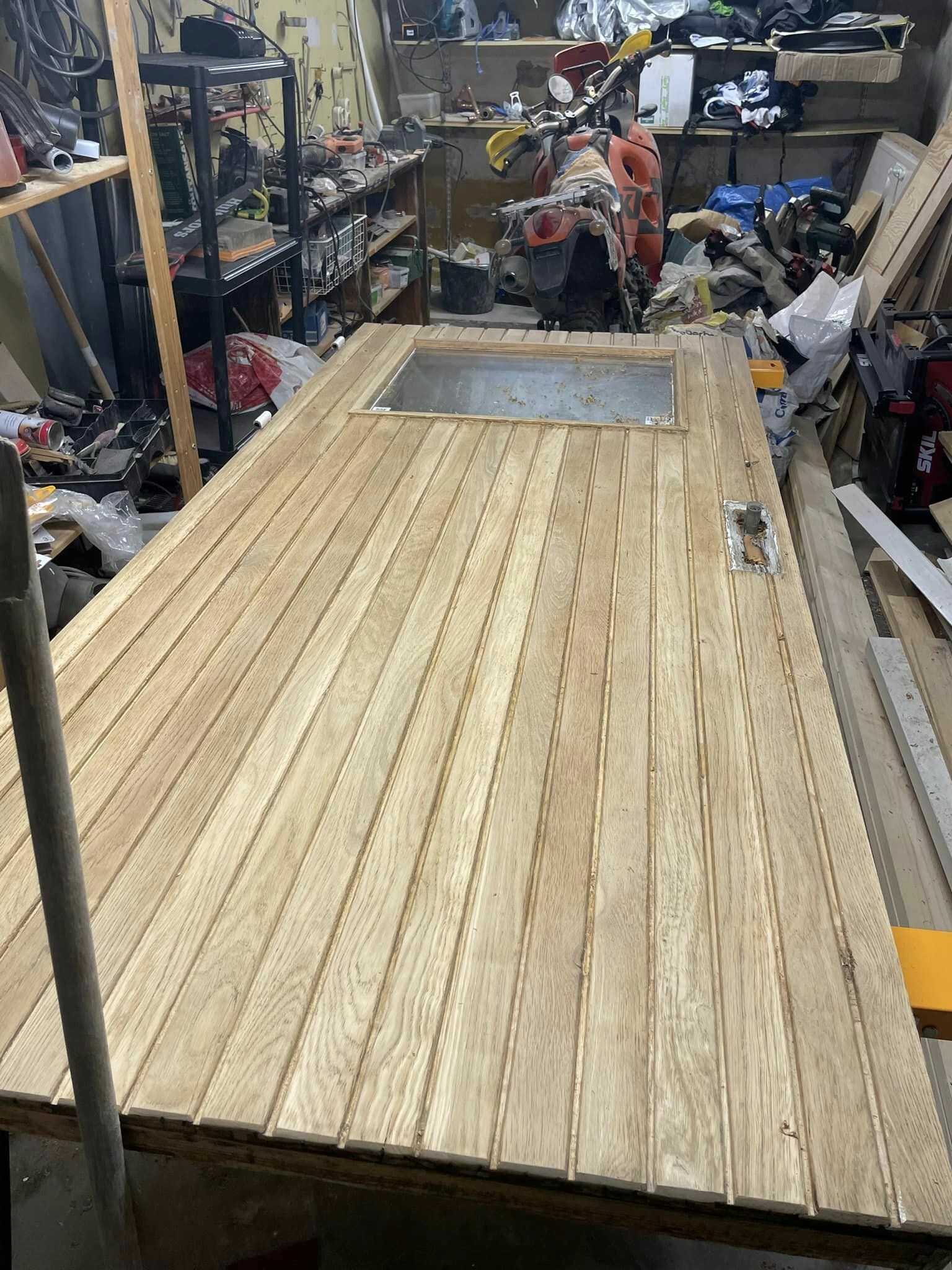
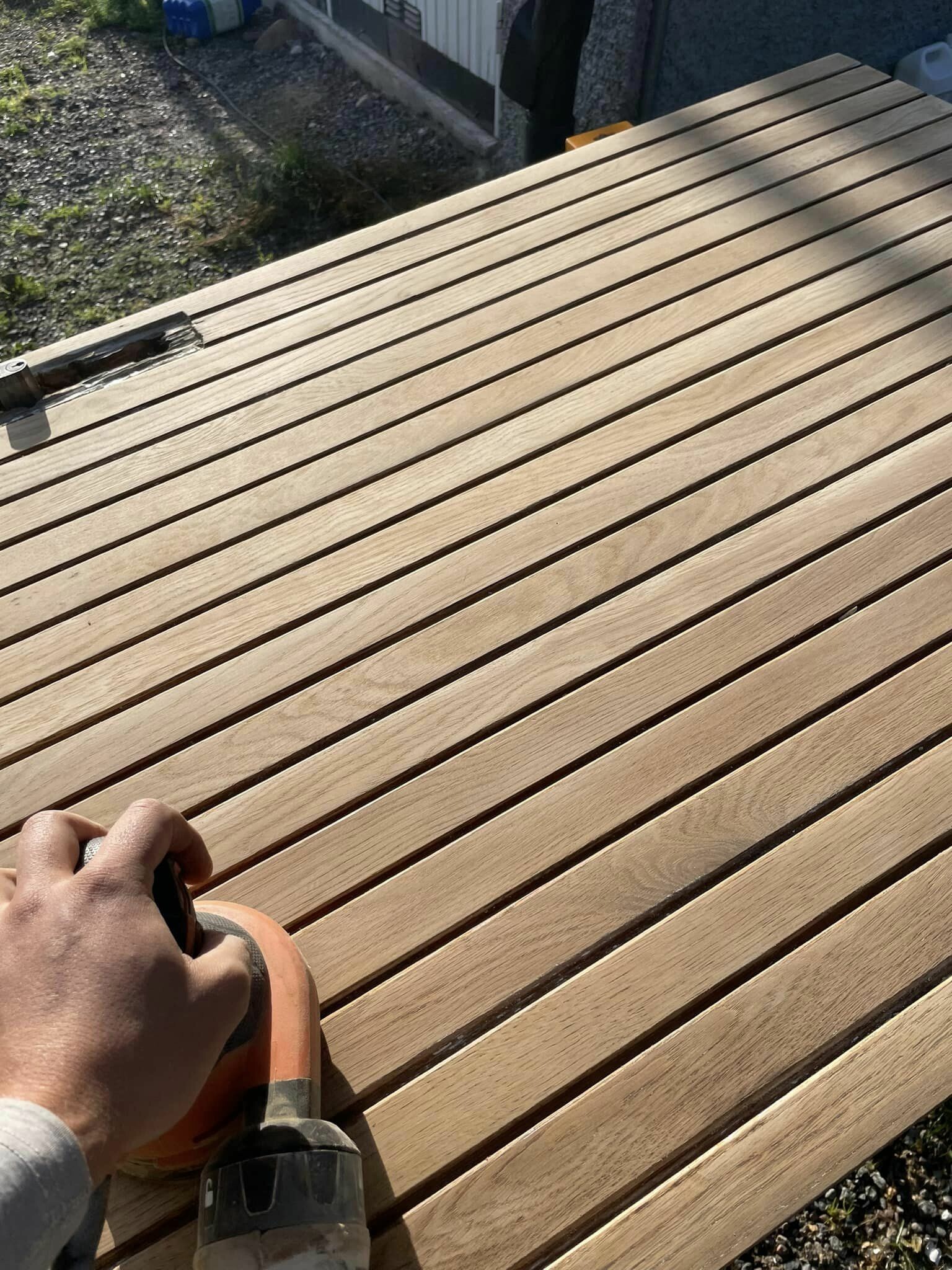
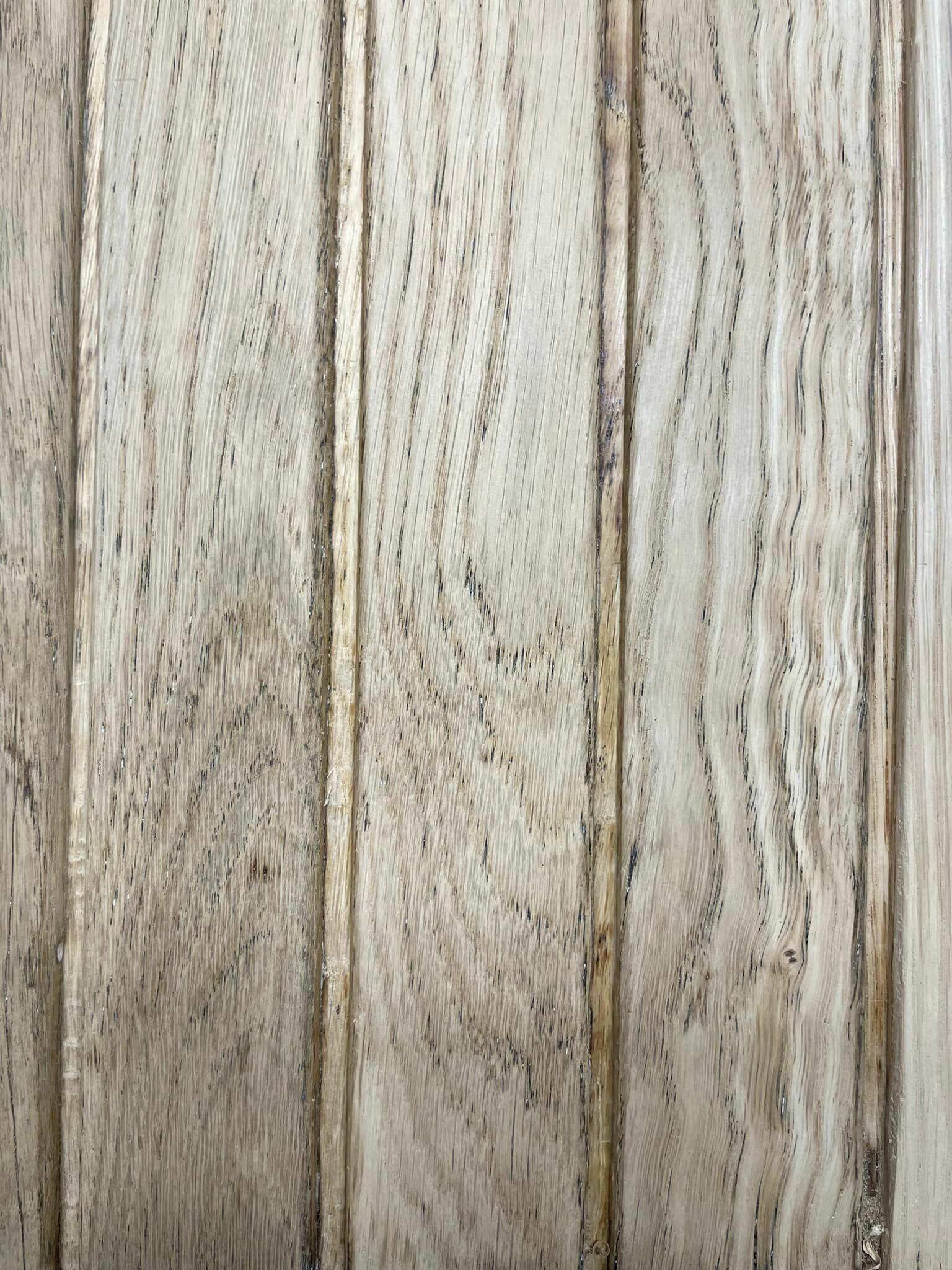
I've continued working and have come across a few more questions 
1: Dark streaks of mold - how do I get rid of them? Sanding down removes too much wood, oxalic acid doesn't work. Any other way?
2: Filler for outdoor use. There are some cracks, small holes, etc. that might be good to seal. Bovalls recommends Ages wood filler, other suppliers claim it's for indoor use. What to do?
3: Could the glass frame be glued, or how are they fastened? There are small pins, but it seems to be "secure" just having a few small pins in it. Ideally, I want to remove it to get access and possibly replace the glass. But I don't want to risk damaging too much. Anyone know?
4: I was considering treating with tung oil from le tonkinois for a long time, but after reading about mold problems, I probably want something with fungicides in it. All suppliers of quality doors recommend Osmo UV protection oil, so I'm leaning towards that now. I've read about some users of tung oil who have had mold problems, and it's said that the lack of fungicides combined with the fatty oil is what makes mold thrive. Thinking that one could start with Osmo UV protection oil and see. The advantage of oil is that it's quite easy to touch up, reapply.
1: Dark streaks of mold - how do I get rid of them? Sanding down removes too much wood, oxalic acid doesn't work. Any other way?
2: Filler for outdoor use. There are some cracks, small holes, etc. that might be good to seal. Bovalls recommends Ages wood filler, other suppliers claim it's for indoor use. What to do?
3: Could the glass frame be glued, or how are they fastened? There are small pins, but it seems to be "secure" just having a few small pins in it. Ideally, I want to remove it to get access and possibly replace the glass. But I don't want to risk damaging too much. Anyone know?
4: I was considering treating with tung oil from le tonkinois for a long time, but after reading about mold problems, I probably want something with fungicides in it. All suppliers of quality doors recommend Osmo UV protection oil, so I'm leaning towards that now. I've read about some users of tung oil who have had mold problems, and it's said that the lack of fungicides combined with the fatty oil is what makes mold thrive. Thinking that one could start with Osmo UV protection oil and see. The advantage of oil is that it's quite easy to touch up, reapply.

Click here to reply