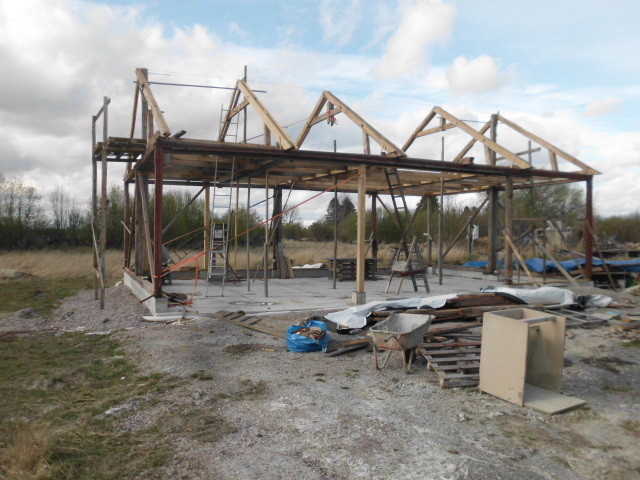
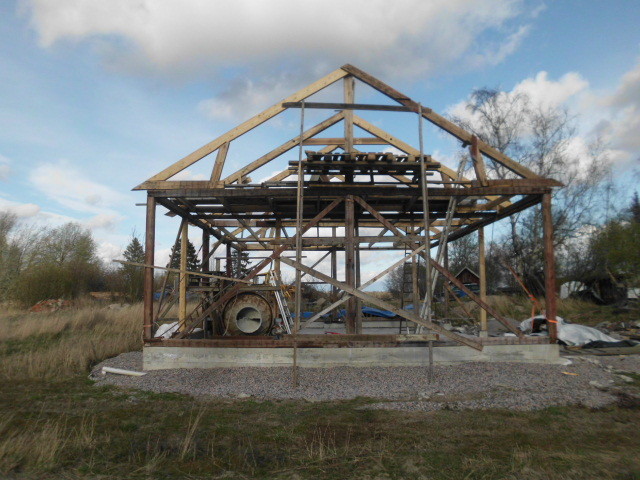
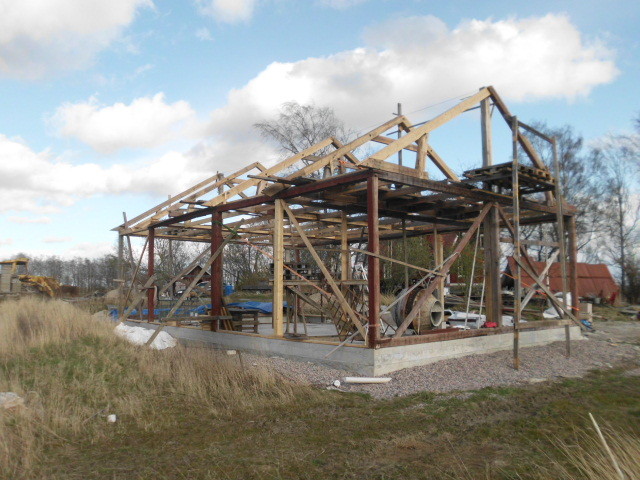
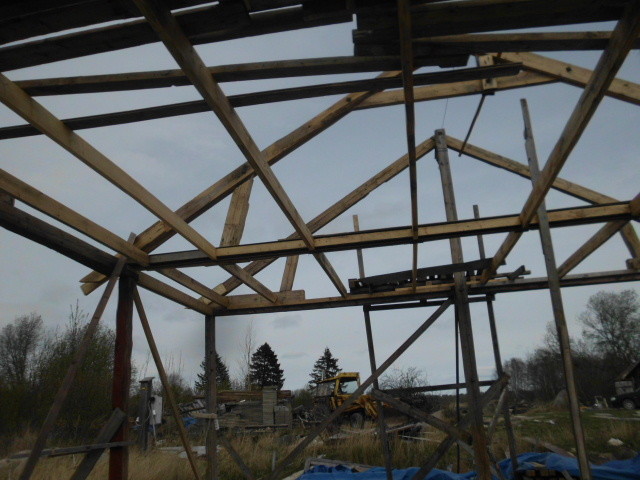
Currently working on assembling an old machine hall and would like suggestions on how to brace the long sides so they don’t bow when the wind hits perpendicularly. The walls of the machine hall consist of 3-meter high, vertical posts (150x150 mm) spaced about 3 meters apart, and between these are beams that support vertical paneling. There is a top beam of 150x150 timber that is spliced in the middle of the posts. This causes the entire long side to bow when the wind hits perpendicularly against the wall. How can I brace the wall effectively and attractively? I have cross-braced the gables and long sides. Adding a brace between the concrete floor and the middle of the long side wall is a solution but somewhat impractical as it takes up floor space. I have read that if you cross-brace between the rafters, you can achieve a shear effect that resists wind loads. I'm not sure if this is feasible since my rafters have a spacing of 3 meters. Does anyone have experience and can offer tips?
A bit difficult to assess without knowing all the details, but a horizontal glulam beam on top of the wall plate (as long as possible and with rigid joints) might do quite a bit. Otherwise, the dimension of the horizontal load-bearing beams is probably quite important. This timber should also be lying down. Diagonal braces between the roof trusses stiffen up the entire roof to provide sheathing action, but that's probably not priority one here.
Depending somewhat on the size of the hall and the truss construction, but otherwise, for example, a horizontal truss with the base against the wall plate. Alternatively, diagonal braces from the middle of the long wall to the short walls.
Looks like there is a floor in the loft. If they are regular tongue-and-groove boards with running joints, that should prevent the long side from bulging and instead distribute the load to the short sides, which absorb it via diagonal struts to the sill.
If the diaphragm action of the loft floor is insufficient, which might be due to the large distance between the trusses, diagonal braces/joists are needed.
But have I misunderstood the problem? It's not within each bay on the long side? Because then it is the thickness of the posts and cross-joists that determine.
With so few trusses, diagonal braces might also be necessary between them for wind loads directly against the gables.
Thank you for all the suggestions! I've had trouble with the computer the past few days and haven't been able to be so active myself. Regarding the "bärreglarna," they are 45x95 but are spliced at the posts and do not help with stabilization against this wind load; they are mostly for carrying the facade panel and perhaps stiffening in the direction of the facade. Showing some clearer pictures. For your information, this is a machine hall I dismantled from another property and am now rebuilding. The dimensions are 13 x 8.5 meters. I believe the floor joist was added when the hall was insulated. There was no floor on top of the joist. I think they solved the wind load problem by casting in a strong steel beam that protruded straight up from the base of the concrete slab, to which they then attached the "double post" (middle post on the long side).
Anyway, the ideas are as follows:
- Diagonal brace(s) perpendicular from the ridge beam down to the concrete slab (or to a concrete foundation on the outside at the back).
- Panels or tongue-and-groove wood on the joist to achieve structural action.
- Reinforcement of the ridge beam on the inside with, for example, a glued-laminated beam.
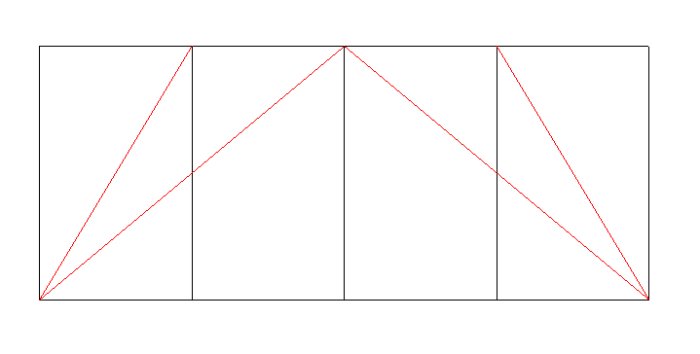
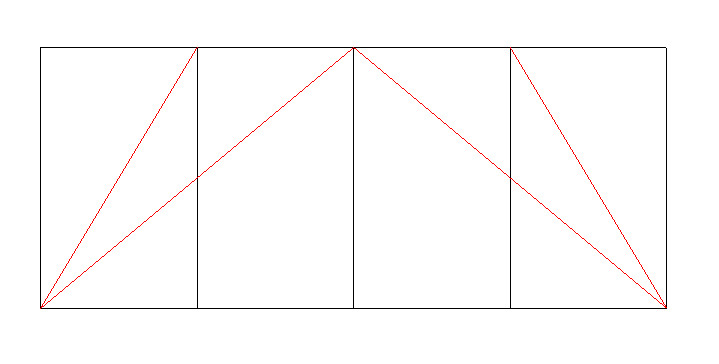
- Tie rods according to Petterovski's suggestion and drawing (I appreciate that you took the time to make a sketch!)
Currently, I'm leaning towards Petterovski's suggestion, although I would like to do it with wood and probably on the underside of the joist. It might be tricky since it would require such long lengths?
Large post constructions are always problematic, even though the basic principles for bracing are simple. Diagonal braces in each outer wall and in the roof planes. The problems are mainly due to the building's size relative to the normal lengths of timber. Therefore, a construction technique that provides moment-resistant joints must be used. Glulam is ideal, partly because it is extra stiff and partly because it can be obtained in large lengths. The fact that the load-bearing beams are joined at the posts is not optimal. In extreme wind loads, 45x95 with a 3-meter span is not sufficient, even if they are mounted lying down, if the c/c distance is too large.
Yes, long lengths do create joints which result in a loss of rigidity. It's probably better if you cross-brace each section if you're going to use lumber, that way the lengths will also be a bit shorter.
Click here to reply
Vi vill skicka notiser för ämnen du bevakar och händelser som berör dig.