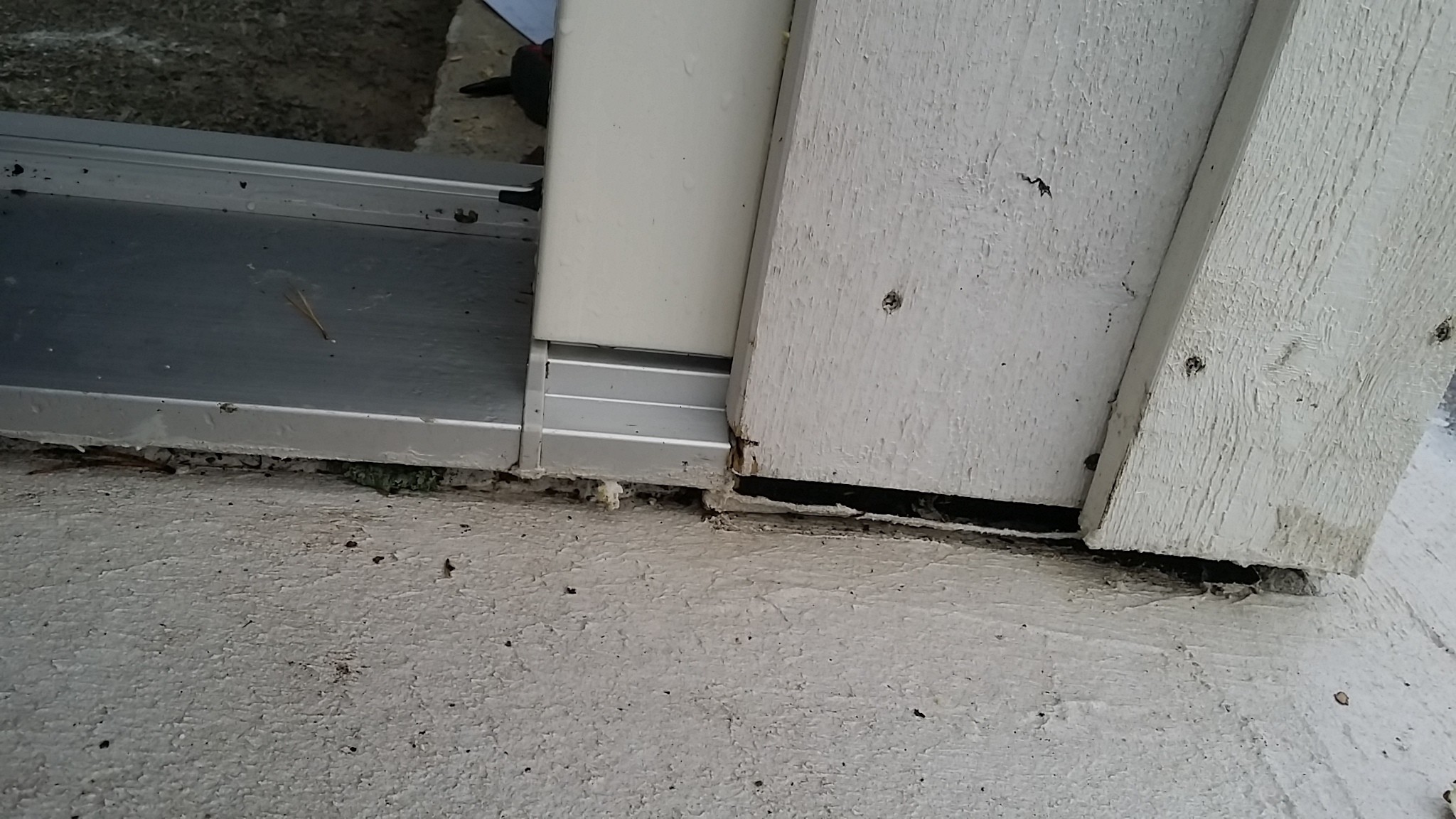
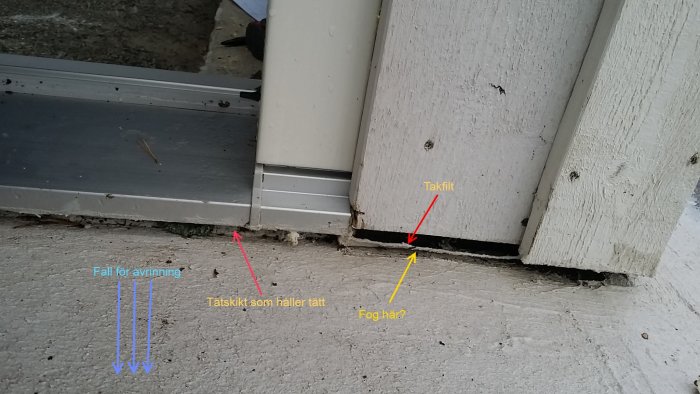
There are two sliding doors that meet in the corner and there are two studs 45x170 and 45x120 against each other standing on a piece of roofing felt (that's what's visible folded in the picture). The light gray is a waterproof layer for outdoor use.
The problem is that water seems to be seeping in between the waterproofing and the piece with roofing felt that the studs stand on, resulting in this:
The studs look dry (what I can see of them) and the insulation lying in the corner against the studs is dry so water only seems to seep under the roofing felt.
Is there any reasonable sealant that can be applied under the trim board?
There is about 16 mm between the board and the concrete in the gap visible in the picture.
No, the cut surface is probably not painted. The company that did it completed everything in half a day so I can't imagine they had time to apply any paint there...
No, the cut surface is probably not painted. The company that did everything finished in half a day, so I can't imagine they had time to apply any paint...
then you should definitely not seal it. better it's open so it dries when it stops raining.
better to do something about all the raw concrete on the outside instead
then you should absolutely not seal. It's better if it's open so it dries when it stops raining.
Better to do something about all the exposed concrete on the outside
So you really think it's better for the water to have free access to run into the house?
No, sand off all the waterproofing/paint and prime, then seal it again with a sealant intended for sealing concrete elements. Sika has it in their range. It must be clean concrete otherwise the sealant doesn't adhere properly.
How is it done under the thresholds?
So you think it's better for the water to flow freely into the house?
No, sand off all waterproofing/paint and prime, then seal it again with a sealant intended for sealing concrete elements. Sika has it in their range. It must be clean concrete, otherwise the sealant will not adhere properly.
How is it done under the thresholds?
If you seal the end grain, it's easier for moisture to get there. Better if it was oiled/painted.
Treat all concrete that is exposed to rain/outdoors.
Hmmm...
It's a heated bedroom underneath so no moisture is coming up from there. Outside the balcony glazing, there is a narrow (outdoor) walkway that is waterproofed (it is the one visible as a light gray slab in the picture).
It's waterproofed under the window/wall sections as well so I can't remove that.
So there's a concrete slab underneath that is waterproofed, and then there's sill insulation under the window sections/sliding doors. In the corner, there's a piece of roofing felt on top of the waterproofing, and the corner is built on top of that felt.
The walkway slopes away from the window sections so the rain running down the glass should drain away (not in), but obviously, water still comes in, and the only place it comes in is under the piece of roofing felt in the corner.
When I lift the roofing felt, I can see that it's completely wet underneath, and there seems to be some capillary effect between the waterproofing and felt drawing in water. On top of the roofing felt and wood is dry.
Can I seal as the picture shows, just against the roofing felt and not up against the wood?
Which sealant works against waterproofing and roofing felt?
Yes, the problem is that the felt is a bit curled up. I'm considering whether to try to remove as much of the felt as possible and then apply some sealant so any water that runs/rains against it can't seep inward...
That will never really be watertight, what idiots built it like that. Should have cast a concrete edge at least 5 cm high to stop the water. But even if you fill it in with sealant, sooner or later the water will find its way in.
That will never be completely sealed, what idiots built it that way. Should have poured a concrete edge of at least 5 cm to stop the water. But clamp it in joint, but sooner or later the water will find its way in.
Well, that's how it is (although a bit of latex can work wonders on unevenly cut drywall)...
Now it's about "saving the situation"... The problem isn't really the window company but the firm that poured the balcony section/walkway and laid it too high because they thought it would be better with a smaller threshold...
Click here to reply
Vi vill skicka notiser för ämnen du bevakar och händelser som berör dig.