I have built a bench and plan to make a shelf underneath. It won't be a straight, nice square, as there's a stud in the middle and in other places it "bulges" out as well. I'm not too concerned about exactly how to do it, but I'm more wondering about the technique for cutting a wooden board to fit in an uneven area. Imagine a stud sticking out (vertically) and you want a wooden board that lies against the wall and the board must be cut out exactly where the stud is... How do you do that? Are there smart tips to make it look nice?
1) If aesthetics don't matter, e.g., it won't be visible. Then I measure with a folding rule or tape measure to see where the stud is from the wall, etc., and transfer it onto the board.
- Since I'm bad at both measuring and cutting straight, it won't be pretty, but it doesn't matter.
2) If it's visible or for any other reason I want a tight fit, I would either make a test cut with a small scrap piece or cut from a cardboard piece and then use it as a template on the board to be cut.
1) If aesthetics don't matter, e.g., it will not be visible, I measure with a folding rule or measuring tape where the stud is from the wall, etc., and transfer that to the board.
- Since I'm terrible at both measuring and cutting straight, it won't be pretty, but it doesn't matter.
2) If it is visible or for some other reason I want a tight fit, I would either test cut a small scrap piece or cut from a cardboard piece and then use that as a template on the board to be cut.
That's how I work too. 🙂
Throwing in a little midway solution which is to deliberately cut so that there is a gap and then bevel the edge. The visual difference if something goes from a 0 mm gap to 2 mm alternately is much greater than if it swings between 2-4 mm. The bevel also creates a shadowing that further conceals imperfections.
Template is safe and good.
One way, step by step...
Place any template material against the uneven edge.
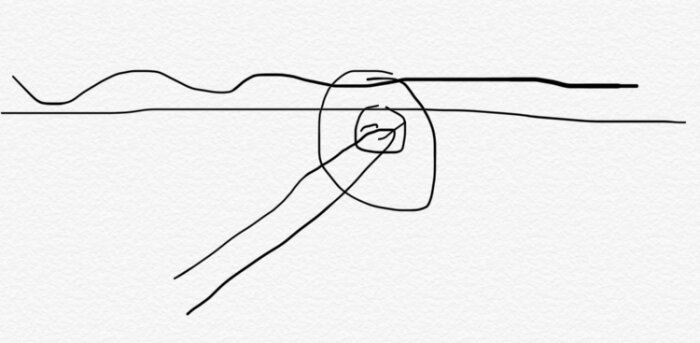
Place a washer on it. Draw a line by letting the washer roll against the uneven edge with a pencil in the hole.
Saw along the line and check the template before the line is traced onto the final piece.
An addition.
If it’s about precision and exact fit, I always cut a little less.
That is, draw on the board using a template you made, then saw a few millimeters inside the lines. Put the piece in place and see if it seems to fit, and adjust.
If it's a thick board, in my experience, a good jigsaw is required if you want a good result, if you plan to use one.
One tip might also be to make the first rough cut with a 10-20 degree angle; the fine-tuning becomes easier when there's less material to cut afterward.
You can also use a contour gauge (a bit unnecessary if it's a completely straight rule) but if there are several irregularities, it works well.
I can tip that Lidl is selling a decent contour gauge for 79kr this week.
I've already cut out for 10 element pipes without it (in wood) but realized that for the last 4 cutouts in tiles it was a sensible investment, would have saved a lot of time if I'd bought it earlier 😩
Click here to reply
Vi vill skicka notiser för ämnen du bevakar och händelser som berör dig.






samovar said: