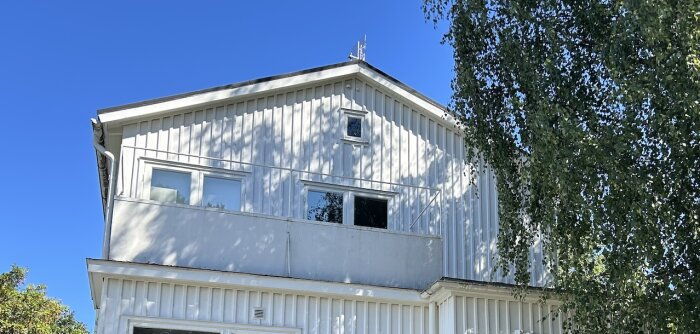
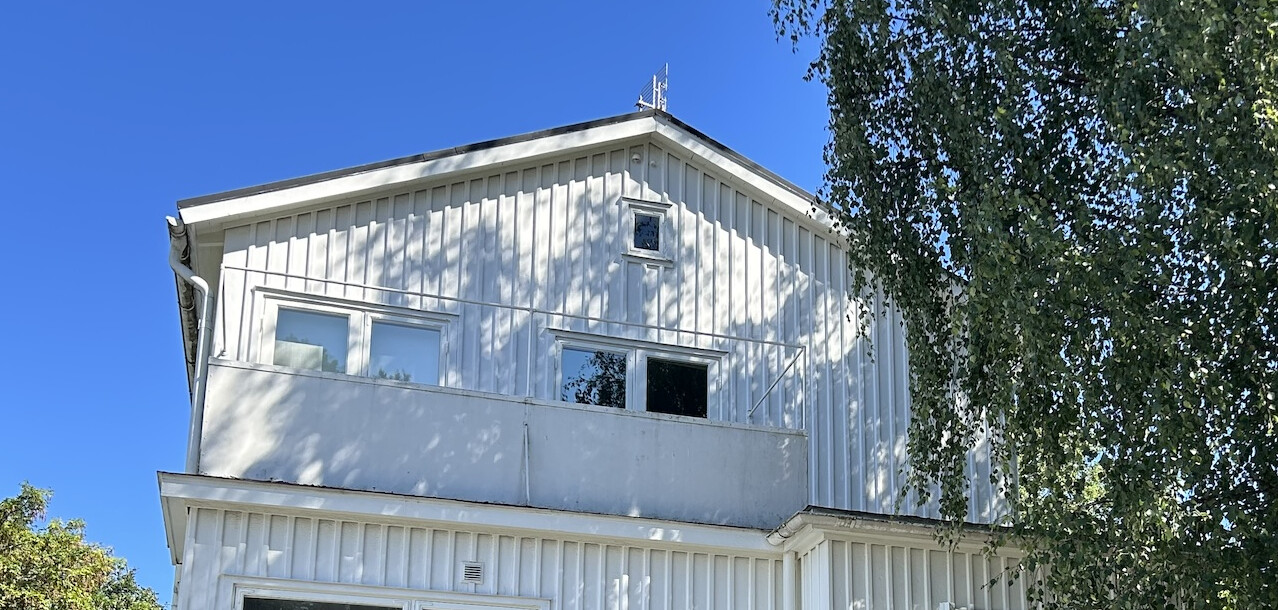
We had water damage through our rooftop terrace in a house from the 1930s. We have now fixed the damage and replaced the old sheet metal with roofing felt, which is supposed to be better for low-slope rooftop terraces. Unfortunately, this meant we had to tear down the old smooth sheet metal railing that likely came with the house from the 1930s – so we need a new railing.
The old sheet metal railing was constructed in a functionalist style, riveted onto T- and L-profiles that stood on the roof and were screwed into the wall. Taking a walk in Södra Ängby in Stockholm, you can see similar railings on many houses. It would be cool if we could maintain this style, but perhaps with modern safety features (so 1100 mm high with a handrail, instead of 800).
I am trying to get wise to do the right thing if we are to maintain the old appearance. Therefore, I welcome knowledge about the following, so I can order correctly when I talk to craftsmen:
- How should the posts for the railing be mounted? The old ones simply stood on the sheet metal roof, with loose decking in sections. I prefer not to drill holes in my new waterproof layer. Should one build a ledger (that is fixed) to attach the posts to?
- Aluminum vs. steel: Is there any reason not to choose aluminum if the railing is going to be white anyway? I don't know exactly what material the original railing was made of, but hardly aluminum. However, it's lighter and cheaper...
- Sheet metal thickness: How thick does it really need to be to prevent the sheet from breaking or buckling from a slight kick?
In this context, it might be worth mentioning that I only have about 60 mm between the roofing felt and the bottom of the doors leading to the terrace, so any potential built fixed deck would have to be on very low joists if I don't want to have to raise (or cut) the doors.
I have tried both searching by myself and talking to balcony companies and sheet metal workers, but unfortunately, smooth sheet metal railings are not very popular.
- Aluminum vs. steel: Is there any reason not to choose aluminum, if the railing is going to be white anyway?
I think you should choose iron, adapt the measurements and height to today's requirements. Aluminum becomes unnecessarily expensive and the old iron/metal railing seems to have worked well for a long time?
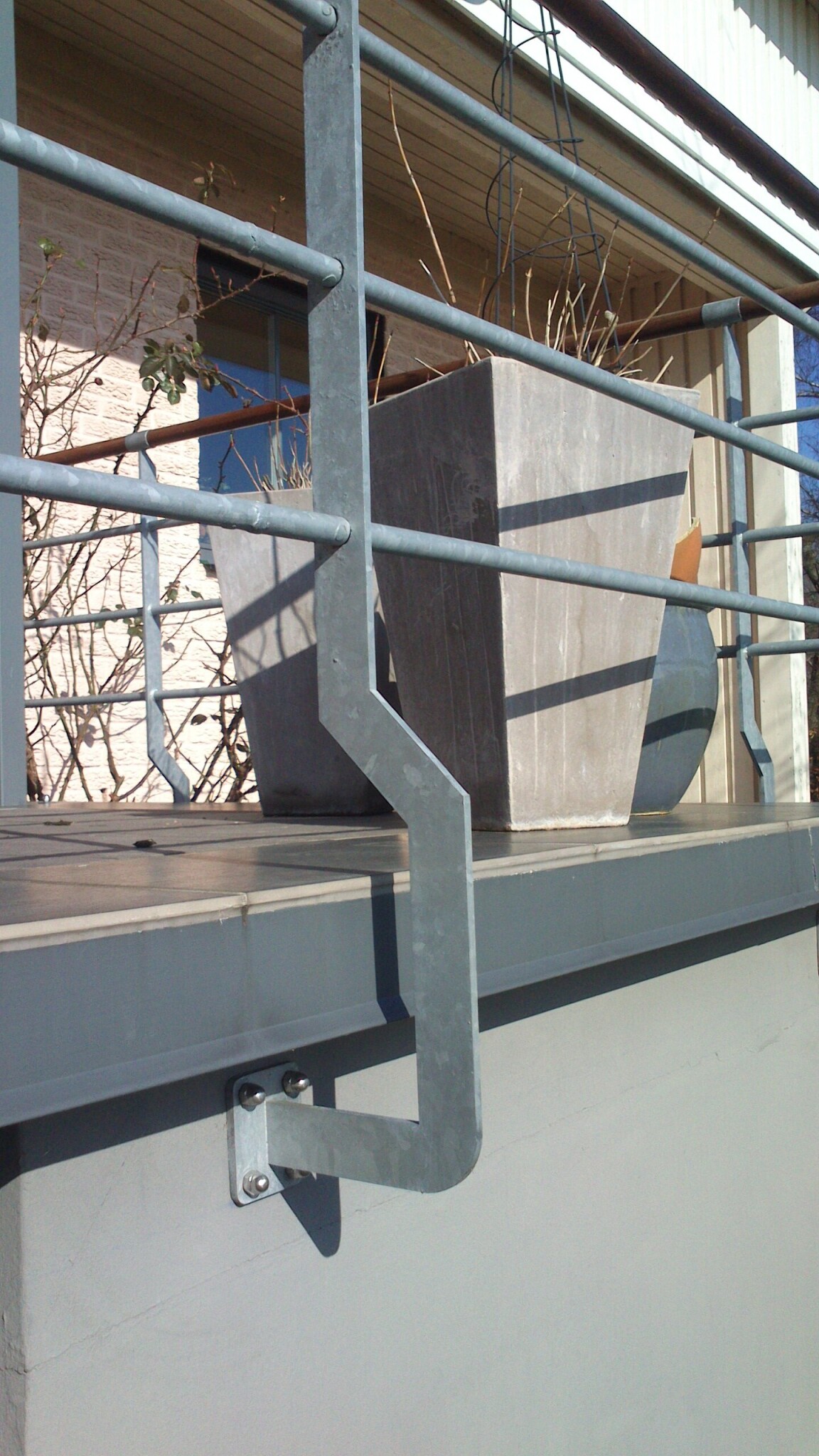
This railing is not approved as a balcony railing. The railing must not be climbable. If one wants a railing with horizontal bars of some kind, it must be supplemented with, for example, glass/plexiglass on the inside.
It also looks like the distance between the bars is way too large. But I assume the purpose of the picture was just to show how you can attach the railing without making holes in the solid roof.
Also, it looks like the distance between the bars is way too large. But I assume the purpose of the picture was just to show how you can attach the railing without making holes in the sealed roof.
That's right.
All railings are climbable. You just swing over.
You should be able to do the same as before, with posts standing on feet on the roof and fastening it to the facade. Then attach a couple of brackets that are "hoops" going from the post around the roof edge and screwed into a rafter.
You seem to have a support in the middle for stability and that might be needed, but we have a 3x4 m balcony that doesn’t have any middle support and it works fine.
The top rail is 8x40 mm flat steel that goes all the way, posts of 20x20 mm every meter, and between the posts there are slats of 10x10 mm mounted in 6x30 mm flat steel at the top and bottom. Each post stands on a plate of flat steel and then it is screwed into the facade.
You can budge the fence a little if you "put some effort," but it doesn’t move.
@fribygg You are probably right. When I've checked, I've found aluminum to be popular among balcony manufacturers, but it's likely unfamiliar in this environment. After looking around a bit more, galvanized steel seems cheaper and easier to deal with.
Thanks @Testarn for your description, and the picture from @Thomas_Blekinge showing side mounting I would preferably avoid side mounting in this case, as well as the "bracket" we had previously. The terrace has a cornice gutter that we've now filled and placed a gutter around it instead. This means that if the railing is to stand on top of or inside the lower wall, it would need to extend nearly half a meter around... I think it would look strange.
I am doubtful that galvanized sheet metal is necessary, probably painted black plate was used originally and the lifespan/durability of the original railing was probably good enough?
I'm doubtful that galvanized sheet metal is needed; probably painted blackplate was original, and the lifespan/durability of the original railing was quite sufficient?
Hm, you might be right. The railing was actually, at least aesthetically, in quite poor condition, which was one reason we didn't try to keep it – but then again, it had been there for almost 90 years and painted over several times, so it might be a passing grade...
At the risk of sounding dumb, since you mention both "iron" and "blackplate" in your answers, we are probably talking about cold-rolled steel sheet in the modern inventory, and that painting provides adequate protection against rust?
Ccpalm said:
Stylish, sure, but do you have a building permit to install something else, then?
Heh, no, there's that detail as well.
Having said that, I've looked into what my neighbors with the same type of house have applied for, or rather not applied for, in terms of building permits, and there are probably quite a few replacements around us that could be remarked upon.
That said, I've checked what my neighbors with the same type of house have applied, or rather not applied for building permits for, and there are probably quite a few changes that could be remarked upon around us.
Hm, yes if they are unauthorized constructions, it's not much of a guide, unfortunately. The big question is whether there could be any cultural historical objections from the municipality? In the "worst" case, the only option is to restore it exactly as it was before. If nothing else, it's the simplest option = permit-free.
Hm, you're probably right. The railing was actually, at least aesthetically, in quite bad shape, which was a reason why we didn't try to keep it – but then it had been there for almost 90 years and painted over several times, so that might be a passing grade...
At the risk of sounding dumb, but since you mention both "iron" and "black plate" in your answers, we're talking in modern terms about cold-rolled steel sheet, and that the painting provides the right protection against rust?
Well, you can probably use any sheet metal, it's more about how expensive the project can become. You can hardly get hold of lead paint like when the railing was new and will have to settle for iron primer.
90 years is a well-accepted lifespan for a painted iron detail on a private house in my eyes, so you or your children aren't likely to need to replace the sheet metal (if the quality of the new sheet is as good as the old one), and you will hopefully get away with one or at most two repaintings during your time as the owner.
If you have it hot-dip galvanized, you probably won’t have to paint either.
You can hardly get hold of red lead like when the railing was new and will have to settle for iron oxide red.
Red lead can be purchased but cannot be sold to private individuals. And for professional use, there are a lot of occupational safety restrictions. So if you find someone who "buys" the paint and then paints it yourself, you've solved both problems 🙂
Click here to reply
Vi vill skicka notiser för ämnen du bevakar och händelser som berör dig.